
NVIDIA's GeForce 7800 GTX Hits The Ground Running
- Posted in
- GPUs
Doom 3 1.3 Performance
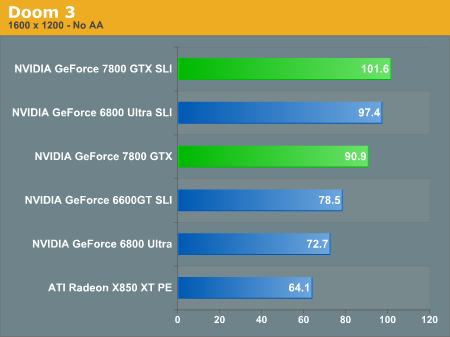
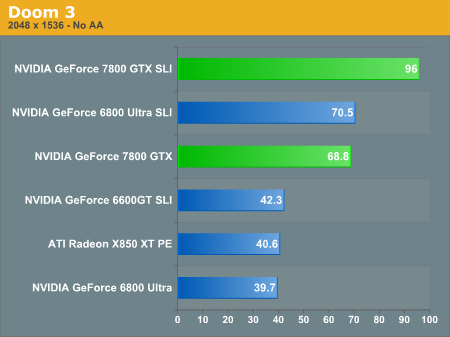
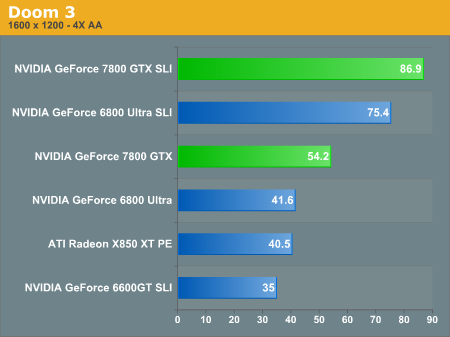
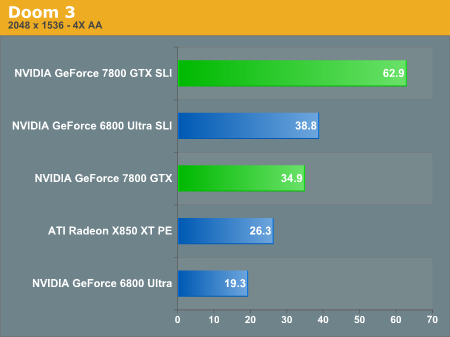
Unlike most of the other games we're looking at, Doom 3 actually places quite a strain on the memory bandwidth of the graphics card. This seems to be the a common occurrence with many of the OpenGL games, though Doom 3 more so than others. The reason for this is the large number of stencil calculations that are required for the real time shadows. This allows the 6800U SLI setup to actually outperform a single 7800GTX by a sizeable margin - remember that the difference in memory bandwidth between a 6800U and a 7800GTX is only 9%. We also see that antialiasing has a major impact on the single 7800GTX, though it still maintains a commanding lead (25 to 81% depending on resolution and settings) over the 6800U. In the SLI configurations, the 7800GTX only leads by 15% at 1600x1200 4xAA, but that grows to 61% when we move to 2048x1536.
Switching to the ATI card, we can see that ATI has done a lot to close the performance gap in Doom 3. While the 6800U still wins in 1600x1200, the ATI card actually comes out ahead at 2048x1536. Like we've seen in a few other games, though, the NVIDIA drivers don't seem to handle 2048x1536 very well. With AA/AF enabled, the 6800U once again takes a 50% performance hit when increasing the resolution. Due to the dark atmosphere and lighting flashes, Doom 3 is a game that definitely needs to run at a high refresh rate or with VSYNC enabled, so again the lack of performance at 2048x1536 isn't the end of the world. What we're mostly concerned with is taxing the hardware to show future potential, and it's safe to say that the 7800GTX - particularly with SLI - will be able to handle all games for many years.
Originally published at https://www.anandtech.com/show/1717 (Wayback Machine).