
No more mysteries: Apple's G5 versus x86, Mac OS X versus Linux
- Posted in
- Mac
The G5 as Server CPU
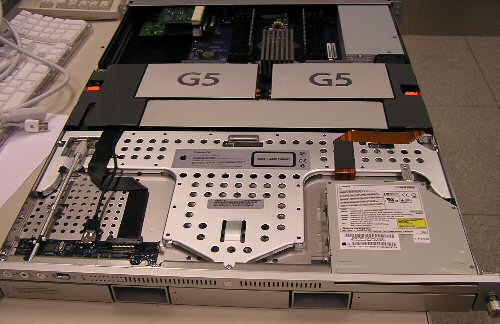
While it is the Xserve and not the PowerMac that is Apple's server platform, we could not resist the temptation to test the G5 based machine as a server too. Installed on the machine was the server version of Mac OS X Tiger. So in fact, we are giving the Apple platform a small advantage: the 2.5 GHz CPUs are a bit faster than the 2.3 GHz of the Xserve, and the RAM doesn't use ECC as in the Xserve.
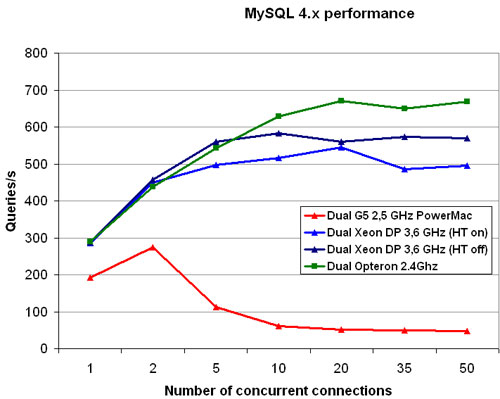
| Dual G5 2,5 GHz PowerMac | Dual Xeon DP 3,6 GHz (HT on) | Dual Xeon DP 3,6 GHz (HT out) | Dual Opteron 2.4Ghz | |
| 1 | 192 | 286 | 287 | 290 |
| 2 | 274 | 450 | 457 | 438 |
| 5 | 113 | 497 | 559 | 543 |
| 10 | 62 | 517 | 583 | 629 |
| 20 | 50 | 545 | 561 | 670 |
| 35 | 50 | 486 | 573 | 650 |
| 50 | 47 | 495 | 570 | 669 |
Performance is at that point only 1/10th of the Opteron and Xeon. We have tested this on Panther (10.3) and on Tiger (10.4.1), triple-checked every possible error and the result remains the same: something is terribly wrong with the MySQL server performance.
SPEC CPU 2000 Int numbers compiled with GCC show that the G5 reaches about 75% of the integer performance of an equally clocked Opteron. So, the purely integer performance is not the issue. The Opteron should be quite faster, but not 10 times faster.
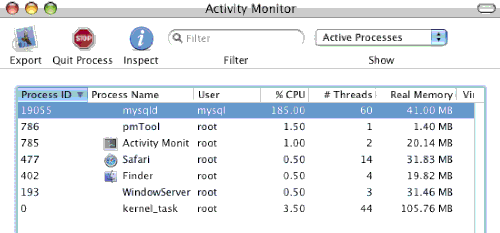
We checked with the activity monitor, and the CPUs were indeed working hard: up to 185% CPU load on the MySQL process. Notice that the MySQL process consists of no less than 60 threads.
| Concurrency | Dual Powermac G5 2.5 GHz (Panther) | Dual Powermac G5 2.7 GHz (Tiger) | Dual Xeon 3.6 GHz |
| 5 | 216.34 | 217.6 | 3776.44 |
| 20 | 216.24 | 217.68 | 3711.4 |
| 50 | 269.38 | 218.32 | 3624.63 |
| 100 | 249.51 | 217.69 | 3768.89 |
| 150 | 268.59 | 256.89 | 3600.1 |
The new OS, Tiger doesn't help: the 2.7 GHz (10.4.1) is as fast as the 2.5 GHz on Panther (10.3). More importantly, Apache shows exactly the same picture as MySQL: performance is 10 times more worse than on the Xeon (and Opteron) on Linux. Apple is very proud about the Mac OS X Unix roots, but it seems that the typical Unix/Linux software isn't too fond of Apple. Let us find out what happened!
Originally published at https://www.anandtech.com/show/1702 (Wayback Machine).