
ATI's Multi-GPU Solution: CrossFire
- Posted in
- GPUs
Pricing and Availability
What ATI has here at Computex is a very early sample of what CrossFire can do. Much like NVIDIA has had, ATI will encounter growing pains of their own with CrossFire. Most motherboard manufacturers are telling us to expect CrossFire motherboards by the end of July at the earliest, but more realistically, we can expect retail availability sometime in August.The price point will be competitive with nForce4 Ultra (not SLI) motherboards, thanks to more aggressive chipset pricing on behalf of ATI. Also note that not all manufacturers will be producing both AMD and Intel CrossFire solutions. For example, MSI is producing an AMD CrossFire motherboard, while ASUS is currently only producing an Intel CrossFire solution. The problem is that most CrossFire manufacturers are also nForce4 SLI manufacturers and they have to be careful not to confuse their customers by offering two products that compete with one another. Choice is a good thing, but from a sales standpoint, it can sometimes be a difficult pill to swallow.
Despite the strong showing at Computex, most motherboard manufacturers have stated that they don't expect ATI's CrossFire chipsets to really make a dent in this year's shipments. ATI's high-end chipset market share will still remain very low in comparison to NVIDIA, but the long term outlooks are definitely positive. Much like they have done in the graphics industry, ATI will provide good balance to NVIDIA in the chipset business now that NVIDIA is king of the high-end AMD market.
The pricing of CrossFire X800 and X850 cards is listed in the following chart along with the existing products that each CrossFire part supports.
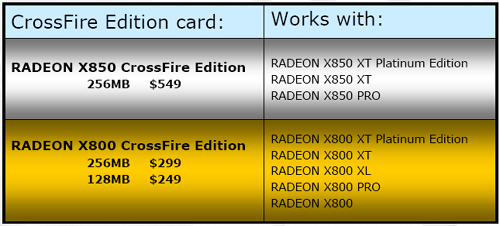
On the high end, we are definitely looking at an expensive upgrade. Those who want the ultimate in performance can be expected to shell out the cash. The X800 versions CrossFire are a little more compelling in terms of affordability.
It will be interesting to see how these CrossFire parts move in price as they are very targeted in application as opposed to NVIDIA's parts, which are marketed as standalone graphics cards that could be used in SLI.
Originally published at https://www.anandtech.com/show/1698 (Wayback Machine).