
The EVGA Z590 Dark Motherboard Review: For Extreme Enthusiasts
- Posted in
- Motherboards
- Intel
- EVGA
- Overclocking
- PCIe 4.0
- LGA1200
- Rocket Lake
- i9-11900K
- EVGA Z590 Dark
- Z590 Dark
Conclusion
We recently reviewed EVGA's first AMD Ryzen motherboard, the X570 Dark, and we were highly impressed with the performance levels on offer. Now it's our time to see how EVGA does in more familiar territory – Intel motherboards – and give our thoughts on the Z590 Dark. Ultiamtely we're looking at an enthusiast-grade motherboard designed for pushing CPUs beyond their limits on extreme cooling methods, and not many motherboards are capable of that.

Many of the EVGA Z590 Dark's features are aimed at overclocking, including an overclocker's toolkit with plenty of features to talk about. Particular highlights include a three-way BIOS selector switch – yes, this board has three BIOS ROM chips if a user manages to corrupt two of them. As well, it offers a slow mode dip switch, PCIe on or off dip switches, and a pair of EVGA Probelt voltage monitoring headers. Even the transposed LGA1200 CPU socket is mounted this way to aid overclocking, as this allows extreme overclocks better access to mount CPU pots.
Above the socket is a pair of horizontally mounted memory slots supporting DDR4-5333, with a maximum combined capacity of 64 GB. EVGA also includes an LN2 mode within the firmware that helps alleviate cold boot bugs when using sub-ambient cooling methods. This also allows for more CPU VCore to be put through; this isn't meant for everyday users, and only experienced users should play about with these settings.
Despite being an overclocking-focused motherboard, the Z590 Dark has plenty for regular users, as well. This includes three M.2 slots, a PCIe 4.0 x16 slot, one PCIe 3.0 x4, and one PCIe 3.0 x4 with support for SATA drives. Unfortunately, the third M.2 slot does share bandwidth with the half-length PCIe 3.0 x4 slot, but EVGA includes two full-length PCIe 4.0 slots operating at x16 and x8/x8 to satisfy users. Other storage options include a PCIe 3.0 x4 U.2 slot, which is rare in and of itself, and a total of eight SATA ports, six of which support RAID 0, 1, 5, and 10 arrays.

For connectivity, EVGA uses dual Intel I225-V 2.5 GbE controllers and an Intel AX201 Wi-Fi 6 CNVi, which provides plenty of options. We're a tad disappointed EVGA didn't include Wi-Fi 6E for the price, and we're not sure why it didn't. However, it does have one of Z590's natively supported USB 3.2 G2x2 Type-C ports, along with four USB 3.2 G2 Type-A and two USB 3.2 G1 Type-A ports on the rear panel. Audio is also decent, with a Realtek ALC1220 HD spearheading things and EVGA's NU Audio SV3H615 amplifiers help bolster things.
Focusing on performance, and the EVGA Z590 Dark did very well in our system tests, with a spectacular showing in our DPC latency and non-UEFI POST time testing. In our computational and game tests, the EVGA performed competitively with other Z590 models we've tested.
With overclocking being one of the touted strong points of the EVGA Z590 Dark, we did manage to achieve 5.4 GHz all-core at 1.541 V on the CPU VCore with the help of the EVGA OC Robot. As expected, due to the enormous amount of CPU Vcore voltage applied, we instantly encountered thermal throttling, even with a minus-three offset set for AVX workloads. In our manual testing from 4.7 GHz to 5.0 GHz, VDroop control was tight, but beyond this, that's when things got a little awry, with much more CPU Vcore applied at full-load than we set within the firmware. Performance in our VRM thermal testing was also respectable, but we would have liked to see better performance given the board's actively cooled power delivery.
Final Thoughts: Dark By Design
We've now reviewed three of the big four overclocking motherboards designed for Rocket Lake, including the GIGABYTE Z590 Aorus Tachyon, the ASRock Z590 OC Formula, and now the EVGA Z590 Dark. And so far, the consensus is this: all of them will give solid performance when paired with an Intel Core i9-11900K.
Meanwhile, as this is our last Z590 motherboard review, it's nice to end things with one of the more interesting ones. It's no secret that EVGA and Vince 'KINGPIN' Lucido are stalwarts within the industry, and they certainly know how to deliver an overclocking motherboard with lots of functionality. The EVGA Z590 Dark is no exception to this. It uses its large 21-phase power delivery to good effect, but in reality, it's it's a 17 to an 18-phase design by most standards; EVGA has added all of its elements, including VCSSA, VCCIO, VCCIO2, and VDDR phases, to provide a bigger number for marketing purposes. There's of course nothing wrong with this in practice, but it is operating at 8+1+1 with doublers, and it has to be stated constructively.
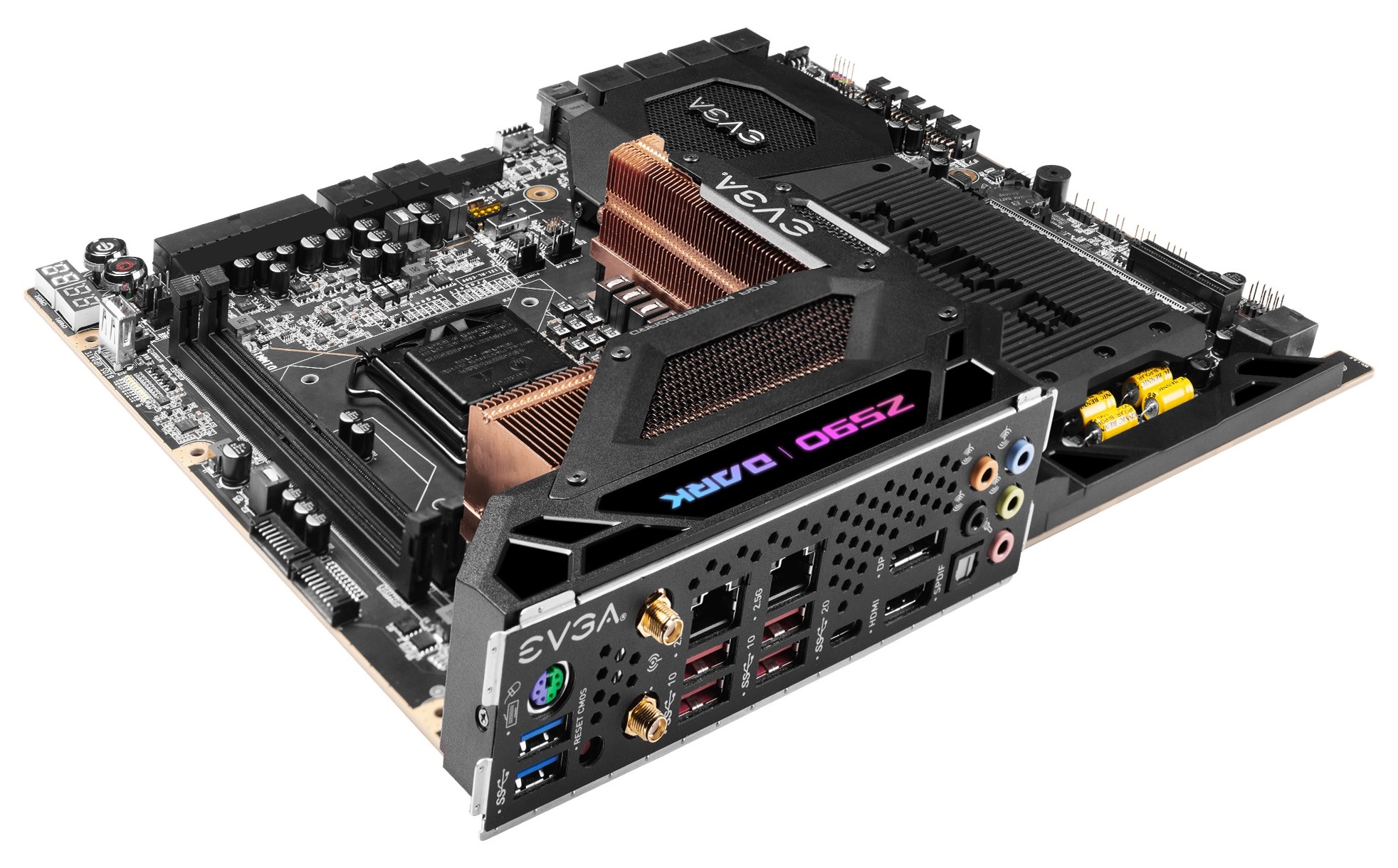
The EVGA Z590 Dark has an MSRP of $600, and EVGA is currently selling it at just that price on their website. For perspective, the GIGABYTE Z590 Aorus Tachyon runs for $530, and the ASRock Z590 OC Formula is $550; so the Dark ends up being the most expensive of the trio.
Ultimately, for users looking for a solid motherboard for a simple system, a cheaper high-end Z590 motherboard will offer much more in terms of both features and controller sets for the price. Still, when it comes to extreme overclocking, a regular board won't be anywhere near as good as the EVGA Z590 Dark, and that's a role that EVGA's board is serving well.
Originally published at https://www.anandtech.com/show/16972/the-evga-z590-dark-motherboard-review (Wayback Machine).