
USB 3.2 Gen 2x2 Portable SSDs Go Native: The Silicon Motion SM2320 UFD Controller Preview
Synthetic Benchmarks - ATTO and CrystalDiskMark
Benchmarks such as ATTO and CrystalDiskMark help provide a quick look at the performance of the direct-attached storage device. The results translate to the instantaneous performance numbers that consumers can expect for specific workloads, but do not account for changes in behavior when the unit is subject to long-term conditioning and/or thermal throttling. Yet another use of these synthetic benchmarks is the ability to gather information regarding support for specific storage device features that affect performance.
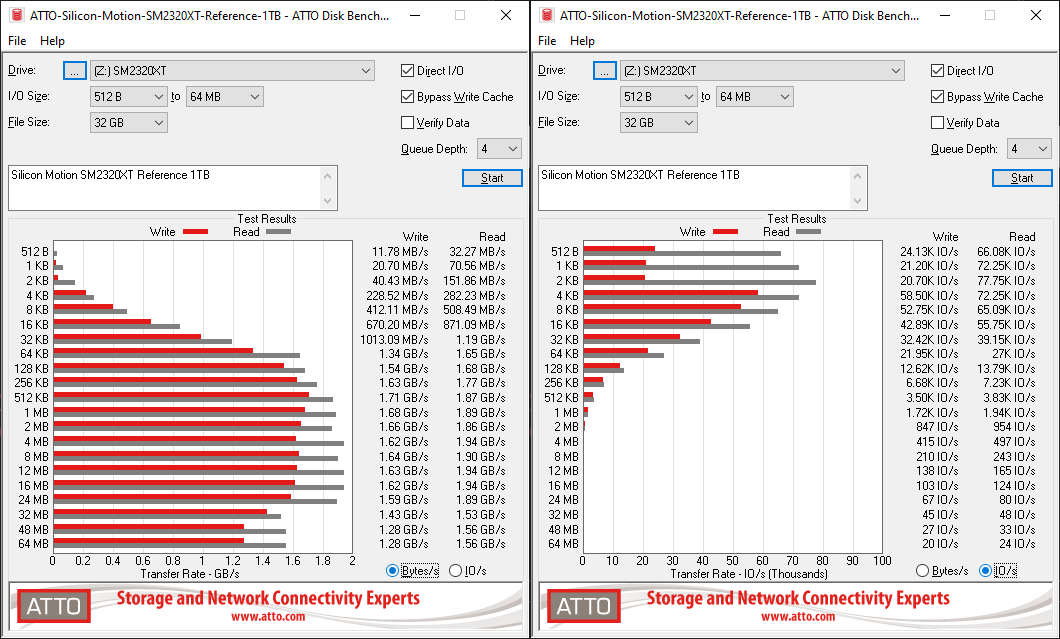
Silicon Motion claims read and write speeds of 2100 and 2000 MBps respectively for specific access traces. The ATTO benchmarks provided below deliver close results. ATTO benchmarking is restricted to a single configuration in terms of queue depth, and is only representative of a small sub-set of real-world workloads. It does allow the visualization of change in transfer rates as the I/O size changes, with optimal performance being reached around 512 KB for writes and 4MB for reads with a queue depth of 4.
| ATTO Benchmarks | |
| TOP: | BOTTOM: |
 |
|
 |
|
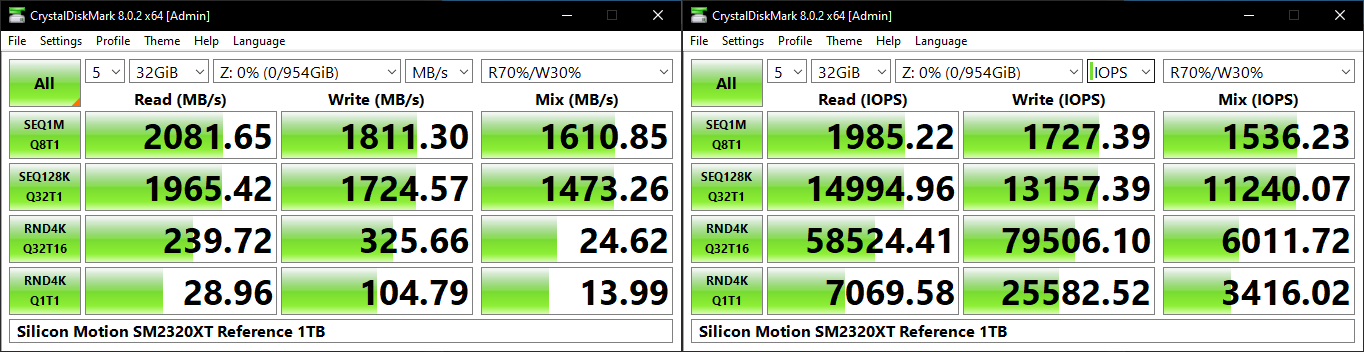
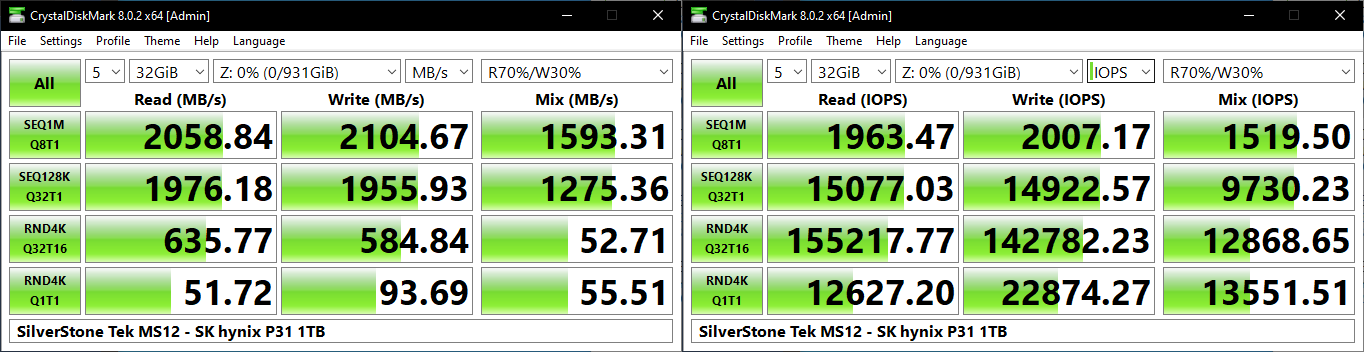
CrystalDiskMark. for example, uses four different access traces for reads and writes over a configurable region size. Two of the traces are sequential accesses, while two are 4K random accesses. Internally, CrystalDiskMark uses the Microsoft DiskSpd storage testing tool. The 'Seq128K Q32T1' sequential traces use 128K block size with a queue depth of 32 from a single thread, while the '4K Q32T16' one does random 4K accesses with the same queue configuration, but from multiple threads. The 'Seq1M' traces use a 1MiB block size. The plain 'Rnd4K' one uses only a single queue and single thread . Comparing the '4K Q32T16' and '4K Q1T1' numbers can quickly tell us whether the storage device supports NCQ (native command queuing) / UASP (USB-attached SCSI protocol). If the numbers for the two access traces are in the same ballpark, NCQ / UASP is not supported. This assumes that the host port / drivers on the PC support UASP.
| CrystalDiskMark Benchmarks | |
| TOP: | BOTTOM: |
 |
|
 |
|
For sequential accesses, the read speeds of the SM2320 reference design match / surpass the bridge-based solutions, while the write speeds are slightly behind (around 1800 MBps against 2100 MBps). In the random access workloads, the DRAM-less nature of the UFD controller result in performance loss for high-queue depth operations. At low queue depths, the write performance of the UFD controller matches the bridge-based solutions with high-end NVMe SSDs.
Originally published at https://www.anandtech.com/show/16942/usb-32-gen-2x2-portable-ssds-go-native-the-silicon-motion-sm2320-ufd-controller-preview (Wayback Machine).