
Asus P5WD2 Premium: DDR2-1066 and the Promise of 955x SLI
- Posted in
- Motherboards
Basic Features: Asus P5WD2 Premium
As discussed in the Dual Core Platform Shootout, NVIDIA does not plan, at this time, to produce a non-SLI version of the nForce4 chipset for Intel. This makes the nF4 Intel boards expensive and specialized in providing support for two video cards working together. The 955X is similarly the enthusiast or high-end version of Intel's new chipset line, with the 945 being the lower cost version of the new Intel chipsets that will be aimed at the computer mainstream. In the chipset hierarchy, you would expect the nF4-SLI based boards to be the most expensive, followed by 955X, and finally the 945. You will also likely see chipsets from SIS, VIA, and ATI that will generally compete with the Intel 945. ATI and SIS in particular are targeted at the integrated video or "G" versions of the 945. Depending on final decisions, you may also see either ATI or VIA (or both) decide to take NVIDIA's approach with an "SLI-like" dual video card setup on the Intel high-end.This puts in perspective the target market of both these motherboards, which is the computer enthusiast. Asus will likely have other 955x boards with some reduction in features, but their top-of-the-line are the P5WD2 Premium with the Intel 955x and the P5ND2-SLI Deluxe with nForce4-SLI Intel. In the past, Asus has had several models of their top boards with essentially the same performance - the less expensive boards just have fewer features.
The point is that other Asus 955x boards may have fewer features and a lower price, but you can expect performance to be very similar to what we have measured with the P5WD2 Premium.
| Specification | Asus P5WD2 Premium | Asus P5ND2-SLI Deluxe |
| CPU Interface | Socket T (Socket 775) for Intel Pentium D & Prescott |
Socket T (Socket 775) for Intel Pentium D & Prescott |
| Chipset | Intel 955x/ICH7R | NVIDIA nForce4-SLI Intel Edition/NVIDIA MCP-04 |
| Pentium D Support (Dual-Core) |
Full Support | Full Support |
| TM2 (Thermal Monitor 2) Support | Full Support | Not Currently Supported (but may be in future) |
| BUS Speeds | 100-450MHz (in 1MHz increments) | 790-1600 MHz (in 1MHz increments) |
| CPU Ratios | Unlock Supported, Adjustable down depending on CPU | Unlock Supported, Adjustable down depending on CPU |
| Memory Speeds | At 200(800) - 400,533,600,667,800 221 - 332,442,553,589,663,737,884 266(1066) |
400-1200 (Asynchronous) |
| PCI/AGP Speeds | Asynchronous (Fixed) | Asynchronous (Fixed) |
| PCI Express | 90 MHz to 150 MHz in 1MHz increments | 100 MHz to 150 MHz in 1MHz increments |
| FSB Turbo | Auto, Standard, Turbo PLUS HyperPath 3 On/Off |
On, Off |
| Core Voltage | Auto, 1.2875V-1.70V in 0.0125V increments | Auto, 0.8375V-1.60V in 0.0125V increments PLUS +100mV option |
| DRAM Voltage | Auto, 1.80V to 2.3V in 0.05V increments | Auto, 1.85V to 2.3V in 0.05V increments |
| Chipset Voltage | MCH - Auto, 1.5V, 1.55V, 1.6V, 1.65V ICH - Auto, 1.05V, 1.2V |
Auto, +1.5V |
| Termination Voltage | FSB - Auto, 1.2V, 1.3V, 1.4V, 1.5V | CPU - Auto, 1.30V, 1.35V, 1.40V |
| SB/SATA Voltage | NA | Auto, +1.6V |
| LDT (Hyper Transport) Ratios | NA | 1x, 2x, 3x, 3.5x, 4x, 5x |
| Memory Command Rate | NA | Auto, 1T, 2T |
| Memory Slots | Four 240-pin DDR2 Slots Dual-Channel Unbuffered Memory to 8GB |
Four 184-pin DDR Dual-Channel Slots Unbuffered ECC or non-ECC Memory to 8GB (64-bit OS) or 4GB (32-bit OS) |
| Expansion Slots | 2 x16 PCIe Slots (configured as 1 x16 and 1 2x/4x) 1 x1 PCIe 3 PCI Slots |
2 x16 PCIe Slots (configured as 1 x16 or 2 x8) 2 x1 PCIe 3 PCI Slots |
| SLI | Semi-SLI - x16 video plus x4/x2 video (Function is Driver Limited) |
NVIDIA (x8 + x8) SLI |
| Onboard SATA | 4-Drive SATA 2 RAID by ICH7R PLUS 2-Drive SATA 2 by Sil3132 |
4-Drive SATA 2 RAID by nF4 PLUS 2-Drive SATA 2 RAID by Sil3132R |
| Onboard IDE | One Standard NVIDIA ATA 100/66/33 (2 drives) PLUS 2-Drive 133/100/66 IDE by ITE |
Two Standard NVIDIA ATA133/100/66 (4 drives) |
| SATA/IDE RAID | 4-Drive SATA 2 RAID by ICH7R RAID 0, 1, 5, 10 Intel Matrix |
4-Drive SATA 2 RAID by nF4 PLUS 4-Drive IDE RAID(8 total) Can be combined in RAID 0, 1, 0+1, 5, and JBOD (8 drives total) 2 SATA 2 Drives by Sil3132R as RAID 0, 1 |
| Onboard USB 2.0/IEEE-1394 | 8 USB 2.0 ports supported ICH7R 2 1394A FireWire ports by TI 1394a |
10 USB 2.0 ports supported nF4 2 1394A FireWire ports by VIA VT6307 |
| Onboard LAN | Dual Gigabit Ethernet Intel PCIe Gigabit LAN PCI Gigabit by Marvel 88E8001 |
Dual Gigabit Ethernet NVIDIA PCIe LAN by Marvel PHY Intel PCI Gigabit LAN |
| Onboard Audio | Azalia HD 8-channel audio, Realtek ALC882D featuring Dolby Digital Live!, Coaxial & Optical SPDIF Out ports |
Realtek ALC850 8-Channel codec with 6 UAJ audio jacks, Coaxial & Optical SPDIF Out |
| Power Connectors | ATX 24-pin, 1 or 2 x4-pin 12V | ATX 24-pin, 1 x4-pin 12V |
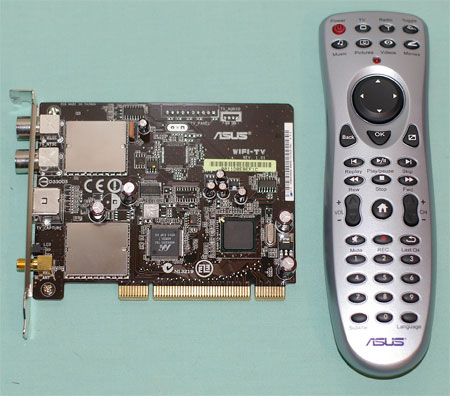
| Other Features | Includes TV Tuner & Remote Control, Asus EZ Plug, Stack Cool 2, AI Overclocking | Asus EZ Plug, Q-Fan2, Stack Cool 2, AI Overclocking |
| BIOS | AMI 0207 (4/30/2005) | Phoenix Award |
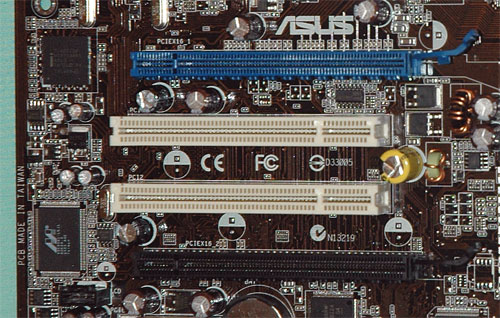
Until we see further developments in dual video-card solutions, the two x16 slots work best in supporting two video cards driving up to four monitors. For those who want to drive a 2nd high-end card, the 2nd x16 slot can be configured in a faster x4 video mode, which will not limit the performance of most current video cards.
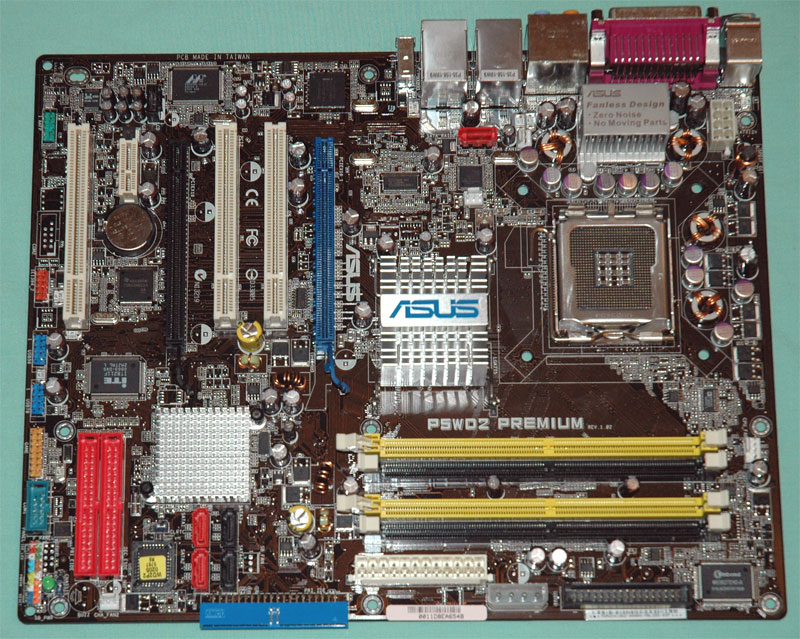
Click to enlarge.
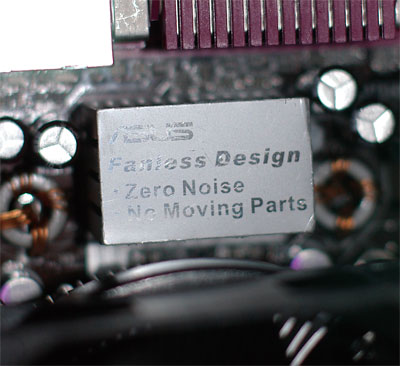
Actual cooling on the board follows the Asus preference for passive "no-fail" cooling, with no active fans on any of the chips. During overclocking, the chipset does create a lot of heat and we would advise that if you plan to seriously overclock the P4, you are going to need to add a fan at least to the Northbridge heatsink.
Voltage options are refreshingly wide on the P5WD2, with memory voltage to 2.3V, a full range of chipset, bus, and termination voltage adjustments, and an exceptionally wide range of vCore voltage adjustments. Memory ratios are also the widest that you will likely see on any 955X board, which allows the option to run the memory much faster than the CPU. The actual memory tweaks, however, are somewhat limited; it would be nice to see some of the tweaks that we have grown to love on the NF4 chipset available on Intel chipsets also.
Asus is still supporting PATA RAID, although it must now have a limited shelf life. Also available is a SATA port positioned for adding a rear-mounted SATA back plate port for those who just like to run an external or portable SATA drive. This feature means that you won't have to open up the case to add a SATA drive.
The only annoying flaw was that the CMOS jumper is poorly positioned. When using 2 video cards, you will need to remove the lower video card to get to the CMOS jumper - or remove the battery to clear CMOS. The layout is otherwise very good, with little to complain about. Some clever manufacturer should consider adding a "CMOS-clear" push button on their motherboard; it would be really handy for enthusiasts who push their boards to the performance limit.
Originally published at https://www.anandtech.com/show/1678 (Wayback Machine).