
AMD EPYC Milan Review Part 2: Testing 8 to 64 Cores in a Production Platform
Compiling Performance / LLVM
As we’re trying to rebuild our server test suite piece by piece – and there’s still a lot of work go ahead to get a good representative “real world” set of workloads, one more highly desired benchmark amongst readers was a more realistic compilation suite. Chrome and LLVM codebases being the most requested, I landed on LLVM as it’s fairly easy to set up and straightforward.
git clone https://github.com/llvm/llvm-project.gitcd llvm-projectgit checkout release/11.xmkdir ./buildcd ..mkdir llvm-project-tmpfssudo mount -t tmpfs -o size=10G,mode=1777 tmpfs ./llvm-project-tmpfscp -r llvm-project/* llvm-project-tmpfscd ./llvm-project-tmpfs/buildcmake -G Ninja \ -DLLVM_ENABLE_PROJECTS="clang;libcxx;libcxxabi;lldb;compiler-rt;lld" \ -DCMAKE_BUILD_TYPE=Release ../llvmtime cmake --build .We’re using the LLVM 11.0.0 release as the build target version, and we’re compiling Clang, libc++abi, LLDB, Compiler-RT and LLD using GCC 10.2 (self-compiled). To avoid any concerns about I/O we’re building things on a ramdisk. We’re measuring the actual build time and don’t include the configuration phase as usually in the real world that doesn’t happen repeatedly.
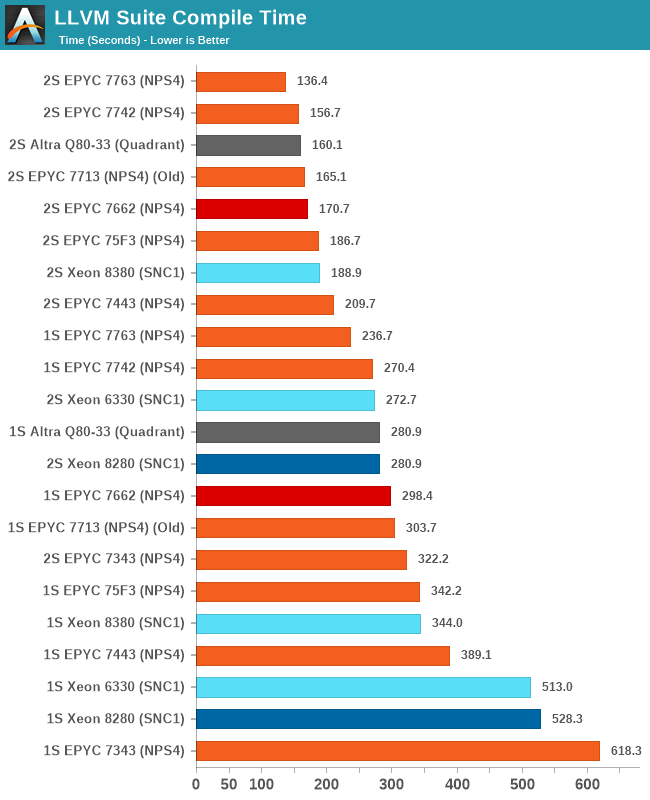
In compiling workloads, the 7763 and 75F3 also saw a 3-4% increase in performance compared to their initial reviews.
The 16-core 7343 ends up as the worst performing chip in this metric, while the 24-core 7443 still managed to put itself well ahead of the 28-core Xeon 6330.
I’ve omitted the 72F3 from the chart due to its bad results of >17 minutes per socket rescaling the chart too much – obviously compiling is not the use-case for that SKU.
Originally published at https://www.anandtech.com/show/16778/amd-epyc-milan-review-part-2 (Wayback Machine).