
WinHEC 2005: Coverage Wrap
- Posted in
- Trade Shows
More from the Expo Floor
While the show floor certainly wasn't as big as what we're accustomed to seeing at E3 or some of the other shows, there were still a few other items that we found interesting. There isn't really a central theme to this, so just pretend you're walking around the exhibition floor with us bouncing from networking to PCI Express to servers, all the while passing LCD displays showing DVD and HD content. And just for the record, CRTs are basically dead. There wasn't a single CRT present at WinHEC, and no one is interested in trying to improve the technology. Even if you love your current 22" CRT, we expect by the time you're ready to upgrade, any CRTs will be at least as old as what you're already using. That tangent aside, here's some of the other exhibits we saw on the floor.Alienware Gaming Zone
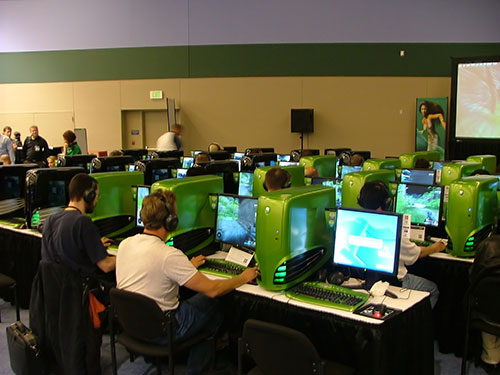
There was a large gaming arena set up in one corner with 30+ Alienware systems. All of the systems were running XP-64 with a 64-bit build of Far Cry. System hardware consisted of Athlon 64 4000+ CPUs with 1GB of RAM and GeForce 6800 Ultra graphics cards. The two game servers were running SLI with (we think) 2GB of RAM in spectator mode. We couldn't really see any difference between the 64-bit version of Far Cry and the "old" 32-bit version, but we were told that it was "substantially faster". Hopefully, we can get the test version back into our labs to validate - or disprove - these claims. We didn't bother participating in the competition where the winner walked away with some hot hardware, but [*cough*] we figure it's nice to let someone else win now and then.
Intel's Dual Core Itanium (Montecito)
 |
 |
| Click to enlarge | |
As far as we're aware, this is the first demonstration of Montecito running at full clock speeds (2.0 GHz). We might have that wrong - on both the clock speed and the "first" claim - but whatever the case, Intel did have a Montecito server present. Just to recap, the Itanium 2 Montecito chip is a dual core processor with SMT/HyperThreading on each core. It tips the scales at a mere 1.72 billion transistors, nearly fourteen times the size of the Prescott core (and made using the same 90nm manufacturing process). Of course, most of those transistors go to the 24MB L3 cache - we'd guess somewhere around 1.4 billion transistors just for the L3 cache and logic, if not more. Running in a dual socket motherboard, the result is eight virtual processors, as you can see in the following screenshot.
Intel's Pelston and Foxton Technologies
 |
 |
| Click to enlarge | |
The server was running the Itanium version of Windows (we're not sure if it was XP-64 or the older Windows for IA-64), but that wasn't really important. What was important was that the chips were up and running and Intel had a demonstration of some of the new technologies for the platform. One of the new technologies present in Montecito is called Pelston. The Pelston technology, if you haven't heard of it, is a way for Intel to increase the yield and reliability of the Montecito processors. With the massive L3 cache, it's pretty much inevitable that there will be defects. Pelston allows the processor to detect cache errors and deactivate the faulty cache lines. The "MCA Viewer" application in the above screenshot shows the results after a second system simulates the failure of various cache lines - 10 so far in the example. Those of you who might worry about the loss of performance with decreased amounts of cache, have no fear: Intel will replace chips that develop more than 90 faulty cache lines (less than 0.1% of the total L3 cache).
Another technology present in Montecito that we didn't see demonstrated is called Foxton. Foxton allows for dynamic overclocking of the processors if certain thermal and load conditions are met. With a sufficient cooling setup, the processors can run at up to 2.2 GHz, at least periodically. That's only a 10% overclock, and it's not even guaranteed, but it's interesting for an Enterprise Class server chip nonetheless. Again, Intel reiterated that Itanium is not a dead technology. They further elaborated that "there are technologies present in the Itanium platform that you can't get with Xeon." The real competition for Itanium 2 comes from IBM POWER5 and Sun ULTRASparc, and with a cost of around $5000 per Montecito processor, Intel is actually something of a "bargain" by comparison.
AMD's Quad Opteron
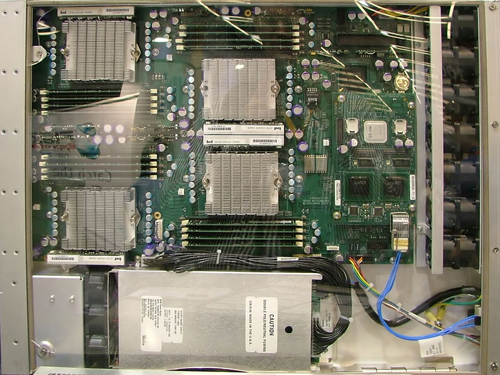
While we're on the topic of servers, AMD had the above Quad Opteron system running with 16GB of RAM (or possibly 32GB - we couldn't confirm the exact amount). It wasn't doing anything particularly useful at the time, and we couldn't determine if the system was using the new dual core Opteron chips or not. If it was, a "wrestling match" between it and the earlier Montecito server might have proved interesting. It might be difficult to setup an apples-to-apples test, however, as the Itanium does rather poorly when running x86 code and it doesn't support x86-64.
Originally published at https://www.anandtech.com/show/1670 (Wayback Machine).