
Caching And Tiering: Intel Optane Memory H20 and Enmotus FuzeDrive SSD Reviewed
Conclusions
Advanced storage configurations involving multiple drives and intelligent storage management software have never quite been able to catch on as a mainstream solution. Simple single-drive configurations remain the default for the overwhelming majority of PCs, and where two or more drives are used, they are often treated as separate volumes with data placement handled manually by the user. The allure of more advanced storage systems with caching or tiering functionality is that they can mix fast and expensive storage with slow cheap storage, in the hopes of providing the best of both worlds—and manage it automatically.
Intel and Enmotus are two of the many vendors who have been pursuing those goals for years. Their latest solutions are adapted to a PC market dominated by notebooks and no longer willing to accept mechanical hard drives in those notebooks. With so many systems now offering just a single M.2 slot, these companies had to get creative in order to fit two dissimilar drives into the system.

For both the Intel Optane Memory H20 and the Enmotus FuzeDrive SSD, the big, slow, cheap storage technology of choice is now QLC NAND. On its own, QLC NAND can make for a decent entry-level drive that offers adequate performance and endurance for most PC use cases. The challenge for these more advanced solutions is to offer a meaningful improvement over baseline QLC SSDs, while not introducing too many new downsides in cost and complexity.
Intel's solution features a morsel of their 3D XPoint memory, providing unbeatable random read performance but unimpressive write speeds. It's nice to see that they've slightly improved the cache performance and they're no longer trying to present a mere 16GB as an adequate cache size, but even the 32GB offered in both capacities of the Optane Memory H20 is rather limited. A clean OS installation and just a handful of applications quickly outgrows this cache size, so every user will have to contend with a significant portion of their workload being uncached or causing cache thrashing. Since QLC NAND is still much faster than a mechanical hard drive, the consequences of a tiny cache aren't a showstopper, and in practice the cache does provide real performance benefits, accelerating many aspects of everyday usage beyond the performance that a single high-end NAND flash SSD can offer.
Enmotus is a software company, so they don't have any special hardware technology like Optane to use. Their FuzeDrive SSD is a clever re-purposing of mundane hardware: transforming a 2TB QLC SSD into a ~1.6TB device with a dedicated 128GB of SLC NAND. That SLC may not have latency as low as Intel's 3D XPoint memory, but having four times the quantity gives Enmotus a lot more flexibility in how to use the fast storage. That fits well with their software's strategy of tiering rather than caching, allowing hot data to be more or less permanently resident in the fast storage. While the FuzeDrive SSD can't match all the performance benefits of Intel's Optane caching, their solution probably provides more improvement to write endurance, and it too provides a real step up from QLC performance.
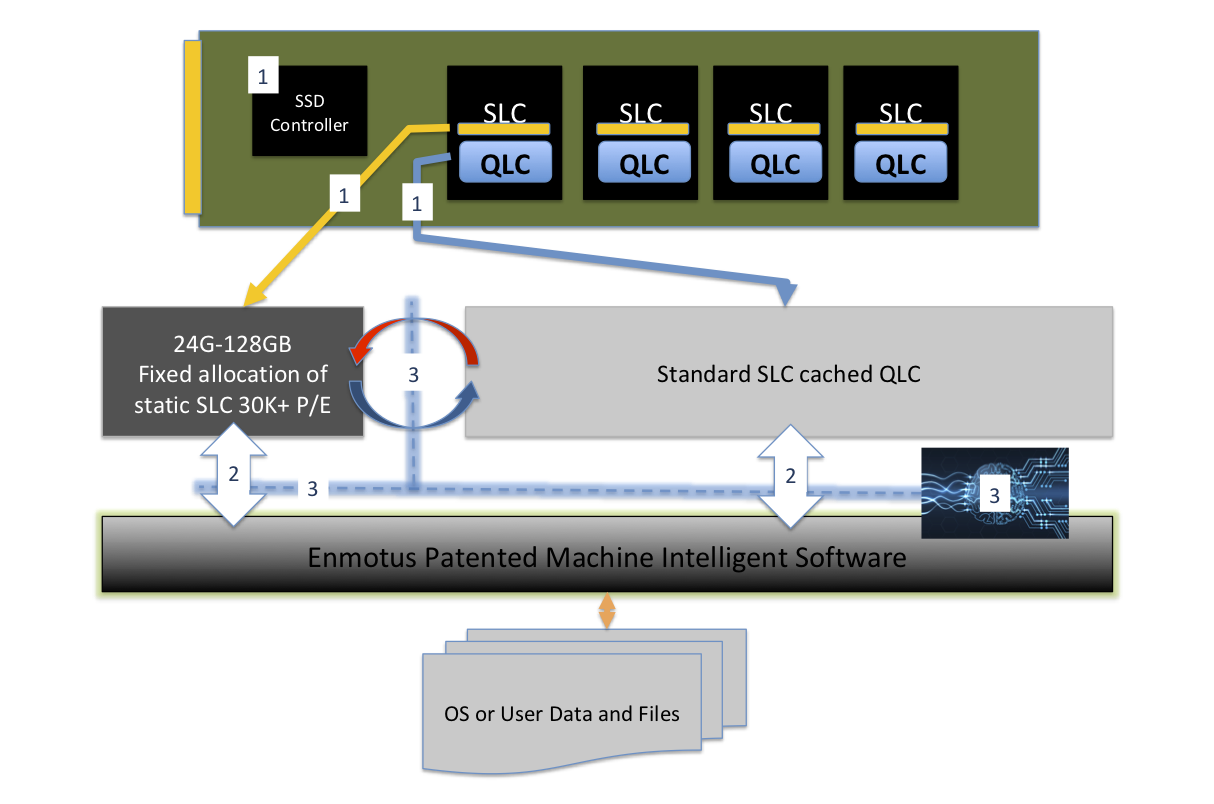
Since both the SLC and QLC in the FuzeDrive SSD are managed by the same controller ASIC, Enmotus also avoids the awkward bottlenecks of the Optane Memory H20's more literal split between the two halves of the drive. Aside from a tiny bit of driver overhead, there's hardly any performance downside for the FuzeDrive relative to an ordinary QLC SSD.
Not only do the Intel and Enmotus solutions differ in their technological approach, they also have different business models for targeting consumers. Intel's Optane Memory H20 is an OEM-only drive; it can only be acquired pre-installed in a new PC (usually a notebook). This ensures that the software portion of the storage solution will be delivered to end users pre-configured, removing the most significant barrier to adoption. It's always hard to get clear price signals for OEM drives, but systems similar to our HP review unit are currently offering the older Optane Memory H10 as build-to-order options for the same price as a pure NAND-based SSD of the same capacity (presumably using TLC NAND). Assuming the Optane Memory H20 replaces the H10 without raising those prices, that's very competitive—at least, by the standards of PC OEM storage upgrades.
Enmotus has been pursuing OEM deals as well, but they're also selling the FuzeDrive SSD through retail channels to consumers for aftermarket storage upgrades and PC building. Their current pricing is in line with top of the line consumer SSDs, which sounds like an awful lot for what is basically entry-level hardware. The clever software and firmware make it into a better storage product, but also reduce the usable capacity by 22% compared to a 2TB QLC drive. Since write endurance concerns for consumer storage are usually overblown and the performance benefits are not enough to clearly put the drive into high-end flagship territory, I don't think the FuzeDrive SSD is a good buy. Fortunately, Enmotus has a PCIe Gen4 successor on the way. That should be better able to compete against high-end TLC drives on raw peak throughput, making high-end pricing a more reasonable proposition.
Originally published at https://www.anandtech.com/show/16681/optane-memory-h20-enmotus-fuzedrive-ssd-review (Wayback Machine).