
Sabrent Rocket Q4 and Corsair MP600 CORE NVMe SSDs Reviewed: PCIe 4.0 with QLC
Conclusion
The Sabrent Rocket Q4, Corsair MP600 CORE and related drives form the first crop of QLC drives to support PCIe Gen4. It is clear from our testing that the PCIe Gen4 support doesn't automatically make these drives high-end. The Gen4 capability on these drives isn't a big deal for overall performance, though they are incrementally faster than most PCIe Gen3 QLC drives.
The Rocket Q4 and MP600 CORE definitely provide faster sequential transfer speeds than other QLC drives and entry-level TLC drives, but for random IO the Intel SSD 670p often steals the spotlight despite only supporting PCIe gen3 on its host interface. Optimizing for fast sequential IO is a great way to produce big numbers for marketing purposes, but the tradeoffs made by the Intel 670p seem for the most part to better for the real world.
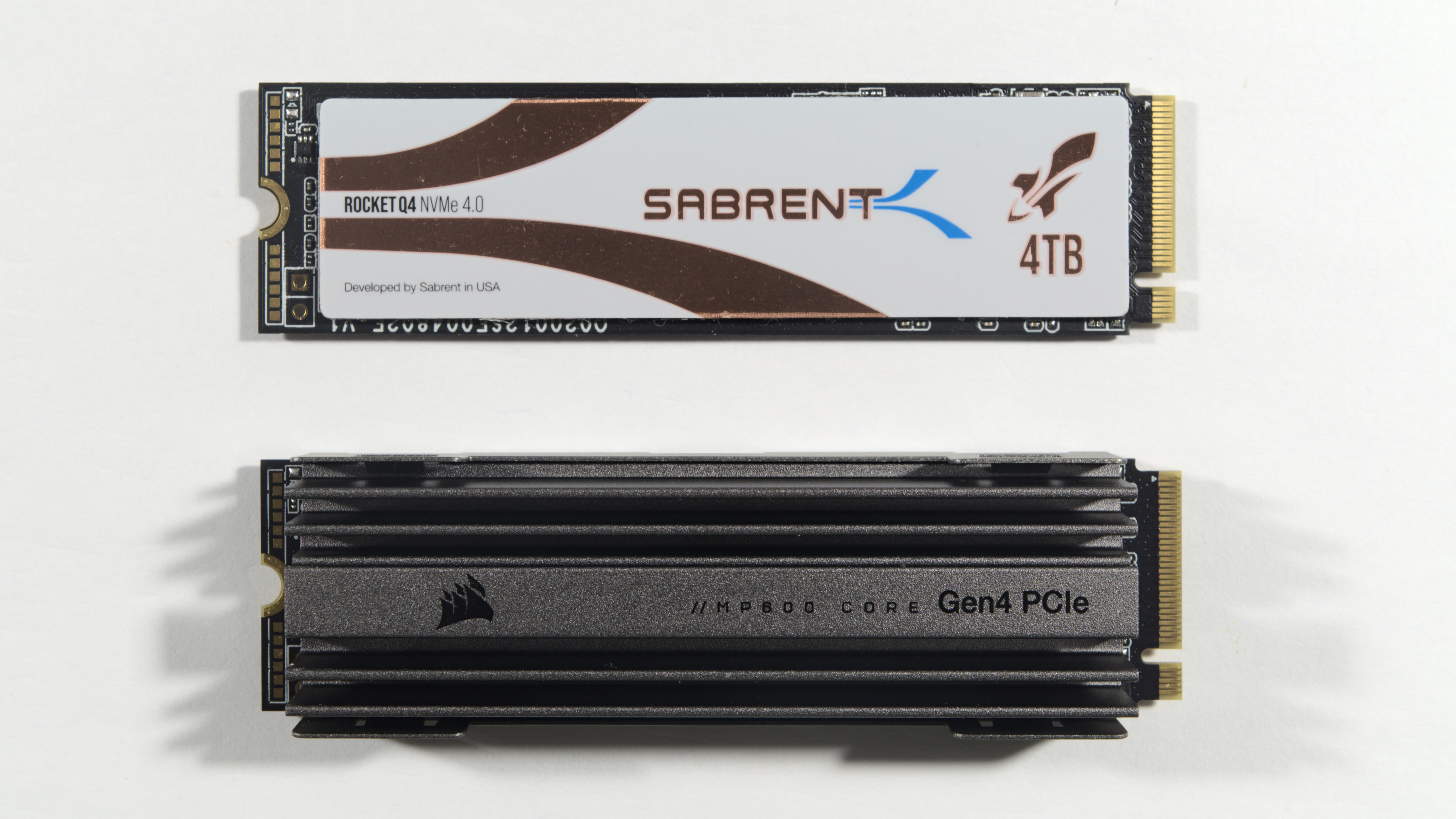
These Gen4 QLC drives inherit the most notable problem with the Phison E16 controller - the high power consumption- and this adds on to the poor efficiency of QLC NAND. The combination still isn't particularly prone to overheating or thermal throttling during normal consumer use, but heatsinks do make more sense for these drives than on most M.2 SSDs currently shipping with fancy heatsinks. There's not much demand yet for PCIe Gen4 SSDs for notebooks, but these drives are definitely ill-suited to that role.
Previous QLC NVMe drives had already proven that QLC can be an acceptable route to mainstream NVMe performance, provided that the drive has a high enough capacity. The Rocket Q4 and MP600 CORE show that peak performance can be extended even further, but they don't do much to illustrate how worst-case performance can be improved to further reduce the downsides of QLC.
| NVMe SSD Price Comparison April 9, 2021 |
|||||||
| 500 GB | 1 TB | 2 TB | 4 TB | ||||
| Sabrent Rocket Q4 PCIe Gen4, QLC |
$149.98 (15¢/GB) |
$279.98 (14¢/GB) |
$689.98 (17¢/GB) |
||||
| Corsair MP600 CORE PCIe Gen4, QLC |
$154.99 (15¢/GB) |
$309.99 (15¢/GB) |
$644.99 (16¢/GB) |
||||
| Mushkin DELTA PCIe Gen4, QLC |
$159.99 (16¢/GB) |
$299.99 (15¢/GB) |
$599.99 (15¢/GB) |
||||
| Sabrent Rocket Q QLC |
$64.99 (13¢/GB) |
$109.98 (11¢/GB) |
$219.98 (11¢/GB) |
$599.98 (15¢/GB) |
|||
| Corsair MP400 QLC |
$109.99 (11¢/GB) |
$229.99 (11¢/GB) |
$593.99 (15¢/GB) |
||||
| Mushkin ALPHA QLC |
$569.99 (14¢/GB) |
||||||
| Intel SSD 670p QLC |
$69.99 (14¢/GB) |
$114.99 (11¢/GB) |
$249.99 (12¢/GB) |
||||
| Samsung SSD 980 DRAMless, TLC |
$69.99 (14¢/GB) |
$129.99 (13¢/GB) |
|||||
| WD Blue SN550 DRAMless, TLC |
$59.99 (12¢/GB) |
$109.99 (11¢/GB) |
|||||
| SK hynix Gold P31 TLC |
$74.99 (15¢/GB) |
$134.99 (13¢/GB) |
|||||
| WD Black SN750 TLC |
$69.99 (14¢/GB) |
$139.99 (14¢/GB) |
$299.99 (15¢/GB) |
$799.99 (20¢/GB) |
|||
As we saw with the TLC drives when the Phison E16 controller first brought PCIe 4 support to consumer SSDs, that extra bandwidth comes at a significant premium. For the more mainstream capacities, the E16 QLC drives are substantially more expensive than the PCIe Gen3 QLC drives using the older E12 controller, or even the recent Intel SSD 670p. However, at 4TB, the premium for Gen4 on a QLC drive is a lot smaller. Mainstream PCIe Gen3 TLC drives are also cheaper than the Gen4 QLC drives, for capacities below 4TB. At and above 4TB there really aren't many options, and almost all of the are QLC-based. It is disappointing that upgrading to PCIe Gen4 has so far precluded these Phison drives from offering the 8TB capacity that is available from Phison E12 drives. That will likely come as 28nm controllers make way for newer models on 12nm or smaller.
These Gen4 QLC SSDs are not a great general-purpose storage solution; they certainly don't combine PCIe Gen4 and QLC and come out with only the best advantages of each. But they are still suitable for some use cases, especially centered around higher capacities.
Originally published at https://www.anandtech.com/show/16577/qlc-pcie-40 (Wayback Machine).