
Buyer's Guide - Entry Level to Mid-Range, March 2005
- Posted in
- Guides
CPU and Motherboard: AMD
In the past Budget Guides, we have continued to list socket A options due to their lower cost. Features and performance may be more limited, and the platform as a whole is reaching the end of the road. It has been a long ride since the initial launch of socket A, and we're now removing it from our recommendations. If you can pick up the parts used or at clearance prices, though, it can still offer plenty of power. Our move to socket 754 began with the last Budget Guide, and recent additions to AMD's lineup now allow us to complete the transition. 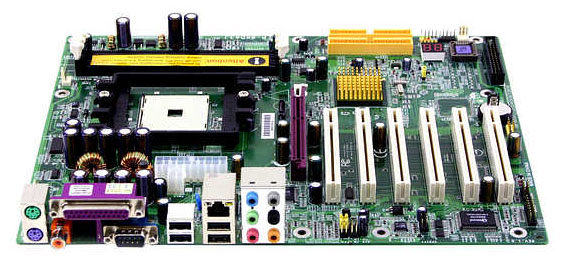 |
 |
| Click images to enlarge. | |
Socket 754 Motherboard: EPoX EP-8KDA3J
Price: $74 shipped
Socket 754 CPU: AMD Sempron 2800+ 1.6 GHz 256KB L2
Price: $89 shipped (Retail)
Total: $163
We've waffled back and forth on the motherboard recommendation for socket 754, and both the EPoX that we list here as well as the Chaintech VNF-250 continue to be good value recommendations. The EPoX wins out on features, while the Chaintech wins out on RAM support and overclocking, as well as overall stability. When using two DIMMs on the EPoX, particularly lower quality (i.e. lower price) modules, you may be forced to run DDR333 speeds instead of DDR400. We would recommend purchasing better RAM for the best compatibility. Even at DDR333 speeds, however, performance is quite good. The remaining features - including hardware firewall, gigabit Ethernet, and Firewire support - all put the EPoX board ahead of other similarly-priced boards.
If you don't need those features, then other boards can be had for less money. We prefer to increase performance and reliability by using the nForce3 250 chipsets on socket 754, but some people will be interested more in cutting costs. Motherboards using SiS, ALi, and VIA can be found at lower prices, and some of them will include integrated graphics that will help to reduce the total system price (and performance) even further. If you're willing to make the trade-off in performance for money, the Chaintech MK8M800 is a micro-ATX board with integrated graphics that costs $65. Memory capacity is limited to two DIMMs totaling 2GB, and overclocking is definitely not a priority. For $65, though, you can get a decent start on a system that will handle most business/office computing tasks for many years (providing nothing malfunctions).
Our CPU recommendation this time goes to the newly launched Sempron 2800+ 90nm processor. Heat and power use should be very low, thanks to the smaller process technology. Overclocking should also be good if you're interested in that, but with an 8X multiplier, you will very likely be limited to 2.2GHz, give or take. Otherwise, performance will be very similar to that of the Sempron 3100+, only ~10% slower due to the lower CPU speed. At $90, socket 754 is now truly in the realm of the budget computer. Sempron 2600+ with only 128KB of L2 cache is also something to consider, and it should at least manage to equal the performance of our previous socket A recommendations, but given the price difference of only $10, we felt that it was worth sticking with the 256K cache on the 2800+.
 |
 |
| Click images to enlarge. | |
Socket 939 Alternative Motherboard: Chaintech VNF4 Socket 939
Price: $91 shipped
Socket 939 CPU: AMD Athlon 64 1.8 GHz 512KB L2 90nm socket 939
Price: $146 shipped (Retail)
Total: $237
If you want to increase performance (and perhaps even overclock), you need a better motherboard and platform. We prefer to stick with the 90nm processors, so we'll jump up to the Athlon 64 3000+ and socket 939. (The Sempron 3100+ 90nm is also an option when combined with the DFI LANParty UT 250Gb - probably the best overclocking motherboard and CPU for socket 754. If overclocking isn't something that interests you, the DFI is still a good board, and socket 754 Athlon 64 chips like the 3200+ are reasonably priced.) The Chaintech VNF4 is also one of the cheapest motherboards for socket 939, and it uses an NVIDIA chipset with PCI Express support. The only feature that some might miss is 1394 support (Firewire). Gigabit Ethernet and 7.1 audio are still present, and at a price of $91, it's hard to complain too much - just a few months ago, motherboards like this carried a price tag of $140 or more!
One area that is a little unclear is the difference between the Chaintech VNF4 and the VNF4/Ultra. Obviously, the Ultra version uses the Ultra chipset, but how much does that really help? Upon closer inspection, the non-Ultra is the nForce4 "standard" - not the 4X - so it is nearly identical to the Ultra. All that is missing is support for SATA-2. If that's worth an extra $10, you can always upgrade to the Ultra version. We don't feel it's necessary.
The Athlon 64 3000+ is a good performing CPU and it has the ability to run 64-bit applications in the near future when XP-64 is finally released (assuming that you don't want to run a 64-bit version of Linux right now instead). When combined with the dual-channel RAM support and increased L2 cache, this setup should be quite a bit faster than the socket 754 Sempron configuration, and while they should both overclock quite well, the 939 will still come out on top. The price jump is pretty substantial, but we feel that it's a good intermediate step between the budget and mid-range price segments. Just remember to get a PCI Express graphics card if you choose this motherboard.
Originally published at https://www.anandtech.com/show/1646 (Wayback Machine).