
ASRock DeskMini H470 Review: A No-Frills LGA 1200 mini-PC Platform
Storage and Networking Performance
Storage and networking are two major aspects which influence the experience with any computing system. This section presents results from our evaluation of the storage aspects in the ASRock DeskMini H470. On this aspect, one option would be repetition of our strenuous SSD review tests on the drive(s) in the PC. Fortunately, to avoid that overkill, UL PCMark 10 has a Full System Drive Benchmark storage test certain common workloads such as booting, loading games, and document processing are replayed on the target drive. The average access times and bandwidth numbers are recorded for each trace and the overall numbers contribute to a benchmark score.

In case of single drive systems, we attempt to allocate 180GB to the primary partition, and leave the remaining space on the drive as a secondary partition. For dual-drive systems, the OS drive is the primary drive, while the other is categorized as the secondary one. Since PCMark 10 requires 80GB of free space at the minimum for processing the Full System Drive Benchmark, we are able to process the benchmark on both the primary and secondary drive in only some of the evaluated systems. The results are presented below.
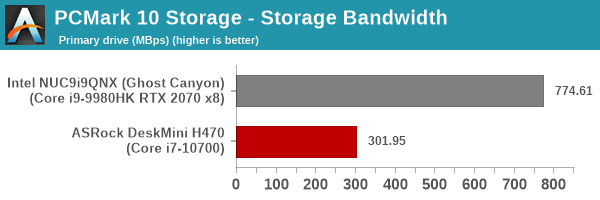
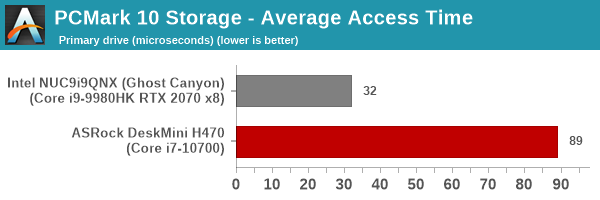
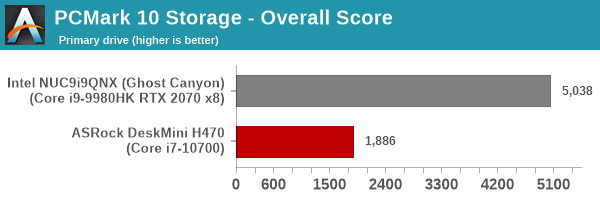
Since the PCMark 10 storage component is a recent addition to our benchmark suite, we only have the Ghost Canyon NUC for comparison. In the battle of primary drives, the Intel SSD 905p Optane drive is against the Crucial P5 with Micron's 96L 3D TLC NAND flash. Commensurate with the cost of the SSDs (~$500 @ around $1.33/GB for the 905p compared to ~$130 @ around $0.13/GB for the Crucial P5), the performance of the Optane drive is well ahead of the flash-based drive in the PCMark 10 storage benchmark numbers.
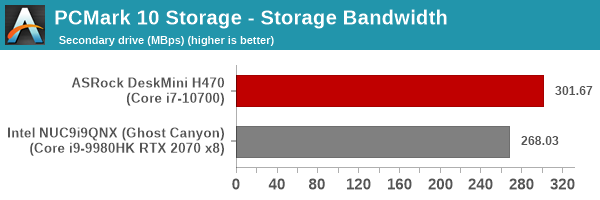
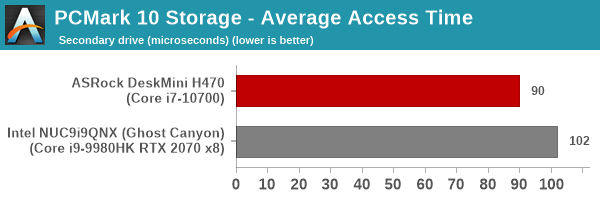
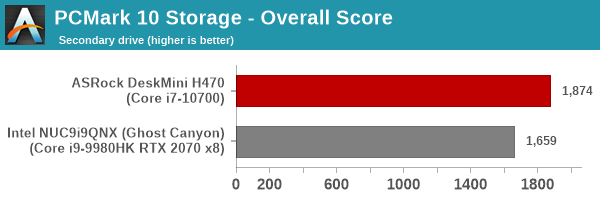
The second partition in the DeskMini H470 is still that of the Crucial P5 - despite the larger partition size and available free size, the numbers closely track those obtained for the primary partition - bandwidth around 301.5 MBps and an average access time for the workloads around 90us. Here, the compared drive in the Ghost Canyon NUC is the Kingston KC2000 - a more like-for-like comparison drive against the Crucial P5 SSD. Both drives are M.2 2280 PCIe 3.0 x4 NVMe drives with 96L 3D TLC flash and use a SSD controller with external DRAM support. Kingston has since replaced the KC2000 with KC2500, but the 1TB version still carries a distinct premium over the Crucial P5 (around $0.18/GB compared to the $0.13/GB) despite the P5 delivering better storage performance as per the PCMark 10 storage bench scores.
On the networking side, we restrict ourselves to the evaluation of the WLAN component in mini-PCs. Since the DeskMini H470 review sample didn't come with any Wi-Fi card, we do not have any iPerf3 benchmark results for the system. The unit has a single wired gigabit Ethernet port, good enough for networking duties in a standard PC. Consumers contemplating the use of the system for networking-focused applications such as firewalls or routers have better options available in the market.
Originally published at https://www.anandtech.com/show/16335/asrock-deskmini-h470-review-a-nofrills-lga1200-minipc-platform (Wayback Machine).