Detailing the Chipsets
The soul of the V40z runs on four Opteron 850 (2.4GHz, 1MB L2, 130nm) processors. The daughterboard obstructs the majority of the airflow to the rear of the system, so plastic rails partition air to each bank of memory and each processor. The cooler air from the hard drive bays is pulled over the daughterboard to cool the rear processors. You'll notice that there is no active cooling on this portion of the chassis; fans directly opposite the daughterboard (slightly above the mainboard) pull cool air from the outside of the case directly over these heat sinks.
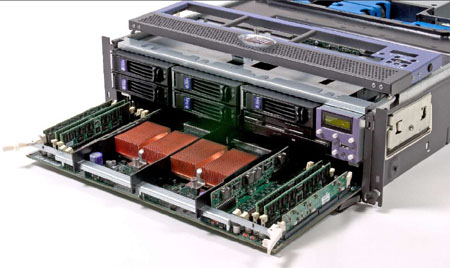
Click to enlarge.
The daughterboard connects to the mainboard via a proprietary Sun interface, but with the rails and guides holding the daughterboard, we had no problems determining if we had a clean connection between boards.
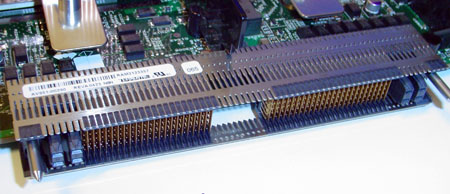
Click to enlarge.
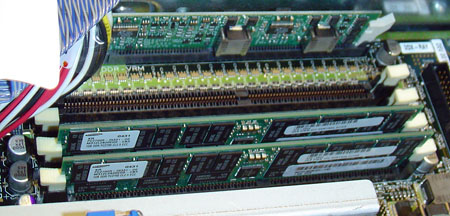
As with any Opteron system, each processor has a dedicated bank of memory; in our case, two Samsung 1GB PC2700 modules per processor. The older 130nm "CG" stepping on Opteron 8xx only allows for PC2700 memory in Sun's V40z, but the newer
"E4" stepping now supports PC3200 as well. We will get more into Sun's 90nm "E4" stepping solution in just a bit. Each processor bank can utilize 8GB of memory (four DIMMs) in 64-bit operation, giving the V40z a total capacity of 32GB.
Click to enlarge.
Behind the bank of DDR DIMMs in the image above, we can also see the 12V individual voltage regulator module (VRM). With larger processor configurations, regulating clean power to each processor becomes essential, and thus, each processor has a dedicated VRM. Below, you can see one of the Opteron 850s is exposed from under the copper heat sink on the daughterboard.
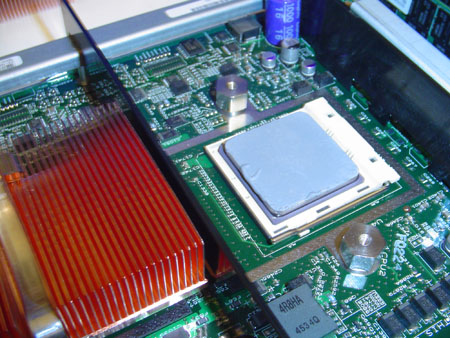
Click to enlarge.



