
EasyShare DX7590: Kodak's Second Ultra-Zoom Digicam
- Posted in
- Digital Camera
Resolving Fine Lines
For our resolution test, we reset the camera to its default settings and then used the highest resolution and quality setting. The camera was then set to +1.0 E.V. For more information, refer to our Testing Procedures page. When reading this chart, the numbers represent lines per picture height (LPH). For example, the number 16 would represent 1,600 LPH. Below are 200% crops of the test. Click on a crop to see the full chart at 100%.We have selected the Sony DSC-F88 to use for comparison due to a similarly-sized sensor and megapixel rating.
| Kodak DX7590 | Sony DSC-F88 |
 +1.0 EV Click to download. |
 +1.0 EV Click to download. |
Roll your mouse over the crops below to see the difference between the Kodak DX7590 and the Sony DSC-F88 resolution charts.
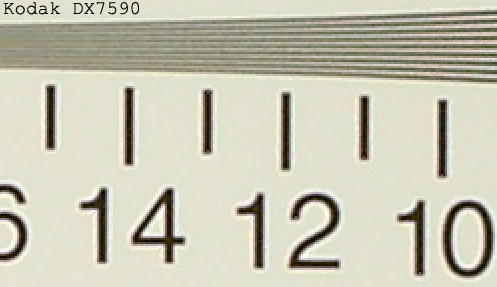
Hold mouse over image.
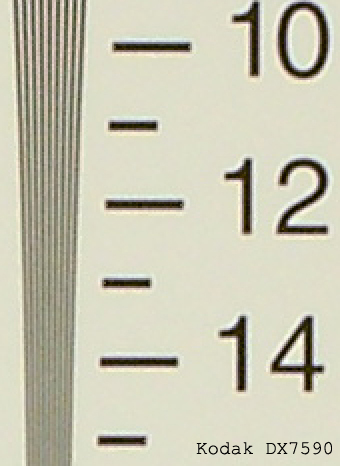
Hold mouse over image.
In the horizontal crop above, the DX7590 shows strong line detail out until 1,100 LPH, which is a bit worse than what we are used to seeing for 5 MP cameras. The Sony DSC-F88 shows a more expected resolution of 1,300 LPH. In the vertical crop, the DX7590 does just a bit better, resolving lines out to 1,150 LPH before the lines are no longer distinguishable. However, the F88 again shows a significant advantage with detail out to 1,300 LPH. Overall, the resolution performance of the DX7590 isn't very impressive. We also noticed a significant amount of JPEG artifacts and halos along the test patterns as well as slight moiré in the extinction zone.
Originally published at https://www.anandtech.com/show/1612 (Wayback Machine).