
The Quest for More Processing Power, Part One: "Is the single core CPU doomed?"
- Posted in
- CPUs
CHAPTER 3: Containing the epidemic problems
Reducing leakage
Leakage is such a huge problem that it could, in theory, make any advance in process technology useless. Without countermeasures, a 45 nm Pentium 4 would consume 100 to 150 Watts on leakage alone, and up to burn 250 Watts in total. The small die would go up in smoke before the ROM program would have finished the POST sequence.
However, smart researchers have found ways to reduce leakage significantly. SOI – Silicon on Insulator - improves the insulation of the gate and thus reduces leakage currents. SOI has made process technology even more complex, making it harder for AMD to get high binsplits on the Opteron and Athlon 64. However, it is clear that the Athlon 64 has a lot less trouble with leakage power than the Prescott, despite the fact that the Athlon 64 has only 20% less transistors than the Intel Prescott (106 versus 125 million).
The most spectacular reduction of leakage will probably come from Intel's "high-k" materials, which will replace the current silicon dioxide gate dielectric. Thanks to this advancement and other small improvements, Intel expects to reduce gate leakage by over one hundredfold! This new technology will be used when Intel moves to 45nm technology.
Another promising technique is Gate Bias technology. By using special sleep transistors, leakage can be reduced by up to 90% while the dynamic power is also reduced with 50% and more.
Body Bias techniques make it possible to control the voltage of a transistor. The objective is to make transistors slow (low leakage) when they are not used, and fast when they are. Stacked transistors and many other technologies also allow for reduction in leakage.[4]
One could probably write a book on this, but the message should be clear: the leakage problem is not going to stop progress. SOI already reduces the problem significantly and high K materials will make sure that the whole leakage problem will remain to be a nuisance, but not a major concern until the industry moves to even smaller structures than 45 nm.
At the same time, strained silicon will reduce the amount of dynamic power needed. With strained silicon, electrons experience less resistance. As a result, CPUs can get up to 35 percent faster without consuming more. This is what should allow the Athlon 64 stepping "E0" to reach higher clock speeds without consuming more.
Reducing Wire Delay
Although wire delay has not been so much in spotlight as leakage power, it is an important hurdle that designers have to take when they target high clock speeds. The resistance of wires has been reduced by both AMD and Intel using copper instead of aluminium. Capacitance has been lowered by using lower-K materials separating wires.
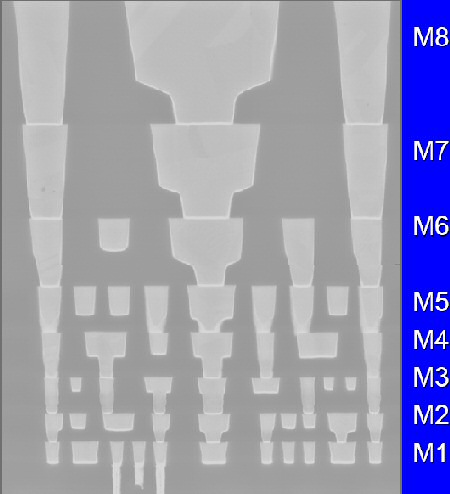
Fig 5. 8 Metal layers to reduce wire delay in Intel's 65 nm CPUs
Adding more metal layers is another strategy. More metal layers enable the wires connecting different parts of the CPU to be packed more densely. More densely means shorter wires. And shorter wires result in lower resistance, which, in turn, reduce the total RC Delay.
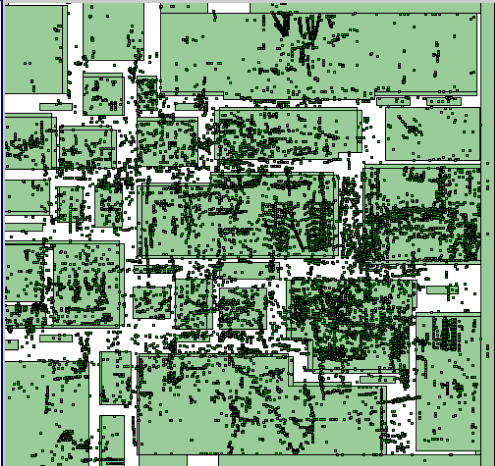
Fig 6. Repeaters on the Itanium Die
Of course, there are limits on what adding more metal layers, using SOI and lower-K materials can do to reduce RC delay. If some of the global wires are still too long, they are broken up into smaller parts, which are connected by repeaters. Repeaters can be used as much as you like, but they consume power of course.
Now that we have wire delay and leakage more or less out of control, let us try to find out what went exactly wrong with the Pentium 4 "Prescott". The answer is not as obvious as it seems.
Originally published at https://www.anandtech.com/show/1611 (Wayback Machine).