
ADATA External and HP Portable SSDs Review: Featuring the ADATA SE800 and HP P700
Synthetic Benchmarks - ATTO and CrystalDiskMark
Most USB 3.1 Gen 2 drives with NVMe SSDs claim speeds of around 1000 MBps, and these are backed up by the ATTO benchmarks provided below. Unfortunately, these access traces are not very common in real-life scenarios.
| 1GBps-Class Drives Performance Benchmarks - ATTO |
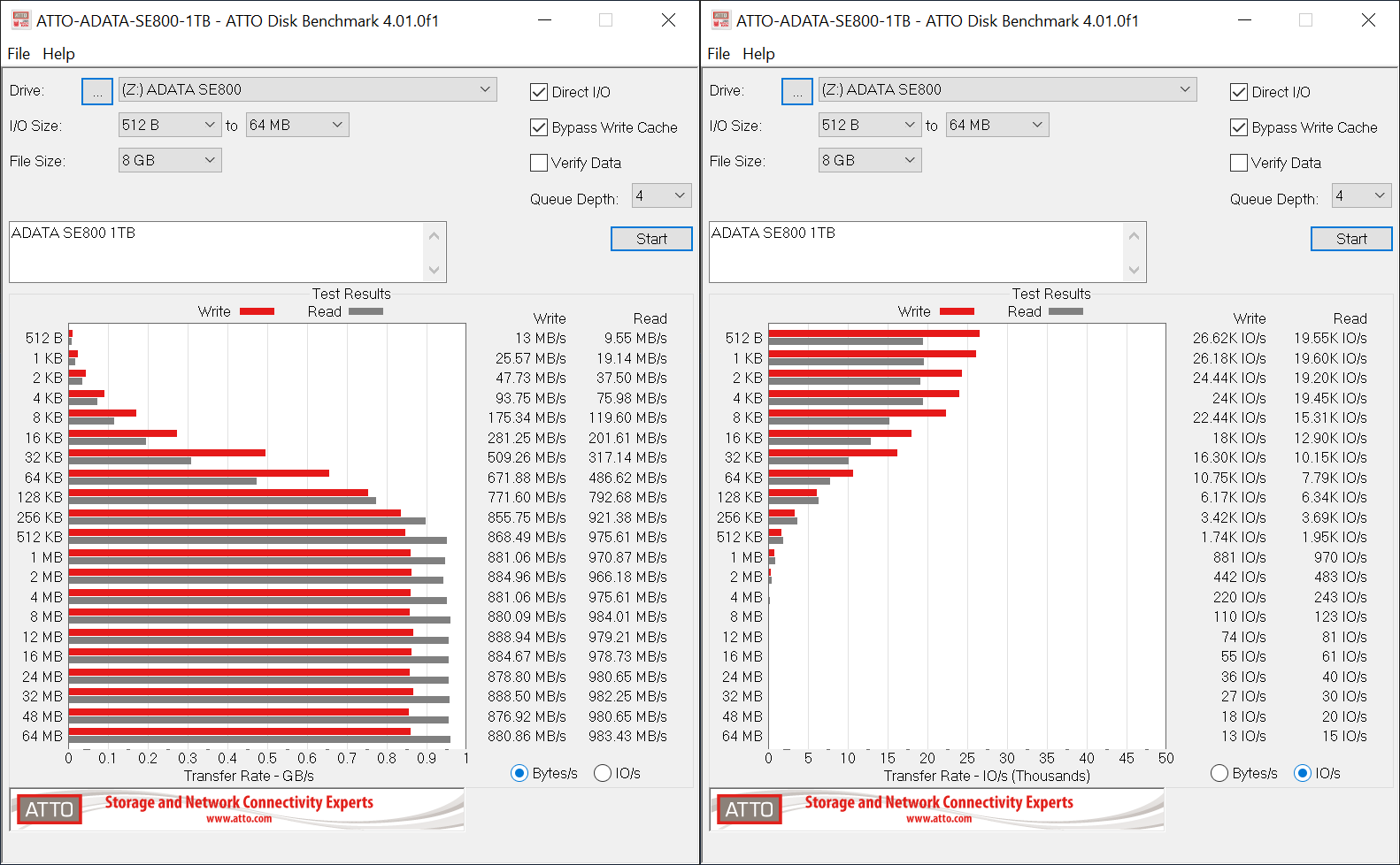 |
The reads for the ADATA SE800 and SE760, as well as the HP P700 come in at around 985 MBps, while the writes for the P700 win out at 955 MBps. The SE800 tops out at around 885 MBps, while the SE760 can reach only 780 MBps.
CrystalDiskMark, despite being a canned benchmark, provides a better estimate of the performance range with a selected set of numbers. As evident from the screenshot below, the performance can dip to as low as 14MBps for random 4K reads.
| 1GBps-Class Drives Performance Benchmarks - CrystalDiskMark |
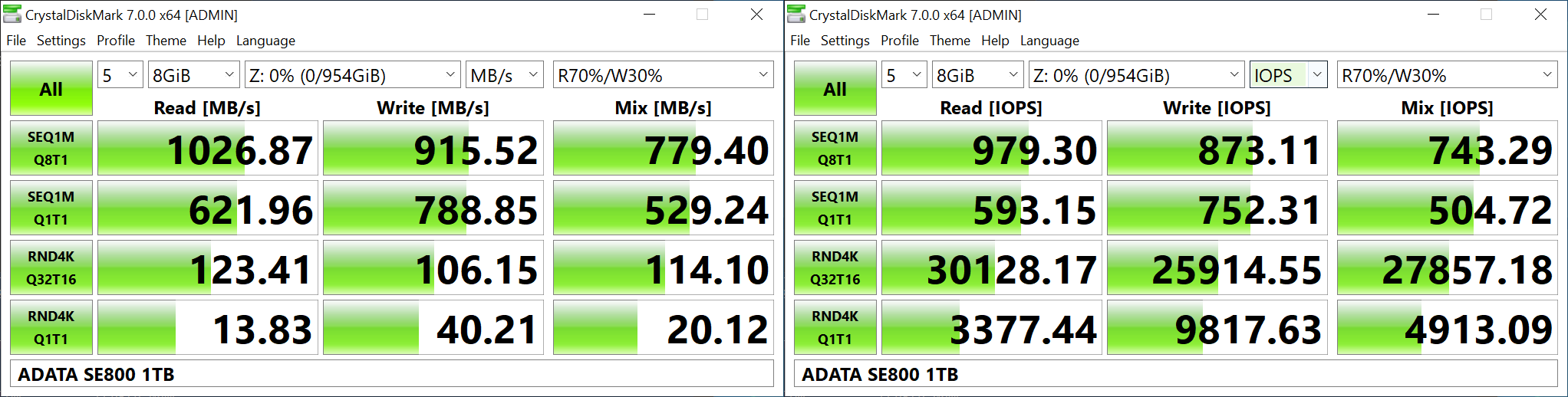 |
The HP P700 again comes out on top with a good balance of read and write speeds for the sequential access case that forms the bulk of typical DAS usage - 1030 MBps / 977 MBps, compared to the ADATA SE800's 1027 / 916 MBps and SE760's 1026 / 822 MBps.
SATA SSDs behind a USB 3.1 Gen 2 bridge claim speeds of around 550 MBps, while traditional USB flash controllers top out around 350 MBps. The ATTO benchmarks for the ADATA SC680, HP P600, and HP P500 provided below back up those claims.
| 500MBps-Class Drives Performance Benchmarks - ATTO |
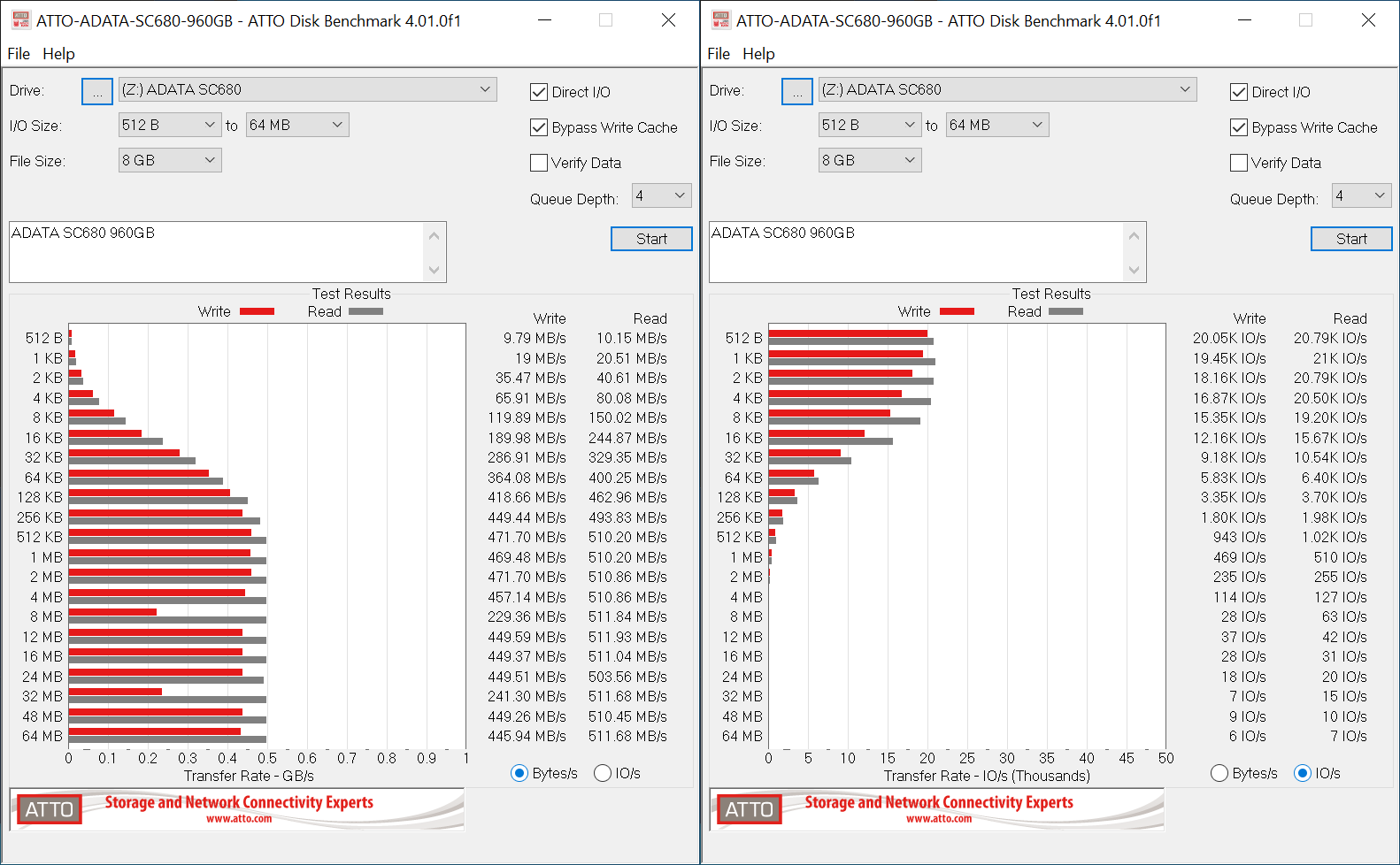 |
The HP P600 comes out on top by a fine margin in the ATTO numbers - 530 / 482 MBps, compared to the ADATA SC680's 512 / 472 MBps. The P500's 344 / 203 MBps numbers are not surprising given the USB flash controller in the device.
| 500MBps-Class Drives Performance Benchmarks - CrystalDiskMark |
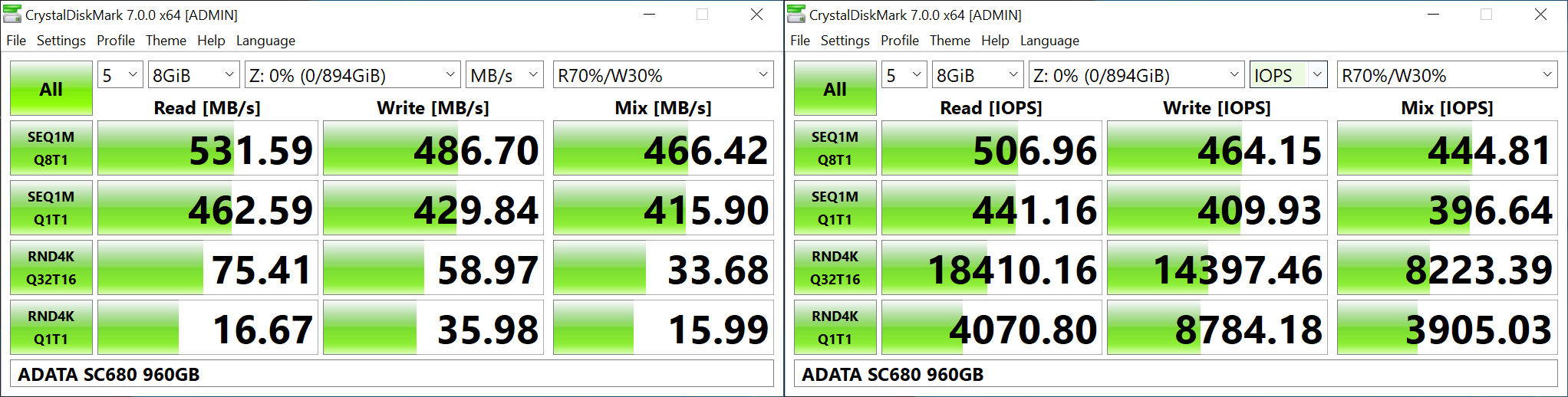 |
CrystalDiskMark provides a better estimate of the performance range with a selected set of numbers. As evident from the screenshots above, the performance can dip to as low as 7 MBps for random writes in the HP P500. The HP P600 provides better peak numbers (554 / 491 MBps) compared to the ADATA SC680 (532 / 487 MBps). The HP P500 clocks in at 350 / 217 MBps for sequential reads and writes.
Originally published at https://www.anandtech.com/show/16101/adata-external-and-hp-portable-ssds-2020-family-review-featuring-the-adata-se800-and-hp-p700 (Wayback Machine).