
VIA PT Series: VIA PCI Express for Intel
- Posted in
- CPUs
VIA PT894 Reference Board
Reference Boards are designed for chipset qualification, so they are not designed for case mounting and they often have abbreviated features.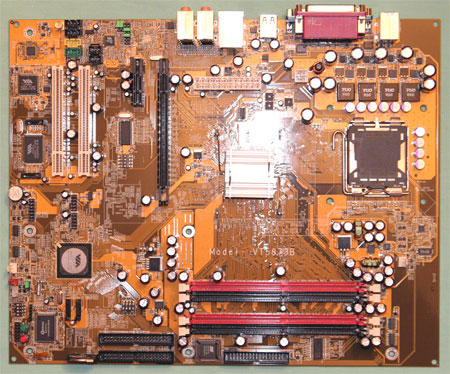
VIA sent us an upper-end board based on the 894 northbridge with the current 8237 southbridge. We had planned to test on-board audio, Ethernet, and SATA, but the Reference Board was equipped with the older 8237 controller (the 8251 is not yet available), no gigabit Ethernet (the PCIe VIA chip was not ready), and basic AC'97 audio instead of the HD audio that will be part of shipping 894/894 Pro boards. This is not really that unusual with Reference boards, so you should not try to read too much into the fact that the 894 Reference Board was stripped compared to production boards. In addition, the 1066 FSB was not yet working, but VIA tells us that it will be fully functioning in production chipsets. The 800FSB was working as expected and all tests were run at 800FSB.
| VIA PT894 Reference Board Specifications | |
| CPU Interface | Intel Socket 775 |
| Chipset | VIA PT894 Northbridge - VIA VT8237 Southbridge |
| Bus Speeds | 200MHz to 232MHz in 1MHz Increments |
| PCI/AGP | 66/33, 75.4/37.7, 88/44, PLL1, Pll2 |
| CPU/PCIe | Synch/Asynch |
| Core Voltage | Default, +0.025V to +0.175V in .025V increments |
| CPU Clock Multiplier | Fixed (Intel) |
| FSB | 800, 1066 |
| DRAM Voltage | 2.50V to 2.80V in 0.1V increments |
| Memory Slots | Four 184-pin DDR DIMM Slots Dual-Channel Configuration Regular Unbuffered Memory to 4GB Total |
| Expansion Slots | 1 x16 PCIe 1 x1 PCIe 2 PCI Slots |
| Onboard SATA/SATA RAID | 2 SATA Drives by VT8237 (RAID 0, 1, JBOD) |
| Onboard IDE/IDE RAID | Two Standard ATA133/100/66 (4 drives) |
| Onboard USB 2.0/IEEE-1394 | 8 USB 2.0 ports supported by VT8237 No Firewire |
| Onboard LAN | Wireless Ethernet 802.11g by VIA VT6655 |
| Onboard Audio | AC '97 2.3 8-Channel by VIA VT1617A |
| BIOS Revision | Award Beta 1/14/2005 |
The basic tweaking and overclocking controls were present on the board, so we were able to do some basic testing of locks and overclocking. This was a pleasant surprise for a Reference Board, since there are often insufficient options to really test locks and overclocking potential.
We confirmed that the PCI/AGP lock and the PCIe Lock were working properly by fixing the PCI/AGP bus at 66/33 and the PCIe bus at 100 - then overclocking the CPU to the highest 232 setting (FSB 928) available in BIOS. In a floating or non-working PCI/AGP lock, most boards will fail at around 217 to 218 CPU setting. With the Reference board, we had no problem at all running at the 232 setting. We confirmed the fixed PCI with a PCI Geiger card in a PCI slot. It also appears that the PCIe can be locked at 100, a large improvement over the floating PCIe frequency in Intel chipsets, which can limit overclocking.
Originally published at https://www.anandtech.com/show/1601 (Wayback Machine).