
Linux and the Desktop Pentium M: Uncommon Performance
- Posted in
- Linux
Compiler Optimizations
Although TSCP is neither a model of practical application nor synthetic benchmark, it does provide us with some valuable data for different breakdowns of compiler flags and optimizations. As we have mentioned in past Linux analyses, compiler flags can show large differences between processors if they are used incorrectly. Remember, our Pentium M is significantly handicapped against K8 and Pentium 4 optimizations, since GCC seems to think that the Pentium M is merely a Pentium Pro, which it is not.Where we denote "-march" in the graph, we mean specifically "-march=k8" or "-march=pentium-m", where it applies.
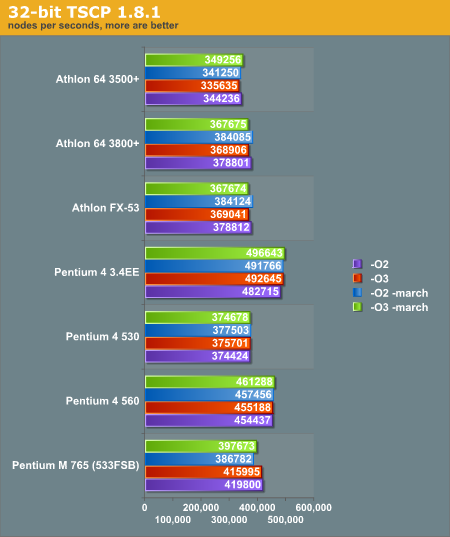
We also retested some of our content creation benchmarks to show the effect of setting "-march=pentium-m" or "-march=pentium4" at compile time. For good measure, we threw in some compilations of the same programs using the Intel C++ compiler, icc. If any compiler is going to utilize fully the advantages of Dothan on Linux, we should think it would be the Pentium M.
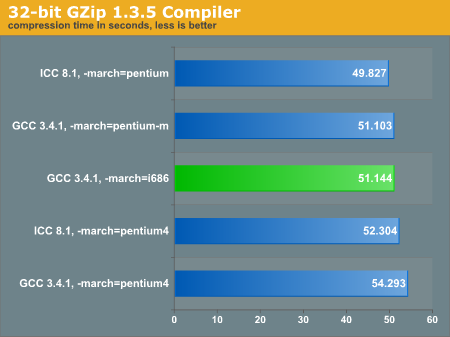
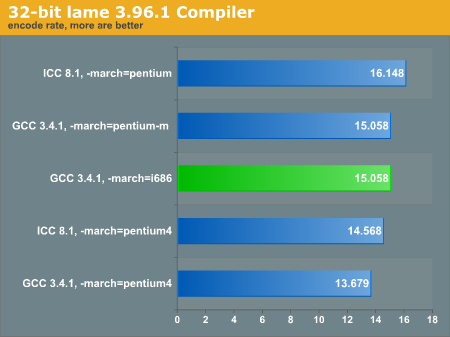
As expected, there are severe differences using the different compile flags. Attempting to set the architecture flag at "Pentium 4" degrades performance severely, and at the same time, there is no difference in performance between the "pentium-m" and the "i686" flag. When we look at ICC, on the other hand, Pentium M gets a nice boost when optimizing for Pentium M.
Originally published at https://www.anandtech.com/show/1576 (Wayback Machine).