
AMD’s Mobile Revival: Redefining the Notebook Business with the Ryzen 9 4900HS (A Review)
GPU Benchmarks
Graphics is going to be a bit more challenging than the CPU tests. Games that test both the CPU and the GPU to the limits are going to find different tradeoffs with each of these systems.
The ASUS Zephyrus G14 is smaller and more thermally limited. It doesn’t have an AMD GPU, so it can’t take advantage of AMD’s new features like SmartShift that can manage power between the CPU and GPU. It technically has the stronger CPU, and while the graphics card is the same, ASUS has the Max-Q version of the RTX 2060, which is optimized for power and efficiency, and exhibits lower clocks. Technically the base frequency of this configuration is higher, at 975 MHz, the turbo is lower at 1185 MHz, and the GDDR6 memory is a lot lower at 1375 MHz (11Gbps/pin).

The Razer Blade 15 has the bigger chassis, and we assume is built for a larger overall TDP. While it has the ‘weaker’ CPU of the two, with fewer cores and lower frequency, it is paired with a full-fat GTX 2060 graphics card. We looked at the data for this card, and it exhibits a lower 960 MHz base frequency, it has the higher 1200 MHz turbo, 1750 MHz memory, and has a direct PCIe 3.0 x16 connection with the processor, while the ASUS system is only an x8.

For our tests, I’ve taken an older test (CS:Source), a couple of modern tests (Civ 6, FFXV) and a new test in Borderlands 3. We used the following settings:
- Final Fantasy, 1080p Fullscreen, Standard Quality
- Borderlands 3, 1080p, Medium Pre-Set
- Civilization 6, 1080p Maximum Preset No MSAA / 1K Occlusion Textures
- Civilization 6, 1080p Maximum Preset 8x MSAA / 2K Occlusion Textures
- Counter Strike Source, 1080p Maximum
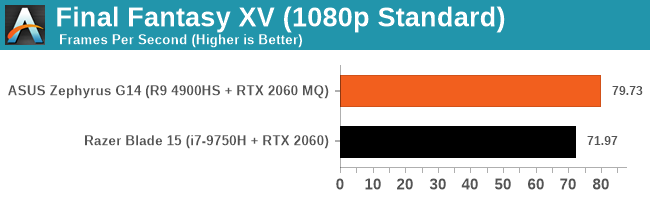
In Final Fantasy, the results were around 10% different, favoring the AMD system.
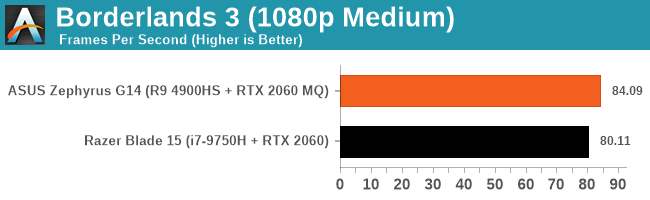
Borderlands 3 was actually fairly close, with less than 5% between them, but still favoring AMD. I did notice that we were fairly close to the cutoff here between being CPU limited and GPU limited.
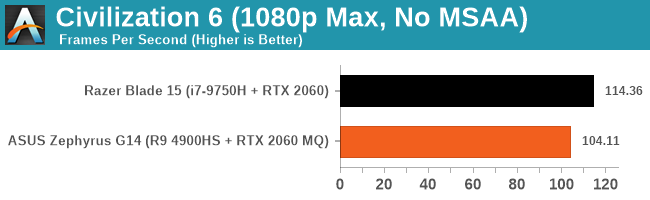
Civilization 6 is well known for constantly updating and being optimized, and here it seems the more powerful GPU wins out by a large 10 FPS margin.
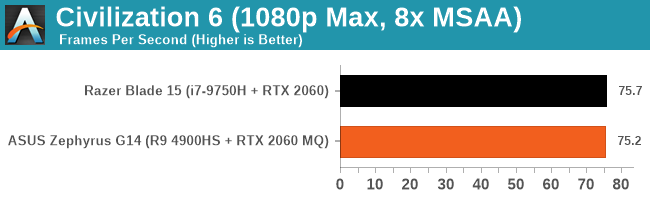
However, if we add in some more compute and detail, we move to a more GPU limited scenario where the results are essentially equal.
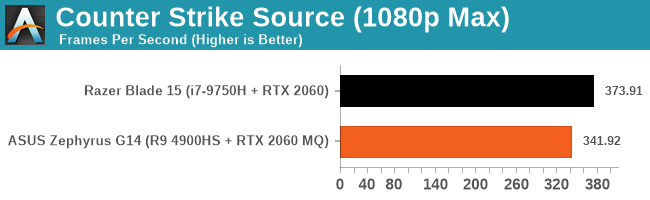
Counter Strike is an odd one, given how old the game is. Here the game favors the Intel machine, with a ~10% advantage.
Like in the CPU tests, I did some of these gaming tests with the power cord removed and on battery saver mode. Results were interesting, to say the least, and can be found on the next page.
Originally published at https://www.anandtech.com/show/15708/amds-mobile-revival-redefining-the-notebook-business-with-the-ryzen-9-4900hs-a-review (Wayback Machine).