
Amazon's Arm-based Graviton2 Against AMD and Intel: Comparing Cloud Compute
Cost Analysis - An x86 Massacre
The Graviton2 showcased that it can keep up extremely well in terms of performance and throughput, even beating the competition in a lot of the tests. However sometimes you don’t care too much about performance, and you just want to get some workload completed in the cheapest way possible, at which point value comes into play.
Amazon does allude to that, stating that the new chip is able to achieve 40% better performance per dollar than its competition. As covered in the introduction, for the 64-vCPU count 16xlarge instances the m6g (Graviton2), m5a (EPYC1), and m5n (Xeon Cascade Lake) are priced at an hourly cost of $2.464, $2.752 and $3.808 respectively.
Translating the time to completion of our various SPEC tests to hours and multiplying by the hourly cost, we end up with a cost per fixed workload metric:

An aggregate of all workloads summed up together, which should hopefully end up in a representative figure for a wide variety of real-world use-cases, we do end up seeing the Graviton2 coming in 40% cheaper than the competing platforms, an outstanding figure.
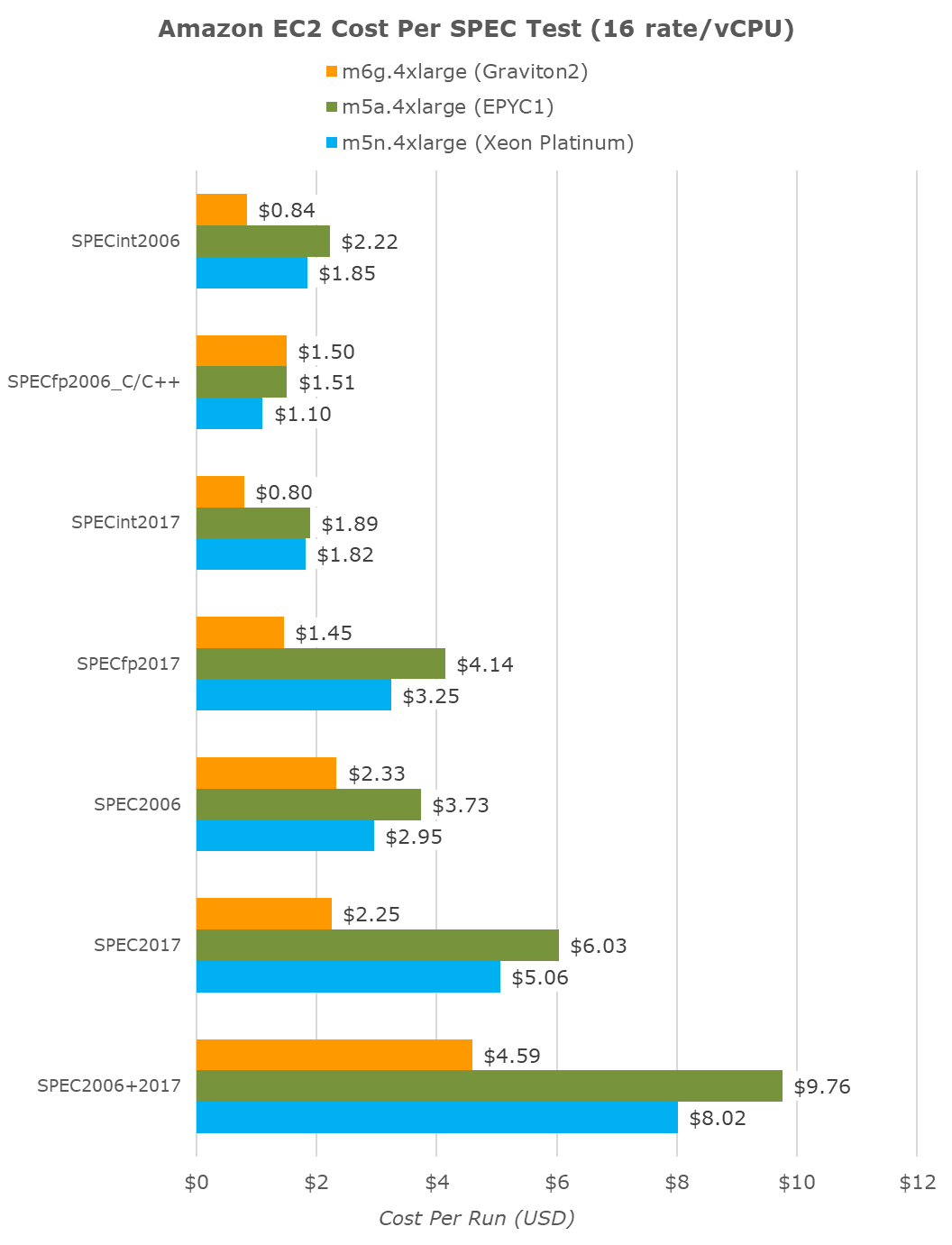
If we were to compare the same fixed workload at smaller instance counts, because of Graviton2’s better per-thread performance, we’re seeing even better results on 4xlarge (16 vCPUs) instances. Here the Amazon chip showcases 43% better value than the Xeon chip, and beats the AMD instances by being 53% cheaper.
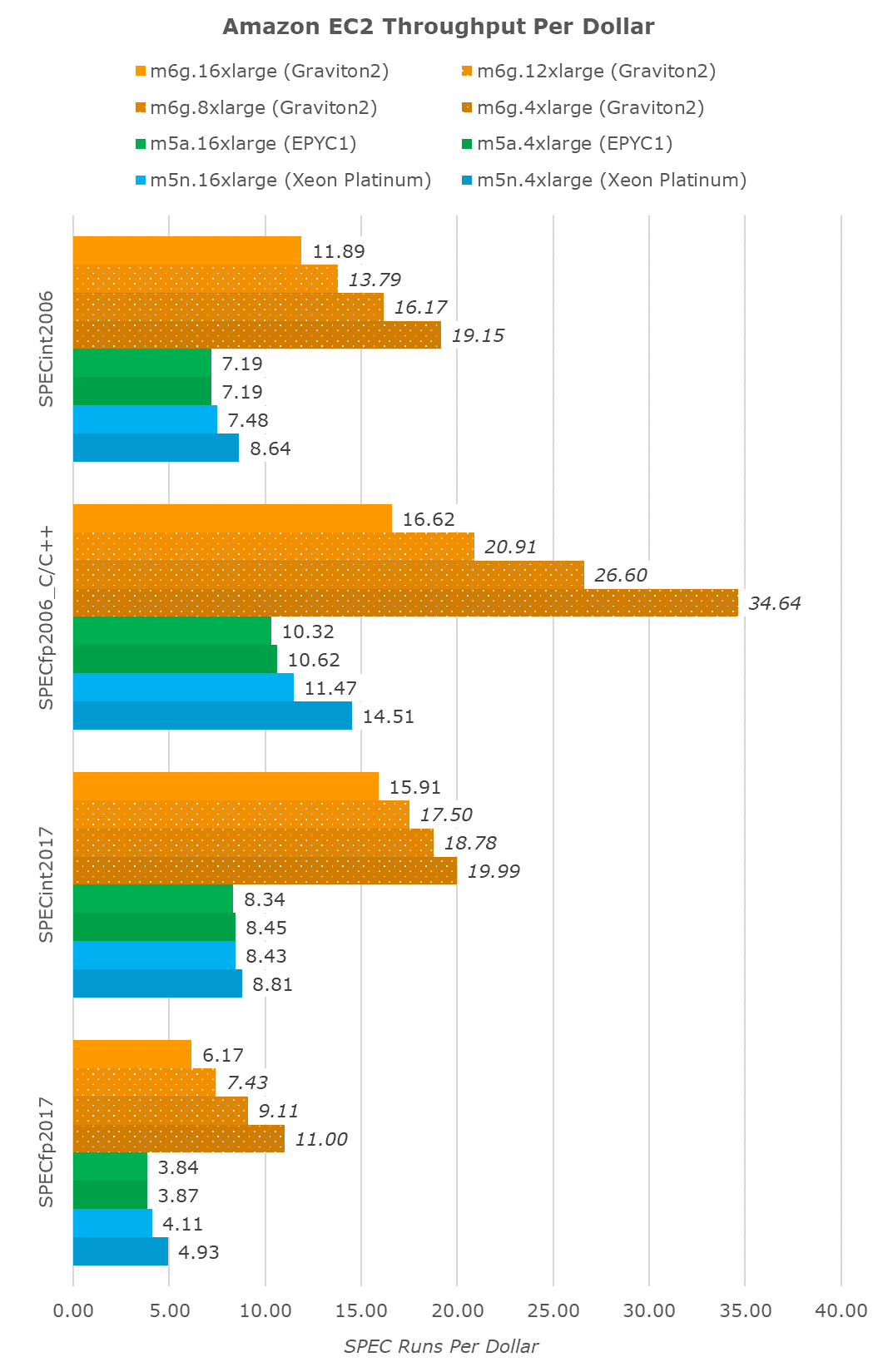
If we were to transform the results into a fixed throughput per dollar metric, we again see the Graviton2 far ahead. The unit here is SPEC runs per dollar.
The lower the vCPU instance size, the better value the Graviton2 seemingly becomes, as its performance with increased vCPUs scales sublinearly, but the cost of bigger vCPU instances scales linearly, an effect that’s almost not present at all in the AMD system, and only marginally present in the Xeon instances.
Again, the Graviton2’s scaling here might differ in production instances, but given that you can’t just chop off half the chip (or have access to only one of two sockets, in Intel’s case here) and that Amazon seemingly isn’t doing any static partitioning of the chip’s shared resources, I do think it’s more likely than not that such performance and value figures will be encountered in the real-world.
Even ignoring the lower vCPU instances, Amazon was able to deliver on its promise of 40% better performance per dollar, and it’s a massive shakeup for the AWS and EC2 ecosystem.
Originally published at https://www.anandtech.com/show/15578/cloud-clash-amazon-graviton2-arm-against-intel-and-amd (Wayback Machine).