
Amazon's Arm-based Graviton2 Against AMD and Intel: Comparing Cloud Compute
Compiler Setup, GCC vs LLVM
For further performance testing of the systems, we fell back to SPEC2006 and 2017. I wanted to make sure that there’s no heated discussions when it comes to the compilation of the test suites, so carefully investigated the compilers out there, particularly regarding the choice between GCC and LLVM.
Overall, I checked three different compiler setups: A freshly compiled GCC 9.2.0 release, Arm’s Allinea Studio Compiler 20 package which comes with both Arm’s closed source LLVM and Flang variants as well as a pre-compiled version of GCC 9.2.0, and Marvell’s branch of LLVM and Flang.
We had seen quite a push by Arm for us to consider GCC more closely than LLVM, as Arm had admitted that they’ve spent more time upstream optimising GCC than they’ve had for LLVM. Given the much more prevalent use of GCC in cloud and datacentre applications, I did somewhat agree with this given that’s most likely what you’ll see people use in such environments.
I ran some single-threaded tests across the different compiler setups, the compiler flags were straightforward with just a simple -Ofast flag as well as -march/-mcpu=cortex-a76 or =neoverse-n1 (alias) for the Arm compiler setup.
As always, our SPEC results aren't officially submitted results, and thus we have to label them merely as "estimates" for this article. Furthermore, SPEC2006 has been retired in favour of SPEC2017, but I still wanted to put up the figures for historical context, as well as mobile comparisons.
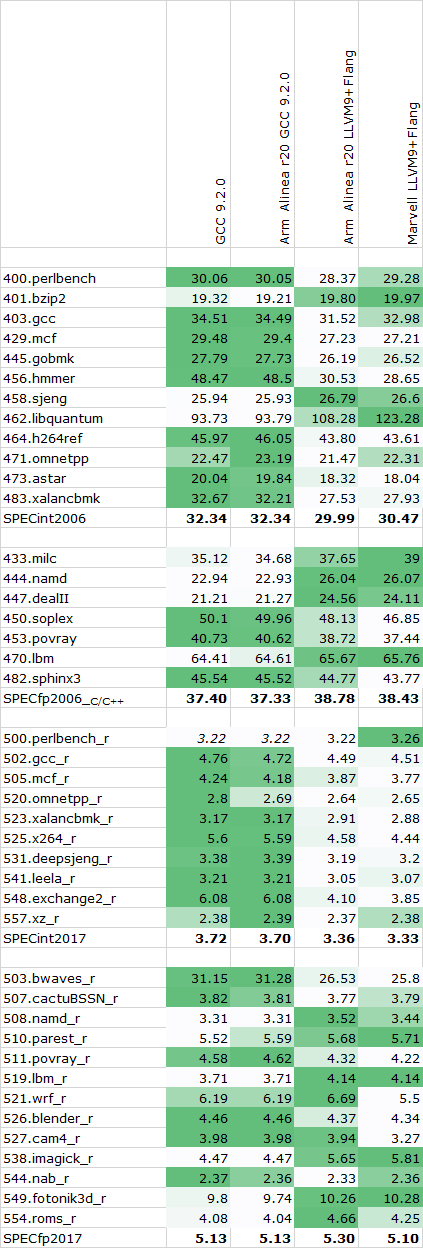
Graviton2 SPEC - Single Threaded - 2.5GHz
The overall results favour GCC in the SPECint workloads, while LLVM seemingly does better in the FP and memory heavy tests. Between the upstream GCC 9.2.0 and Arm’s precompiled version there’s seemingly no performance difference whatsoever, while there is some minor difference between Marvell’s setup and Arm’s branch of LLVM.
I ended up going forward with a clean compile of GCC 9.2.0 both for the Arm as well as x86 systems – meaning we’re using the exact same compiler for both architectures, just with different compile targets.
For x86, we’re again using the simple -Ofast flag for optimisations, and using the corresponding -march/-mtune targets for the EPYC and Intel platforms, meaning zenver1 and skylake-avx512.
Overall, it’s a bit odd to see GCC ahead in that many workloads given that LLVM the is the primary compiler for billions of Arm devices in the mobile space. Arm has said that they’re trying to put more effort into this compiler as seemingly it’s lagging behind GCC in terms of some optimisations.
Originally published at https://www.anandtech.com/show/15578/cloud-clash-amazon-graviton2-arm-against-intel-and-amd (Wayback Machine).