
Intel NUC10i7FNH Frost Canyon Review: Hexa-Core NUC Delivers a Mixed Bag
Networking and Storage Performance
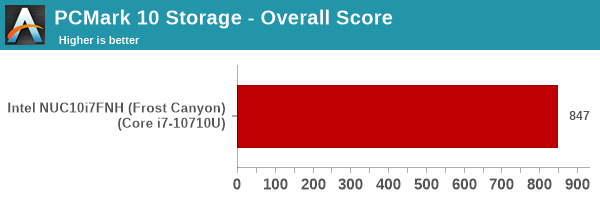
Networking and storage are two major aspects which influence our experience with any computing system. This section presents results from our evaluation of the storage aspect in the Intel NUC10i7FNH (Frost Canyon). One option would be repetition of our strenuous SSD review tests on the drive(s) in the PC. Fortunately, to avoid that overkill, PCMark 8 and PCMark 10 have storage benches where certain common workloads such as loading games and document processing are replayed on the target drive. Results are presented in two forms, one being a benchmark number and the other, a bandwidth figure.
We first ran the PCMark 8 storage bench on selected PCs and the results are presented below.
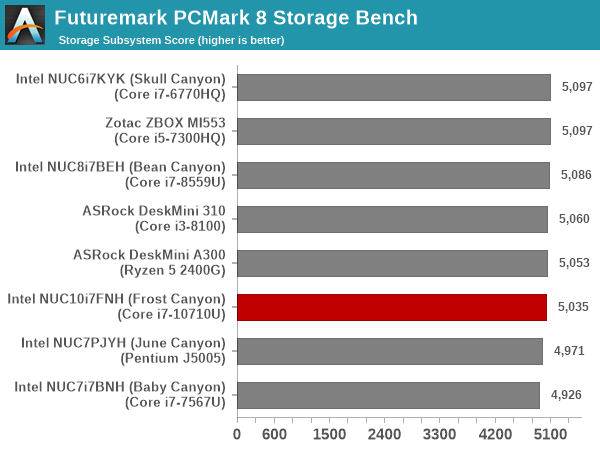
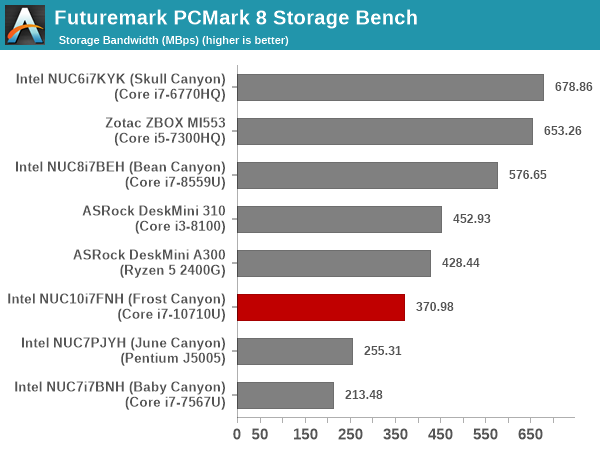
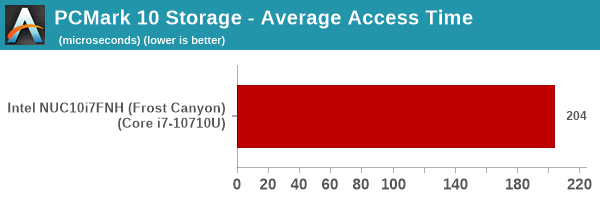
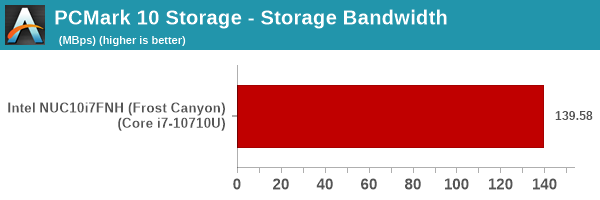
The PCIe 3.0 x2 SSD doesn't perform up to the mark when compared to the PCIe 3.0 x4 SSDs used in the other systems. However, it is still better than the SATA SSDs used in other systems. The Frost Canyon NUC is the first one in our SFF PC set to be subject to the PCMark 10 Storage Bench, and as such, we do not have any other systems to compare its average access time of 204 us and storage bandwidth of 139.58 MBps against.
On the networking side, we are yet to set up our 802.11 ax / Wi-Fi 6 testbed for small form-factor PCs, and hence, there are no bandwidth numbers to report yet. However, it must be noted that the Frost Canyon NUC is the first NUC to come with 802.11ax / Wi-Fi 6 support, and its theoretical maximum bandwidth of 2400 Mbps betters the 1733 Mbps offered by the Wireless-AC 9560 in the Bean Canyon NUC. The AX 201 WLAN component uses the CNVi capability in the Comet Lake-U SiP with only the radio being an external chip. The AX 201 has a 2x2 simultaneous dual-operation in 2.4 GHz and 5 GHz bands and also comes with support for 160 MHz-wide channels.
Originally published at https://www.anandtech.com/show/15571/intel-nuc10i7fnh-frost-canyon-review (Wayback Machine).