
Intel's Long Awaited BTX Form Factor
- Posted in
- Cases/Cooling/PSUs
BTX Cooling and Airflow Explained
We know the purpose of the BTX design and why each component is placed where it is, but the question is, will it work? Will a single CPU heatsink fan be able to effectively cool all of the critical components in a system? In our preview of BTX last year we explained the placement of each component as well as showed a top view of the heat paths in a BTX system. The CPU, Northbridge, Southbridge, and VGA card are all inline which creates a single path for air to flow and in one single direction, from front to back through the thermal module.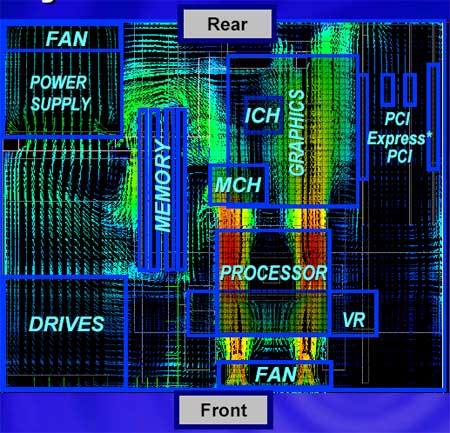
From the picture we see the flow of air pushed back through the CPU thermal module towards the Northbridge, Southbridge, and VGA card. As this air flows around the CPU, it warms up, as we can see from the red areas to the left and right of the CPU. This warm air then flows over the Northbridge and seems to cool as it travels further back in the chassis. At the left we see the channel of air flowing to the left over the memory and out through the PSU. The channel on the right flows straight back to the VGA card and out through groups of holes in the back of the case.
Intel will incorporate various other features that will help their CPUs perform at an efficient level no matter the conditions beginning with the Pentium 4 6xx series chips scheduled for Q1 of 2005. One feature is an enhanced version of their mobile processor SpeedStep technology called just that, Enhanced SpeedStep Technology; EIST or EST. EIST will allow the operating system to lower the CPU's power state during idleness which will reduce heat dissipation and power consumption. Another feature which will have a great effect on a system's thermal conditions as well as safety is the Thermal Management feature. This feature allows the CPU to immediately cut its clock speed to a fraction of its normal operating clock speed when the motherboard detects it is operating at temperatures out of the norm. There are a lot of Centrino-eque technologies at work here. The lessons learned from Pentium M have played heavily on system design as well as processor design.
So how will Intel's new BTX form factor affect third party manufacturers specializing in cooling equipment? The fact of the matter is that cooling hardware will always be required. We have seen in past ATX case reviews that no matter how many fans are in a case, a single 80mm fan at the front as an intake, or a set of six 80mm fans throughout a mid tower case, current hardware will operate under normal loads. Users, however, still prefer to spend their money on extra cooling equipment to get the most out of their systems. Intel has been bundling their heatsink fans with their CPU's since the beginning while third party manufacturers like Zalman and Thermaltake provide solutions for enthusiasts who prefer custom hardware. So the market for third part hardware will still be there for the BTX form factor as it has been for ATX.
Originally published at https://www.anandtech.com/show/1544 (Wayback Machine).