
Intel's Long Awaited BTX Form Factor
- Posted in
- Cases/Cooling/PSUs
Noise Testing ATX, BTX
Besides the thermal advantages Intel claims BTX to have over ATX, Intel also states that BTX systems will produce much lower sound levels then ATX systems. We can see this as being true since our BTX evaluation kit includes the AOpen B300 which has zero case fans. The only cooling equipment in this BTX system is the thermal module which adjusts its speed according to the overall temperature of the system and the power supply. In turn, the only hardware producing any sound in the system would be the thermal module and the power supply.As we measured the sound levels of the AOpen B300, we noticed that as the Pentium 550's temperature rose from 62 to 63 degrees, the fan speed increased from 1400rpm to 1700 rpm. We realized that the heat sink fan was overcompensating for the increase of 1 degree to bring the temperature back down to a stable level.
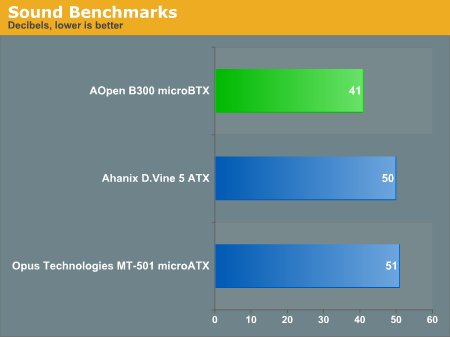
We see that the uBTX AOpen B300 combined with Intel's thermal module and FSP power supply produced an extremely quiet 41dB of sound compared to the ATX D.Vine 5 and uATX TT-501. The D.Vine 5 had dual 60mm fans at the back while the TT-501 actually had two 80mm fans at its rear that produced the extra 9-10dB along with the CPU heatsink fans and power supplies.
The low sound levels of the BTX system came at a price of slightly higher temperatures through the case. Is the point of BTX to eliminate case fans entirely or just reduce them to keep a positive balance between thermal and sound levels? If a 80mm or even a 60mm fan is placed at the back of the chassis directly in line with the CPU thermal module, the air flow will be increased having a greater cooling effect on the components while still keeping sound levels to a minimum.
Originally published at https://www.anandtech.com/show/1544 (Wayback Machine).