
The Microsoft Surface Laptop 3 Showdown: AMD's Ryzen Picasso vs. Intel's Ice Lake
- Posted in
- Laptops
- CPUs
- AMD
- Intel
- Microsoft
- Surface
- Ryzen
- Surface Laptop
- Ice Lake
- Sunny Cove
- Surface Laptop 3
- Picasso
Benchmark Analysis: Boost Behavior
Let’s dig into some of the testing to see how the systems responded during the benchmarks. We re-ran several of the tests while simultaneously monitoring the processor frequency, temperature, and power. Unfortunately for our comparison, the power polling results provided by our monitoring tools don’t seem to monitor the same power draw. The Intel power numbers are for the SoC package, but the AMD power numbers appear to be just the CPU cores, which is an unfortunate byproduct of testing two different platforms.
PCMark 10

PCMark 10 is a benchmark platform that attempts to simulate real-world tasks by running a variety of workflow, and the results were perhaps the most interesting of any of the benchmarks. There is a major discrepancy in how the AMD CPU behaved compared to the Intel. The Ice Lake platform kept the CPU frequency at a minimum of 3.5 GHz, with bursts to 3.9 GHz when under load. The Picasso processor was very aggressively switching from low frequency to high frequency, and was rarely indicating that it was over 3.0 GHz, but clearly demonstrating its higher peak frequency of 4.0 GHz in several locations. Both systems were fairly even in terms of CPU temperature, and Intel’s aggressive turbo levels were evident with peak power levels of 40 Watts for brief moments. The Ice Lake platform finished the benchmark about 200 seconds quicker than the Picasso system.
Cinebench R20 Single-Thread
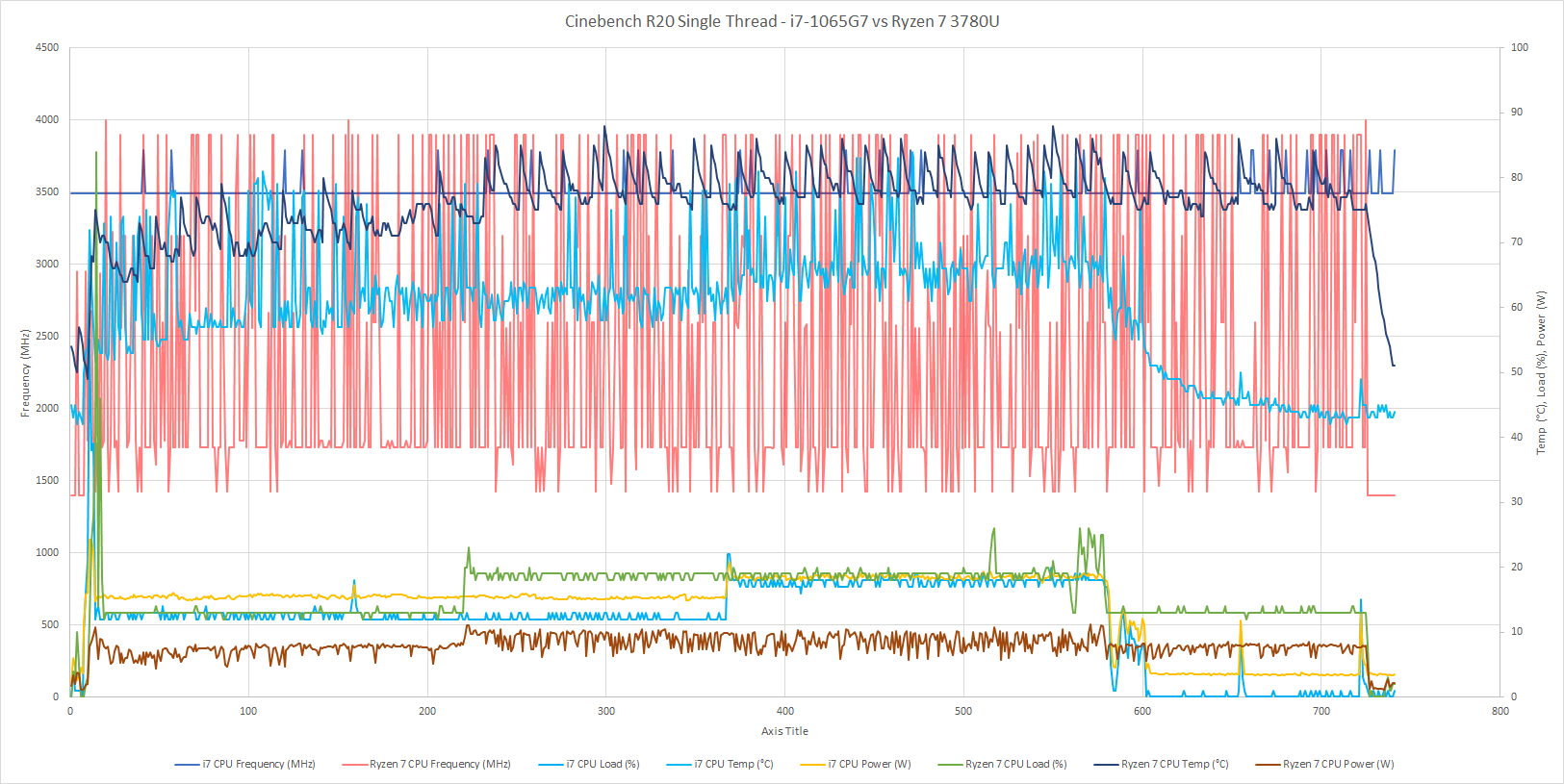
We see somewhat similar results when only a single CPU core is loaded with the Picasso CPU frequency varying quite a bit. There’s also an average higher temperature on the AMD platform during this workload, and once again Ice Lake finishes the rendering quite a bit sooner thanks to its stronger CPU cores.
Cinebench R20 Multi-Thread
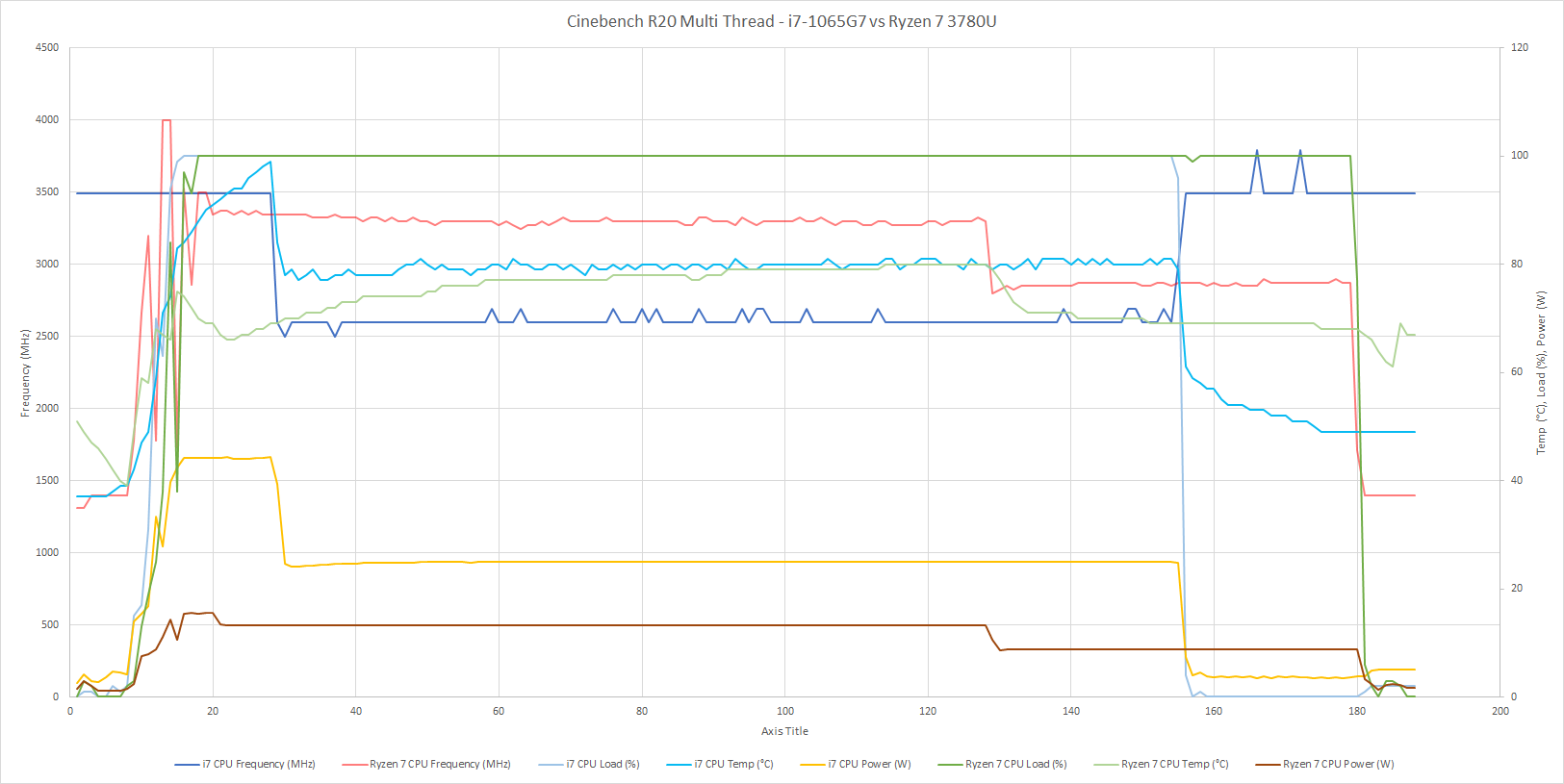
With all cores loaded the graph is considerably altered. Here the AMD processor is able to maintain a much higher frequency across its cores for much longer, while Intel's chip is only able to maintain 3.5 GHz for about 30 seconds before it runs out of headroom, dropping the cores down to around 2.6 GHz. But despite the lower frequency, the much higher IPC on Sunny Cove allows the Ice Lake platform to finish quite a bit sooner.
Originally published at https://www.anandtech.com/show/15213/the-microsoft-surface-laptop-3-showdown-amd-picasso-vs-intel-ice-lake (Wayback Machine).