
Intel and AMD in a Web Application Shoot-out
- Posted in
- IT Computing
Microsoft .NET
This was probably the most interesting test out of the bunch, as there was a recognizable difference in the two architectures. Our .NET test was run on the recently released FuseTalk .NET collaboration application.The .NET platform is the new framework for building Windows-based and web-based applications from Microsoft. It not only replaces the older ASP platform, but introduces some up-to-date languages that run on the Common Language Runtime, which is the backbone of .NET. The three main languages used with .NET are: C# (similar to C++), VB.NET (somewhat similar to VB), and J# (fairly close to JAVA). Whatever language in which you write your code, it is compiled into an intermediate language, CIL (Common Intermediate Language). It is then managed and executed by the CLR (Common Language Runtime).
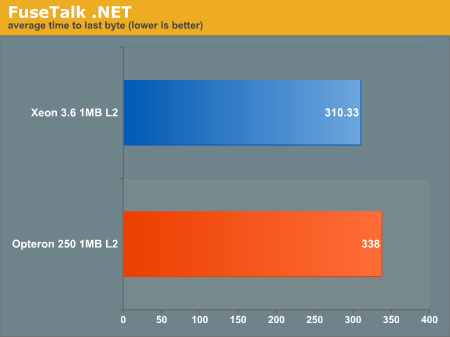
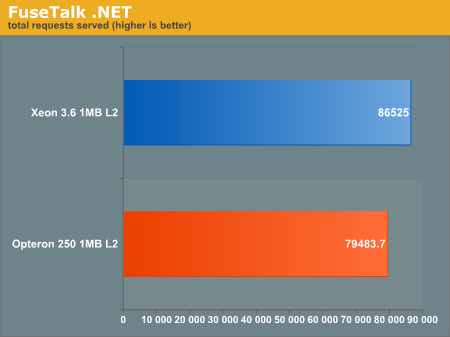
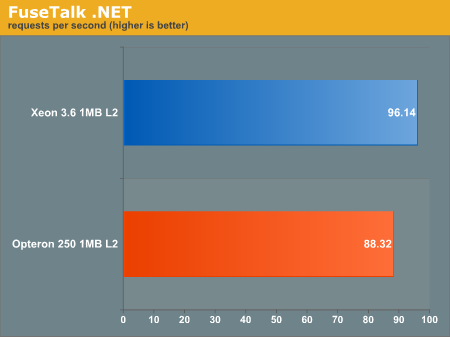
As you can see from the test results below, the Xeon managed to take the lead by approximately 8%. Why? Well, the one interesting piece of information that the .NET JIT (Just in Time) compiler takes into account during the compilation to native code is CPU architecture. According to a Microsoft MSDN article published by Allan McNaughton from Intel, the .NET JIT compiler takes CPU architecture into account during the last phase of compilation to native code. Specifically, during compilation, the JIT will detect Intel processors and produce code that takes advantage of Intel NetBurstTM and Hyper-Threading technology. With version 1.1 of the JIT compiler, Intel's Streaming SIMD Extensions 2 can also be a factor. At the time of publication, no information regarding any performance enhancing optimizations that occur for the AMD Opteron were found.
Conclusion
The results throughout much of these tests were a draw, right up until the Microsoft .NET tests. The Intel specific optimizations that the .NET compiler makes give Intel the advantage on Microsoft's platform, by a decent 8% margin. Your application server platform would now make an impact on which CPU architecture to choose. Obviously, on the .NET platform, Intel is the choice if you want the fastest there is. Because of the relationship that Intel has with Microsoft, it can only get better as the .NET framework matures. One could hope that Microsoft will work with AMD and get the JIT compiler to optimize for AMD's K8 architecture.Originally published at https://www.anandtech.com/show/1515 (Wayback Machine).