
The ADATA XPG SX6000 Pro 1TB SSD Review: Realtek's Entry-level NVMe Solution
Mixed Random Performance
Our test of mixed random reads and writes covers mixes varying from pure reads to pure writes at 10% increments. Each mix is tested for up to 1 minute or 32GB of data transferred. The test is conducted with a queue depth of 4, and is limited to a 64GB span of the drive. In between each mix, the drive is given idle time of up to one minute so that the overall duty cycle is 50%.

The DRAMless SSDs all perform poorly on the mixed random IO test, but the ADATA XPG SX6000 Pro is by far the fastest of them, and the only one that outperforms the Crucial MX500 mainstream SATA SSD. The Mushkin Helix-L manages to be slower than even the ADATA SU750 DRAMless SATA SSD.
 |
|||||||||
| Power Efficiency in MB/s/W | Average Power in W | ||||||||
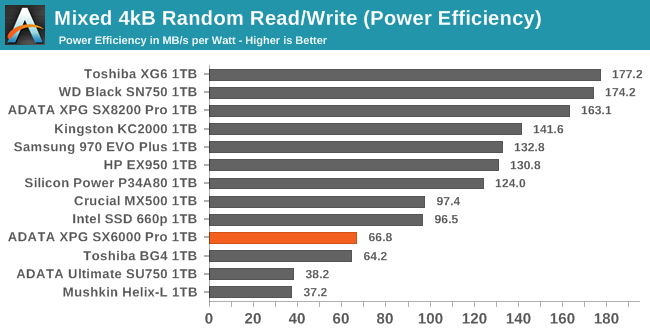
Unsurprisingly, the SX6000 Pro and other DRAMless SSDs turn in the worst power efficiency numbers for the mixed random IO test. Most of them don't draw all that much power, but they're so much slower than the high-end drives that their efficiency scores are several times smaller.
 |
|||||||||
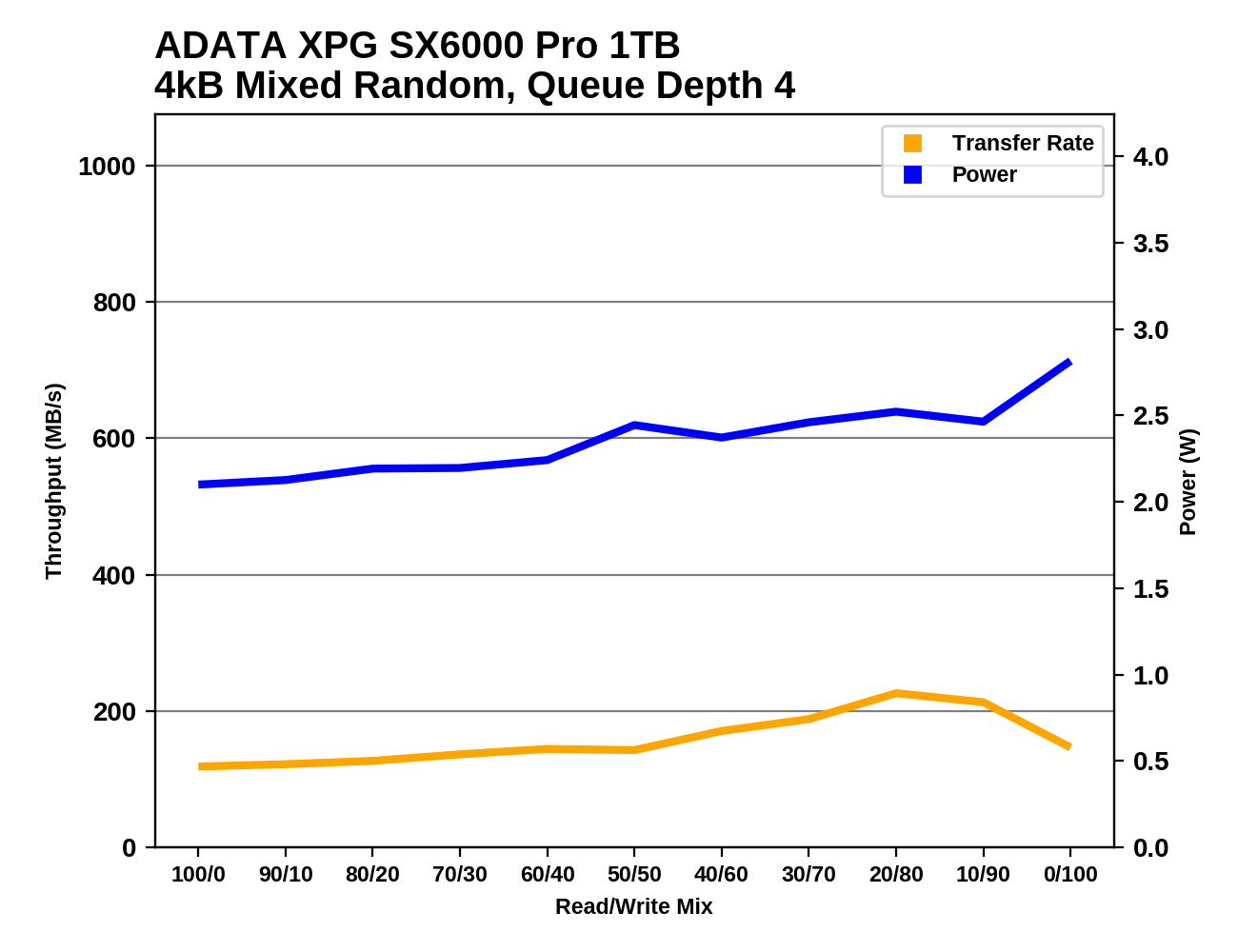
The performance of the SX6000 Pro grows slowly as the workload mix shifts from read-heavy to write-heavy. Toward the end, performance drops and power consumption spikes, indicating that the SLC cache ran out, but the SX6000 Pro almost made it to the end of the test without slowing down. The other DRAMless NVMe drives have fairly flat performance across the entire test, and definitely don't handle the write-heavy half anywhere near as well as the SX6000 Pro.
Mixed Sequential Performance
Our test of mixed sequential reads and writes differs from the mixed random I/O test by performing 128kB sequential accesses rather than 4kB accesses at random locations, and the sequential test is conducted at queue depth 1. The range of mixes tested is the same, and the timing and limits on data transfers are also the same as above.
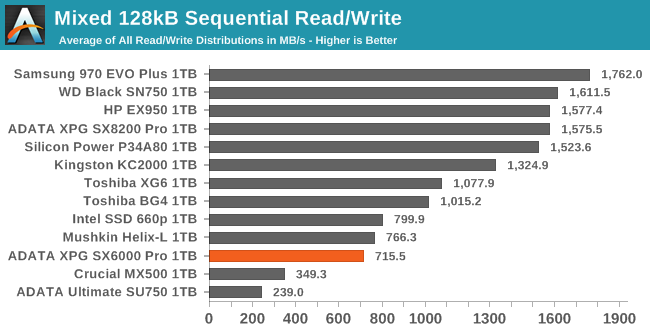
The ADATA XPG SX6000 Pro may have turned in respectable results for the individual sequential read and write tests, but on the mixed sequential IO test it is the slowest NVMe drive in the bunch.
 |
|||||||||
| Power Efficiency in MB/s/W | Average Power in W | ||||||||
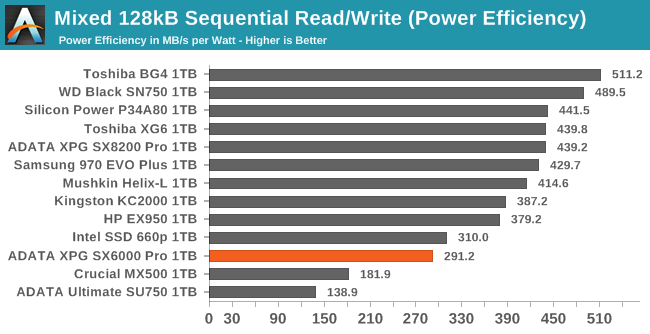
In addition to being at least a bit slower than competing low-end NVMe drives, the SX6000 Pro draws substantially more power than the other DRAMless SSDs, so it has a relatively low efficiency score while the Toshiba BG4 tops the charts and the Mushkin Helix-L scores about par.
 |
|||||||||
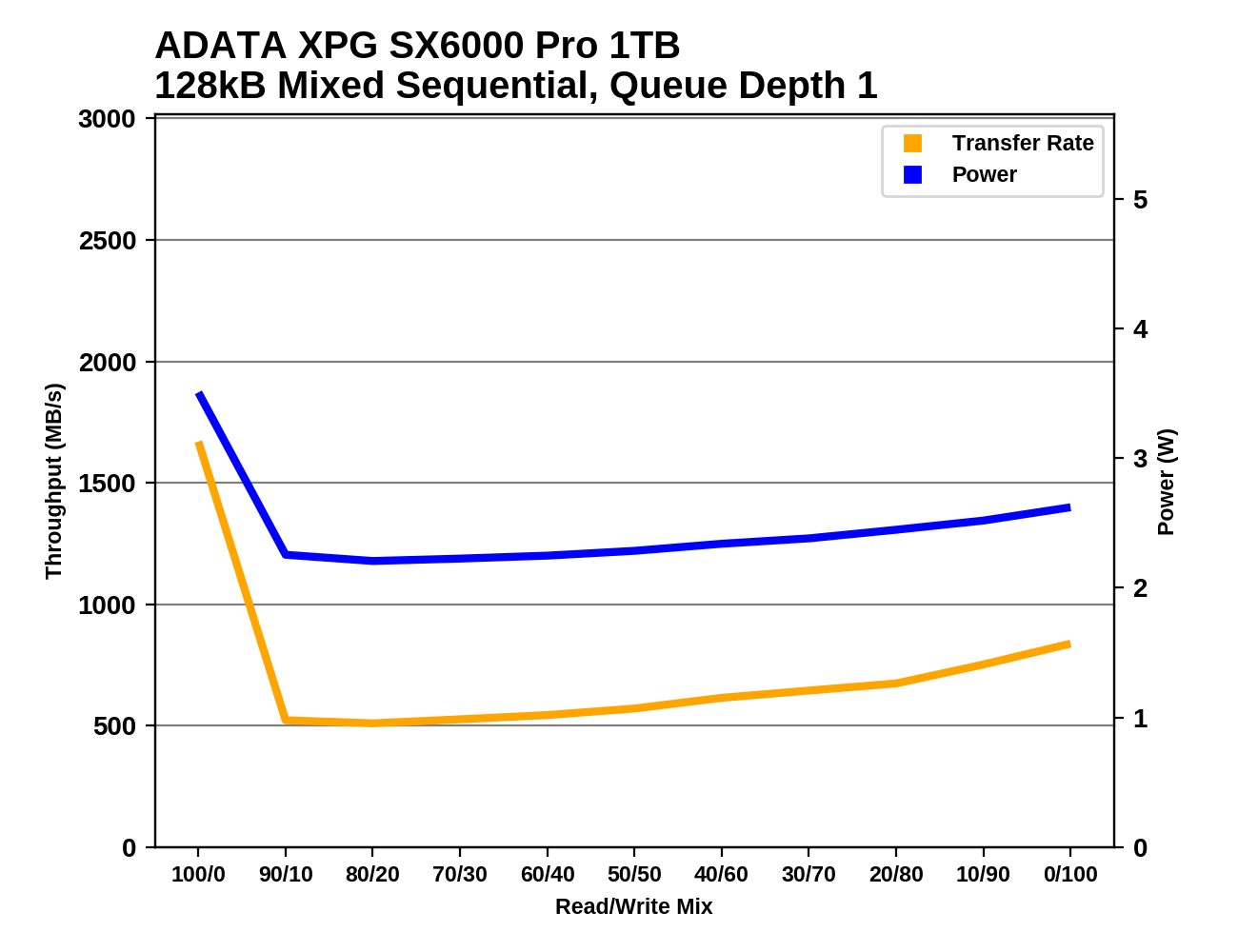
The sequential read speed of the SX6000 Pro is fine, but performance drops steeply as soon as any writes are added to the mix. Through the rest of the mixed sequential IO test, performance increases very slowly, and the SX6000 Pro doesn't get the typical performance spike at the end when the workload shifts to pure writes.
Originally published at https://www.anandtech.com/show/15139/the-adata-xpg-sx6000-pro-1tb-ssd-review (Wayback Machine).