
The ADATA Ultimate SU750 1TB SSD Review: Realtek Does Storage, Part 1
Mixed Random Performance
Our test of mixed random reads and writes covers mixes varying from pure reads to pure writes at 10% increments. Each mix is tested for up to 1 minute or 32GB of data transferred. The test is conducted with a queue depth of 4, and is limited to a 64GB span of the drive. In between each mix, the drive is given idle time of up to one minute so that the overall duty cycle is 50%.
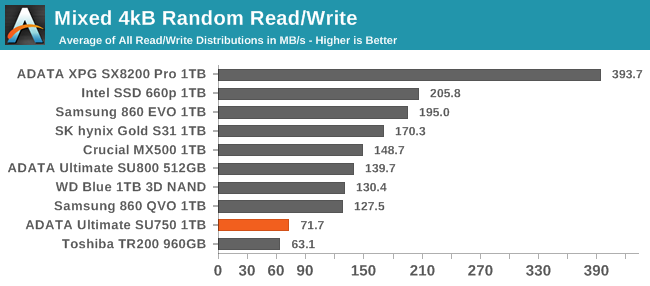
The two DRAMless SSDs have the worst overall performance on the mixed random IO test. The ADATA Ultimate SU750 comes out a bit ahead of the Toshiba TR200, but it's still roughly half the performance of a mainstream SATA drive with a DRAM cache.
 |
|||||||||
| Power Efficiency in MB/s/W | Average Power in W | ||||||||
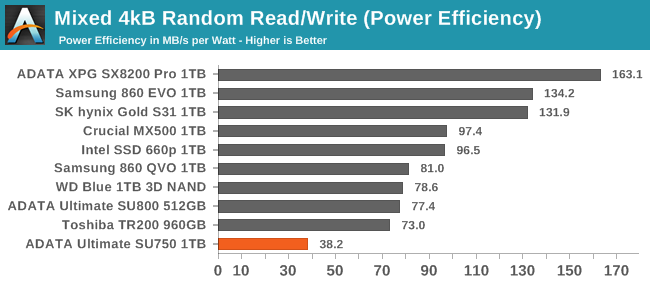
The SU750 has by far the worst power efficiency score on the mixed random IO test. It's again the most power-hungry SATA drive, while the somewhat slower Toshiba TR200 stands out with remarkably low power consumption that keeps its efficiency score close to the mainstream SATA drives.
 |
|||||||||
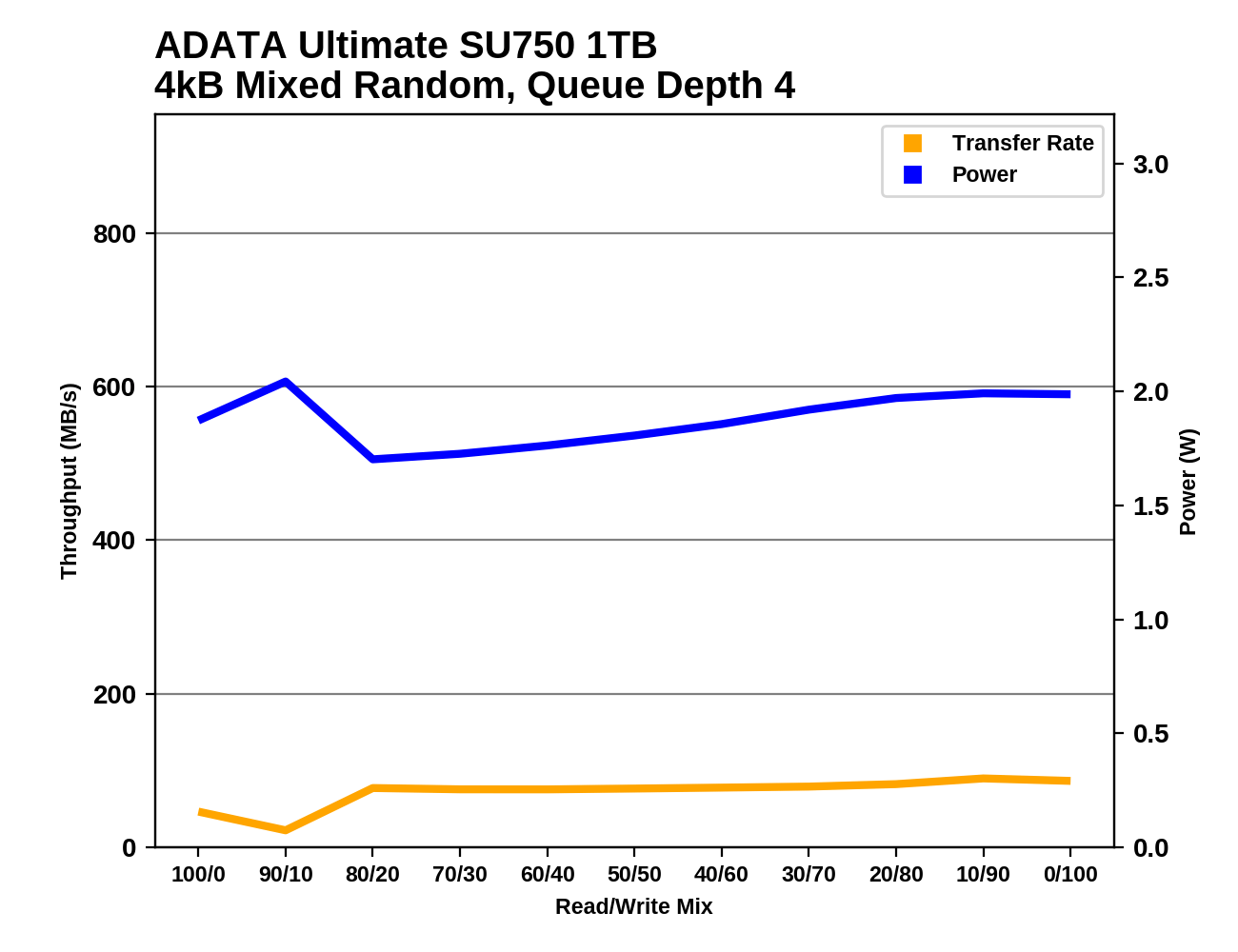
The performance of the SU750 takes a hit when writes are first introduced to the mix, but it recovers and then some for the 80/20 read/write mix. After that, performance is pretty flat where most SSDs steadily pick up the pace as the workload becomes more write-heavy. There's a power consumption spike during the 90/10 phase that is similar to what we saw during the random read test, likely indicating another bout of poorly-timed background work by the controller.
Mixed Sequential Performance
Our test of mixed sequential reads and writes differs from the mixed random I/O test by performing 128kB sequential accesses rather than 4kB accesses at random locations, and the sequential test is conducted at queue depth 1. The range of mixes tested is the same, and the timing and limits on data transfers are also the same as above.
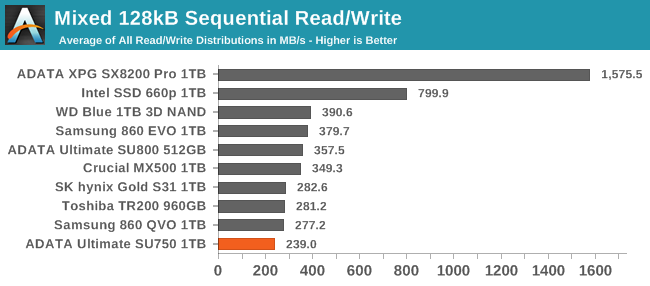
The ADATA Ultimate SU750 is the slowest drive on the mixed sequential IO test, coming in at about 15% slower overall than the other two entry-level drives (and the SK Hynix Gold S31).
 |
|||||||||
| Power Efficiency in MB/s/W | Average Power in W | ||||||||
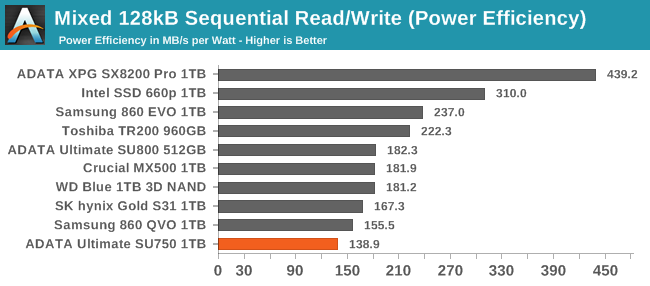
Likewise, the power efficiency of the SU750 is in last place, but not by a huge margin like it was for random IO. Total power consumption by the SU750 is actually a bit below average, but not as low as it ought to be for this level of performance.
 |
|||||||||
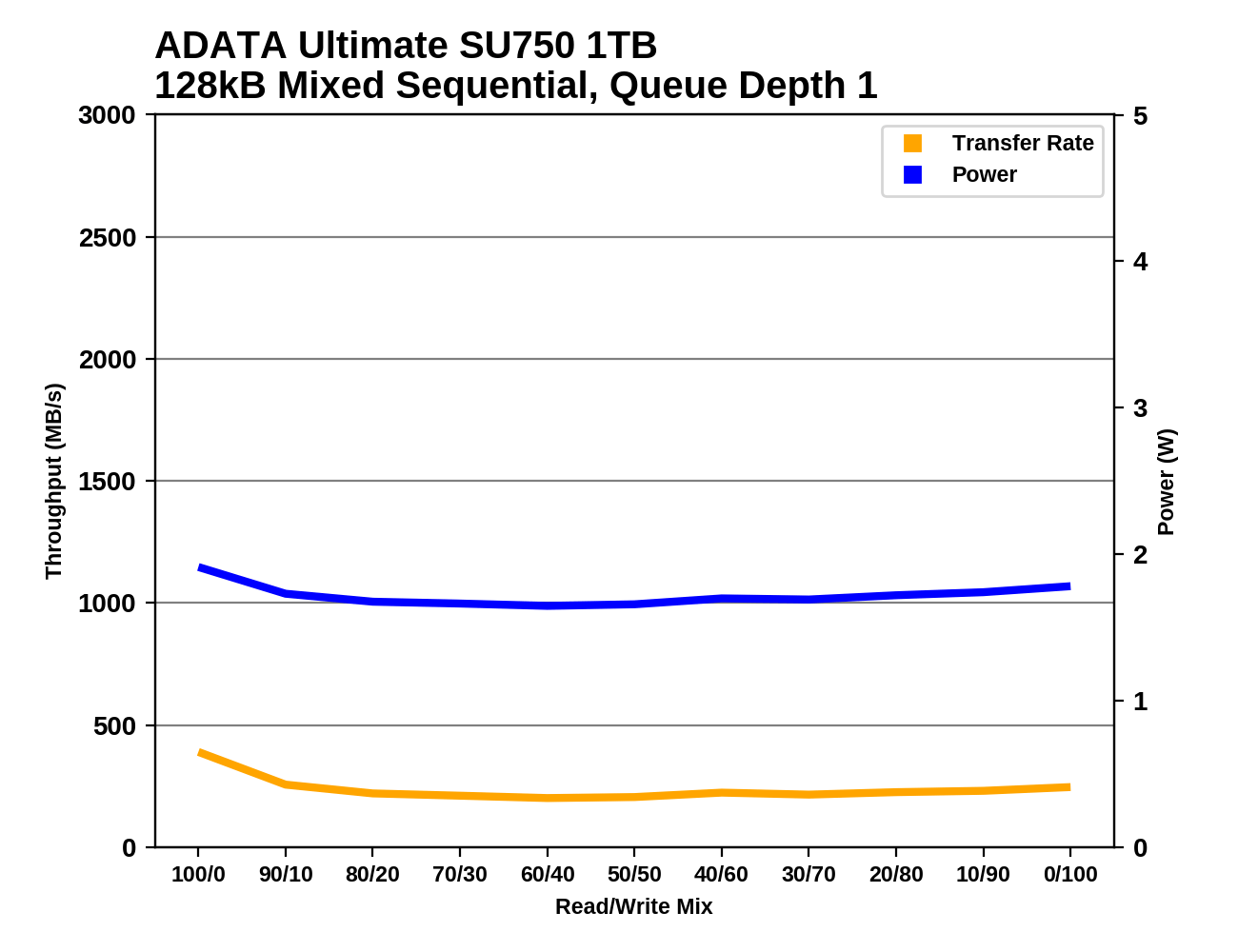
The SU750's performance trend through the mixed sequential IO test is fairly typical for a low-end drive: it loses performance during the early phases as writes are added to the mix, and doesn't really gain it back later on. The Toshiba TR200 and SK Hynix Gold S31 both show very similar performance curves that are consistently a bit faster the the SU750, but the TR200 is always drawing much less power.
Originally published at https://www.anandtech.com/show/15138/the-adata-ultimate-su750-1tb-ssd-review (Wayback Machine).