
The ADATA Ultimate SU750 1TB SSD Review: Realtek Does Storage, Part 1
Whole-Drive Fill
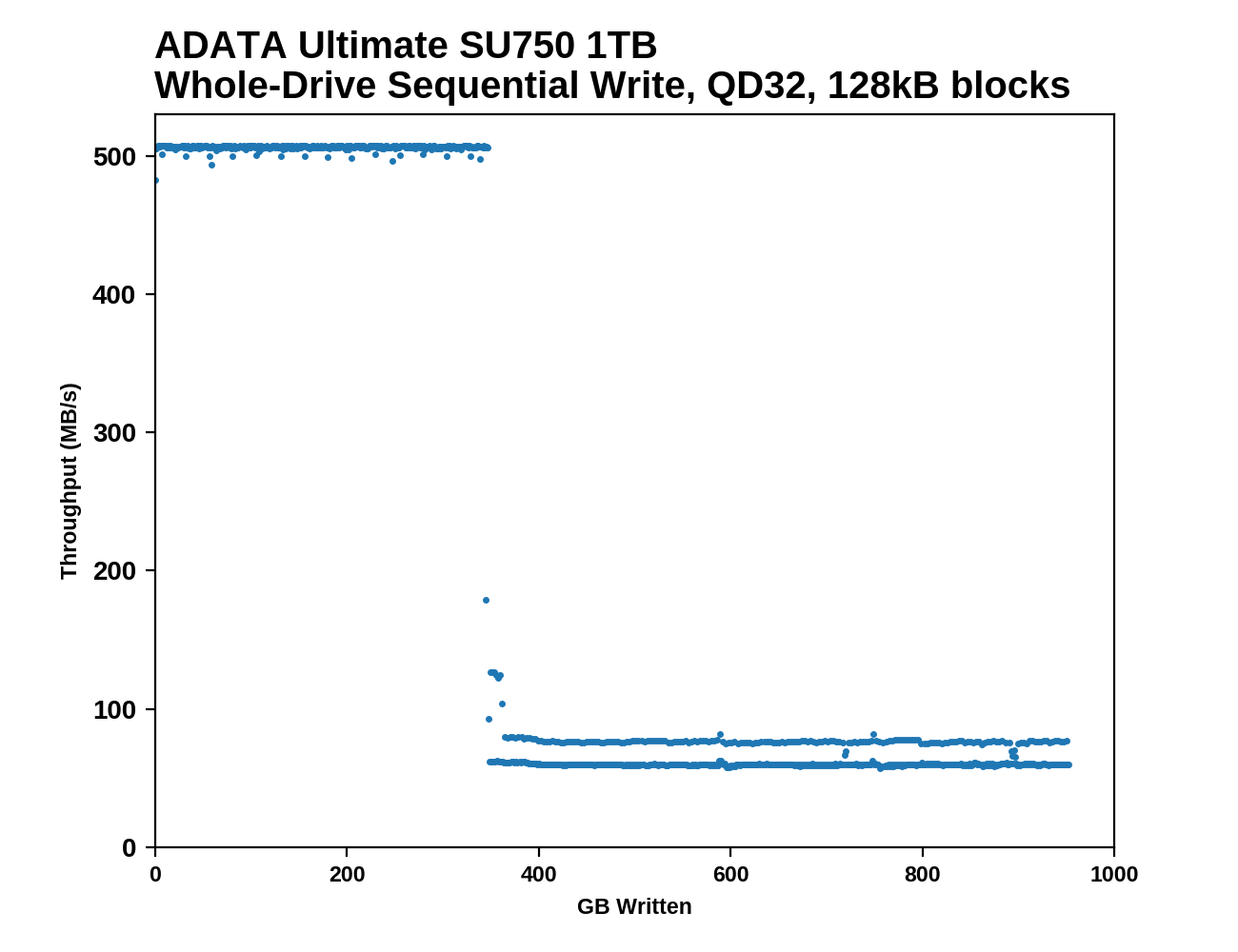
This test starts with a freshly-erased drive and fills it with 128kB sequential writes at queue depth 32, recording the write speed for each 1GB segment. This test is not representative of any ordinary client/consumer usage pattern, but it does allow us to observe transitions in the drive's behavior as it fills up. This can allow us to estimate the size of any SLC write cache, and get a sense for how much performance remains on the rare occasions where real-world usage keeps writing data after filling the cache.
 |
|||||||||
The SLC write cache on the 1TB ADATA SU750 is quite large, lasting for about 345GB of sequential writes before performance drops down to QLC-like speeds. In both phases, the performance is very consistent, and the transition when the SLC cache fills up is abrupt.
 |
|||||||||
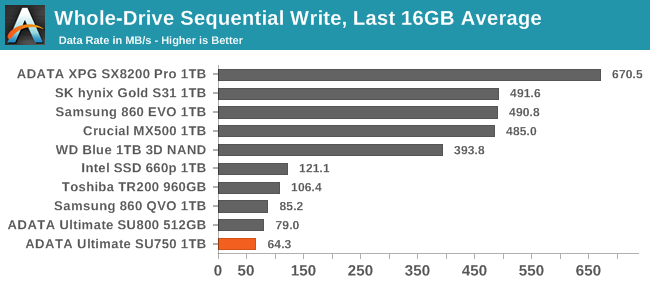
| Average Throughput for last 16 GB | Overall Average Throughput | ||||||||
The post-cache write speed of the SU750 is actually even slower than the QLC-based Samsung 860 QVO, but the much larger cache on the SU750 means its overall average write speed across the entire drive filling process is slightly faster.
Working Set Size
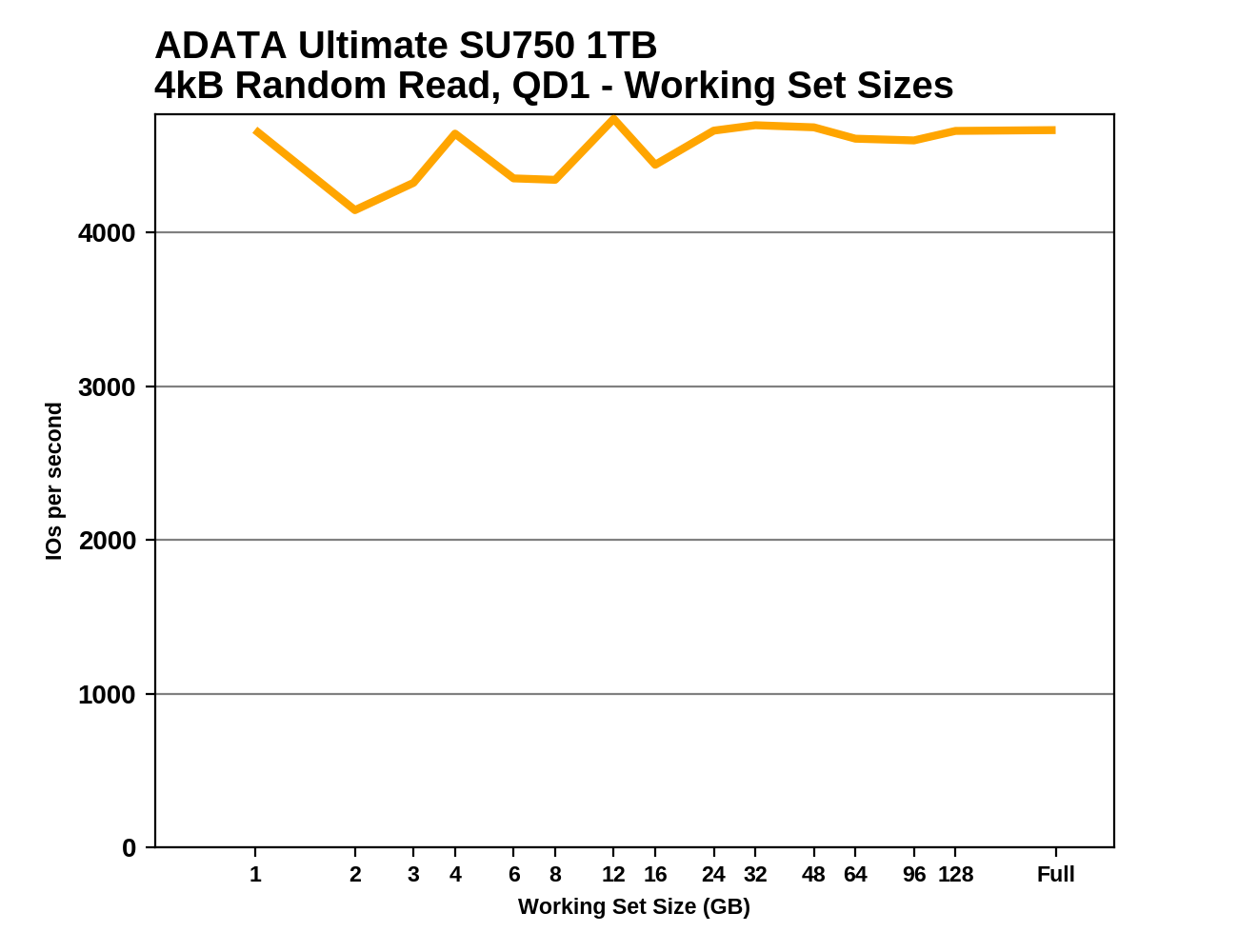
When DRAMless SSDs are under consideration, it can be instructive to look at how performance is affected by working set size: how large a portion of the drive is being touched by the test. Drives with full-sized DRAM caches are typically able to maintain about the same random read performance whether reading from a narrow slice of the drive or reading from the whole thing. DRAMless SSDs often show a clear dropoff when the working set size grows too large for the mapping information to be kept in the controller's small on-chip buffers.
 |
|||||||||
The QD1 random read performance of the SU750 is fairly low regardless of the working set size. There's no clear indication of performance being affected by the size of the controller's caches for mapping information. Even when the random reads are confined to a mere 1GB slice of the drive, performance is no better than when reading from the entire drive. The Intel 660p is the only drive in this bunch that does show a clear performance drop, caused by it having a 256MB DRAM cache instead of the more typical 1GB for a 1TB drive.
Originally published at https://www.anandtech.com/show/15138/the-adata-ultimate-su750-1tb-ssd-review (Wayback Machine).