
The SK Hynix Gold S31 SATA SSD Review: Hynix 3D NAND Finally Shows Up
Whole-Drive Fill
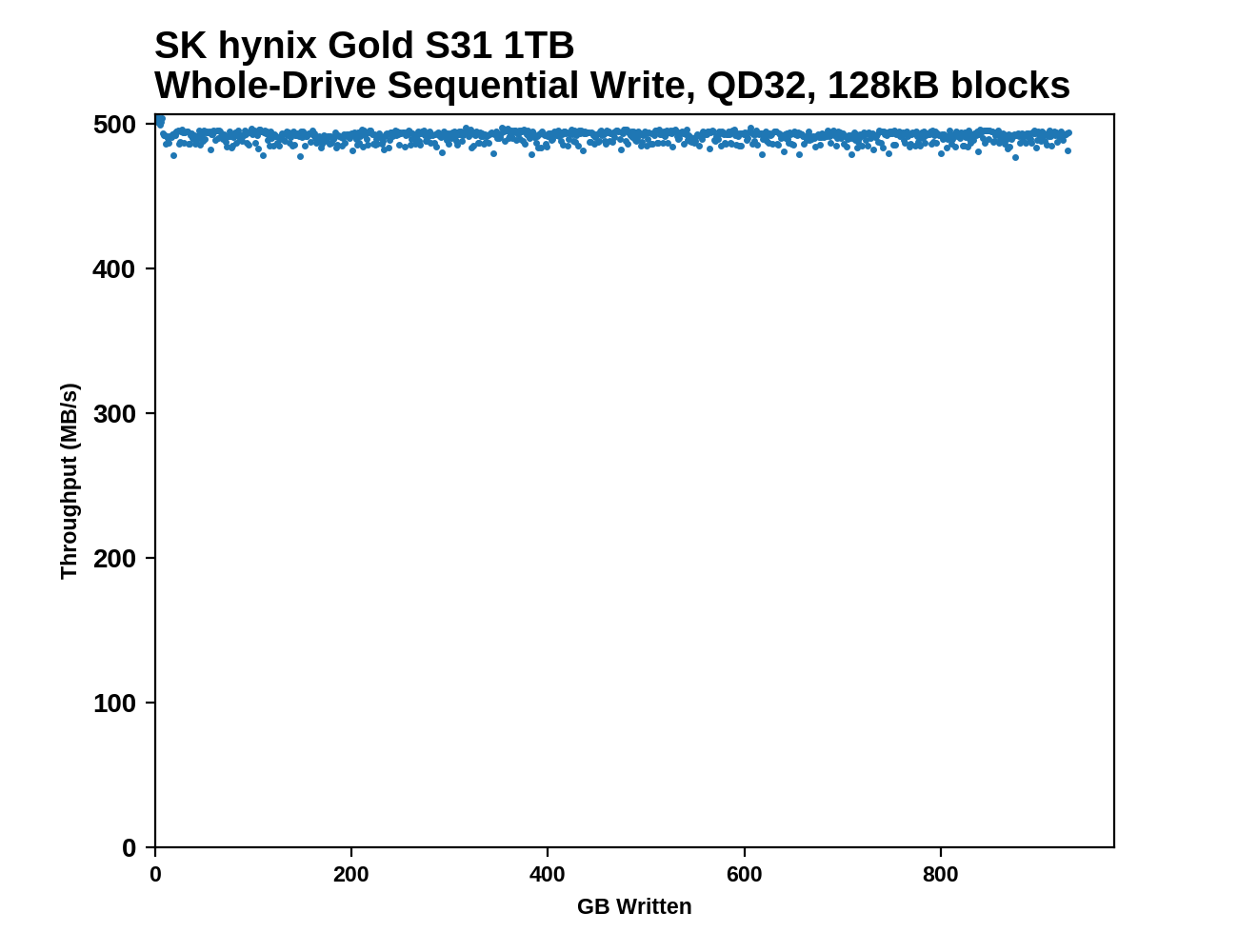
This test starts with a freshly-erased drive and fills it with 128kB sequential writes at a queue depth of 32, whilst recording the write speed for each 1GB segment. This test is not representative of any ordinary client/consumer usage pattern, but it does allow us to observe transitions in the drive's behavior as it fills up. This can allow us to estimate the size of any SLC write cache, and get a sense for how much performance remains on the rare occasions where real-world usage keeps writing data after filling the cache.
 |
|||||||||
The SK Hynix Gold S31 drives seem to have relatively small SLC cache sizes: a bit less than 4GB for the 250GB model, and around 8GB for the 500GB and 1TB models. The 1TB model barely loses any speed after the cache fills up, but the smaller two are significantly slower once the cache runs out. The 250GB S31 is also a few percent slower even at the beginning when writing to its SLC cache, but it's still pretty close to saturating the SATA link. All three S31s show very consistent sequential write speeds after the cache is full, with no long-term drift in performance and minimal short-term variation.
 |
|||||||||
| Average Throughput for last 16 GB | Overall Average Throughput | ||||||||
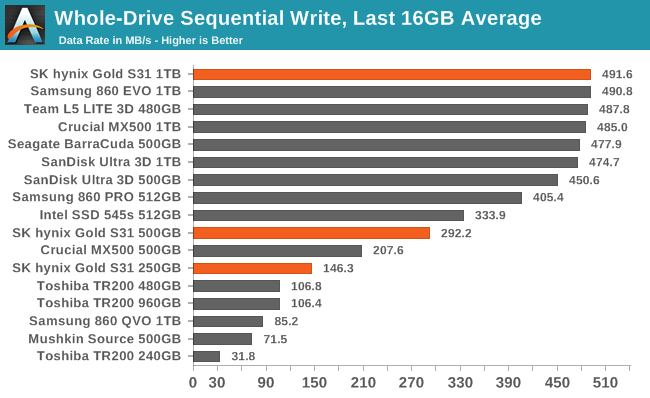
The 1TB S31's post-SLC performance is as good as any other mainstream SATA drive, but the sustained performance from the two smaller models is a bit on the slow side. Most of the competition in this space uses 256Gb TLC dies, but the Hynix drives are all making due with fewer 512Gb modules, consequently having less parallelism to work with. Even so, the smallest S31 is still clearly faster than the DRAMless or QLC-based drives.
Originally published at https://www.anandtech.com/show/15076/the-sk-hynix-gold-s31-sata-ssd-review (Wayback Machine).