
Microsoft's Portable Media Center Devices: Exposed
- Posted in
- Smartphones
- Mobile
Getting Sidetracked: Shuttle's new MCE XPC - The Perfect Testbed
Since we wanted to test the new Portable Media Center devices on a Windows XP Media Center Edition system, this was the perfect opportunity to try out Shuttle's latest and greatest XPC - the SB83G5C.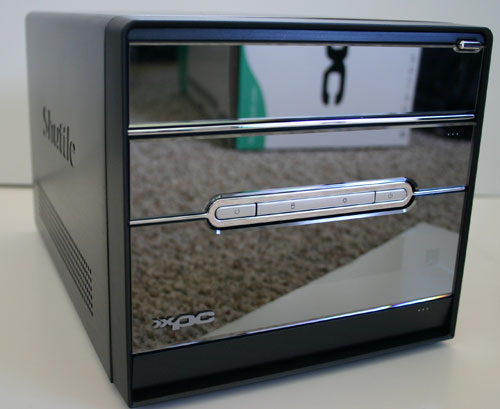
The new G5 chassis is much improved from previous Shuttle designs, yet still maintains the form factor and beauties that made the XPC so popular. This particular model has a LCD display at the front that interfaces to MCE2004 to display date/time as well as playback information.
The G5 8300 series uses Intel's 915G chipset and supports all of Intel's Socket-775 processors. While our particular sample relied on the 915G's integrated graphics, Shuttle usually ships their XPCs with a PCI Express GeForce 6600 to make it more of a gaming powerhouse. Remember that by using the 915G chipset, there is no AGP slot on the motherboard, only a single PCI Express slot in addition to the regular 32-bit PCI slot. And as with all Shuttle XPCs, the system can only support a single slot graphics card.
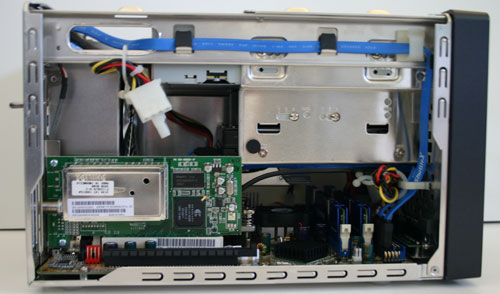
The system has a linearly controlled fan that remains quiet for the vast majority of the time; however, transcoding content for synchronizing to the PMC did cause things to heat up and the fan to spin faster/louder. Since the fan is linearly controlled, there are no noticeably discrete steps in fan speed. It gradually increases until the desired temperature has been reached.
The inside of the system is very clean and neat, thanks to Shuttle's clever engineering. There is virtually no cable clutter in the pre-assembled system due to the use of a proprietary Shuttle-designed interface to the front of the case and Serial ATA for both the hard drive and DVD drive.
Our test sample was paired with a Pentium 4 550 (Prescott running at 3.40GHz), which left the system's fan running fairly quiet despite its heat production. Given the extremely high CPU demands of Windows XP Media Center Edition, using such a fast processor is necessary to minimize the response time of the media center application. As to why MCE is such a CPU hog, that's more of a question for Microsoft - one to which we have yet to find an honest answer.
When it comes to MCE PCs, Shuttle has the right formula - these machines need to be small and they need to look like they fit in a living room. With the advent of the BTX form factor and with Windows XP MCE 2005 coming out, the competition is definitely looking towards more out-of-the-box designs for MCE PCs, putting the burden on Shuttle to once again innovate. What we're still waiting to see from Shuttle is another revolutionary design, similar in impact to what made the XPC what it is today - until then, we can't complain about the evolution that the design has seen since its creation.
Originally published at https://www.anandtech.com/show/1489 (Wayback Machine).