
Linux Desktop CPU Roundup: Cutting Edge Penguin Performance
- Posted in
- Linux
DDR2 versus DDR1
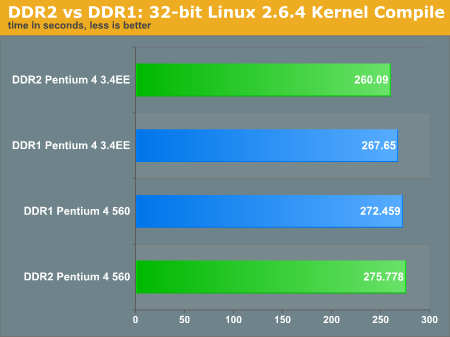
There are very few real-world benchmarks that completely demonstrate total memory bandwidth saturation. For real world applications, latency becomes critical - or at least logic dictates. Below, you can see what happens to our Intel processors when we run them on DDR2 and DDR1. We used the same low latency Mushkin PC-3200 (2-2-2) that we used for the AMD testbed as our DDR1 kit. Low latencies are something that DDR2 modules lack right now; and even though our Corsair XMS2 memory operates at ~675MHz, the timings are less than spectacular 4-4-4.Let's take a look at a kernel compile - a typical memory and CPU hog.
Below are the two different configurations of Intel processors running DDR1 and DDR2 during our Mental Ray 3.3.1 benchmark.
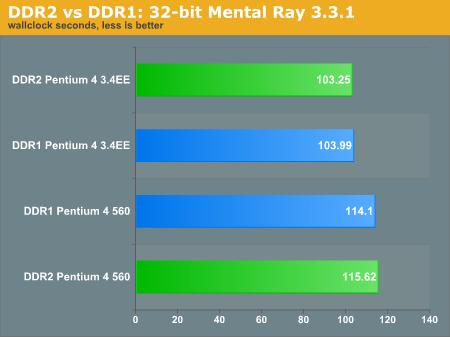
We are not really given a clear indication of which configuration runs better. The P4EE with DDR2 smidges past any other configuration, we expect more differentiation between the two. Let us look at some more content creation tests.
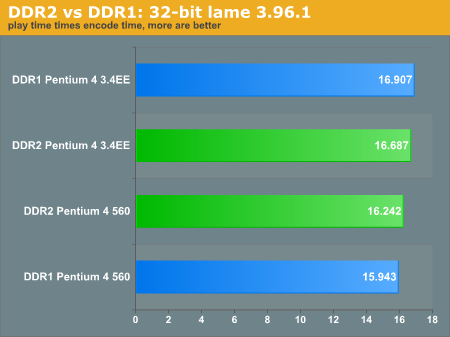
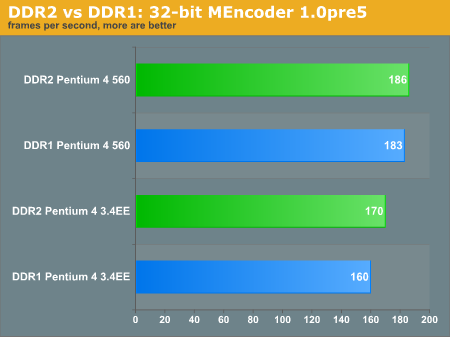
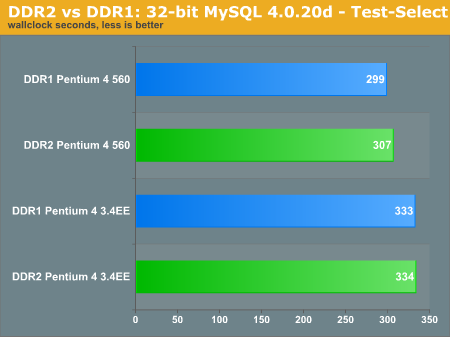
Notice that the MySQL test-select benchmark improves with DDR1 over DDR2. When we are making thousands of little queries to the database, we are relying more heavily on low latencies rather than the larger headroom of DDR2. However, consider our warning to take the sql-bench tests with a grain of salt. They do not entirely reflect SQL performance or workstation performance. The inconsistancy of which memory configuration from one benchmark to another definitely complicates issues. Price generally finishes the discussion for us.
Originally published at https://www.anandtech.com/show/1481 (Wayback Machine).