
AMD Rome Second Generation EPYC Review: 2x 64-core Benchmarked
Legacy: 7-zip
While standalone compression and decompression are not real world benchmarks (at least as far as servers go), servers have to perform these tasks as part of a larger role (e.g. database compression, website optimization). With that said, we suggest you take these benchmarks with a large grain of salt, as they are not really important in grand scheme of things. We still use 7zip 9.2, so you can compare with much older results.
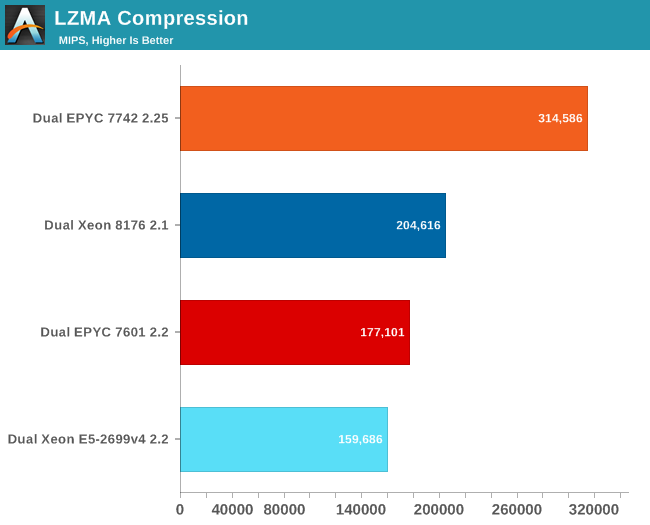
Compression on modern cores relies almost solely on cache, memory latency, and TLB efficiency. This is definitely not the ideal situation for AMD's EPYC CPU, but the EPYC 7742 scales very well, offering 77% higher performance than Naples. That is better than expected scaling.
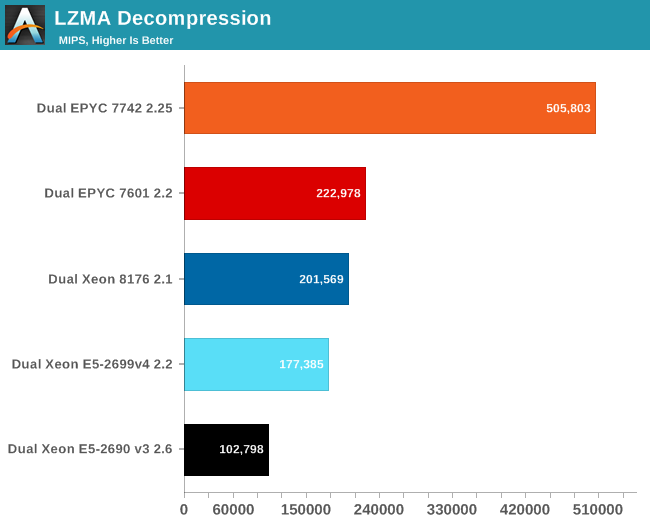
Decompression relies on less common integer instructions (shift, multiply). AMD's Zen2 core handles these instructions even better because doubling the cores results in no less than 127% (!) better performance.
Even though this benchmark is not that important, it is nevertheless impressive how AMD engineering made this graph look. Never have we seen AMD dominating benchmarks by such a wide margin.
Before people accuse us of choosing a benchmark that shows AMD in the best light, consider this benchmark as one of our synthetic tests more than anything else, designed to showcase core execution port potential. It is not really indicative of any real-world performance, but acts as a synthetic for those that have requested this data.
Originally published at https://www.anandtech.com/show/14694/amd-rome-epyc-2nd-gen (Wayback Machine).