
The Kingston KC2000 SSD Review: Bringing BiCS4 To Retail
Random Read Performance
Our first test of random read performance uses very short bursts of operations issued one at a time with no queuing. The drives are given enough idle time between bursts to yield an overall duty cycle of 20%, so thermal throttling is impossible. Each burst consists of a total of 32MB of 4kB random reads, from a 16GB span of the disk. The total data read is 1GB.
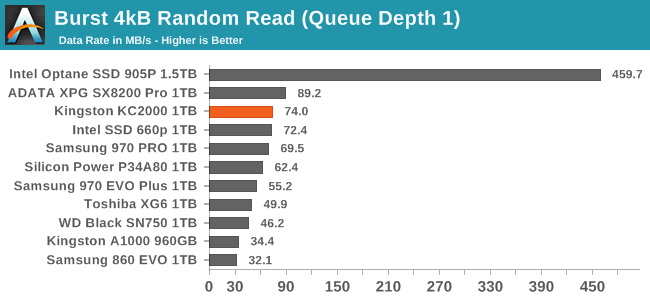
The Kingston KC2000 continues the trend of drives using Silicon Motion's NVMe controllers delivering top-notch burst random read performance, but the ADATA SX8200 Pro that uses Micron 64L TLC is still faster than the KC2000's 96L Toshiba NAND.
Our sustained random read performance is similar to the random read test from our 2015 test suite: queue depths from 1 to 32 are tested, and the average performance and power efficiency across QD1, QD2 and QD4 are reported as the primary scores. Each queue depth is tested for one minute or 32GB of data transferred, whichever is shorter. After each queue depth is tested, the drive is given up to one minute to cool off so that the higher queue depths are unlikely to be affected by accumulated heat build-up. The individual read operations are again 4kB, and cover a 64GB span of the drive.
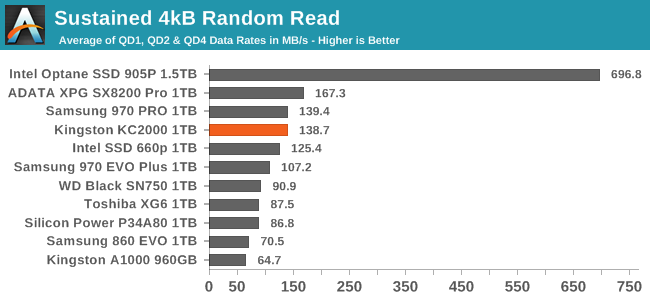
On the longer random read test, the Samsung 970 PRO catches up to the KC2000 but otherwise the rankings and spread of scores are similar to the burst random read results.
 |
|||||||||
| Power Efficiency in MB/s/W | Average Power in W | ||||||||
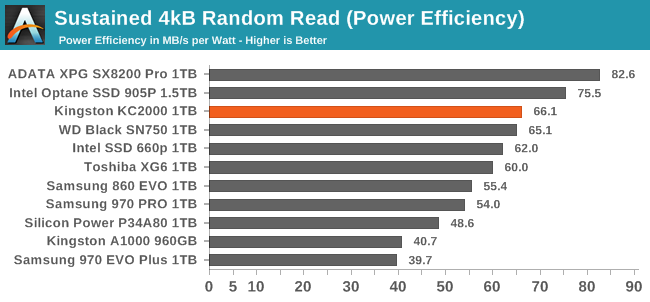
The KC2000 turns in an excellent power efficiency score for random reads, but is still outclassed by the ADATA SX8200 Pro. The KC2000 manages a slightly higher efficiency score than the WD Black SN750, which is quite a bit slower than the KC2000 on this test but also uses less power than any of the other NVMe drives in this bunch.
 |
|||||||||
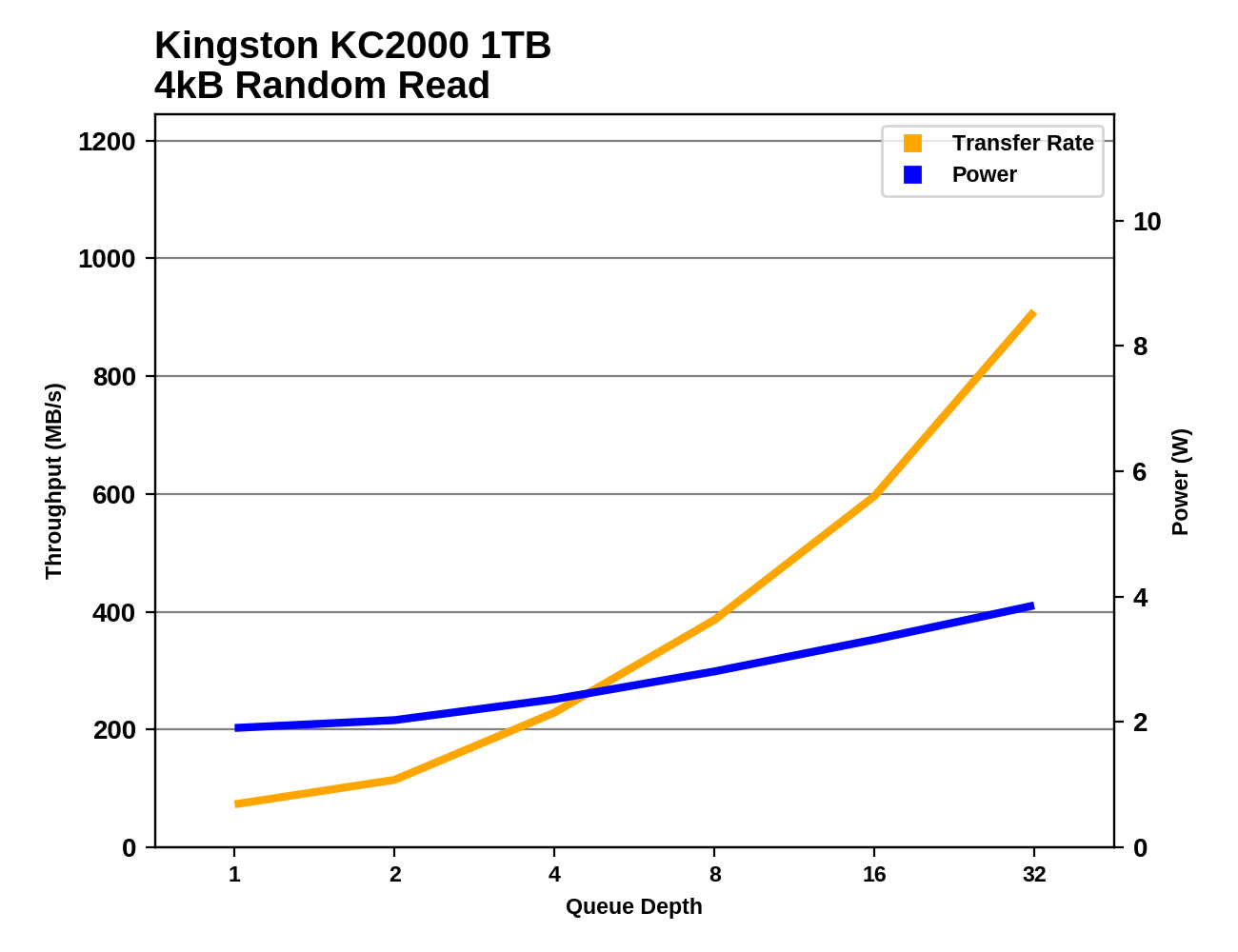
Several of the competing drives are able to eventually outperform the Kingston KC2000 for random reads, given a sufficiently high queue depth. The WD Black and Toshiba XG6 manage to do so while drawing much less power, so the KC2000's excellent efficiency score on this test only holds up at low queue depths.
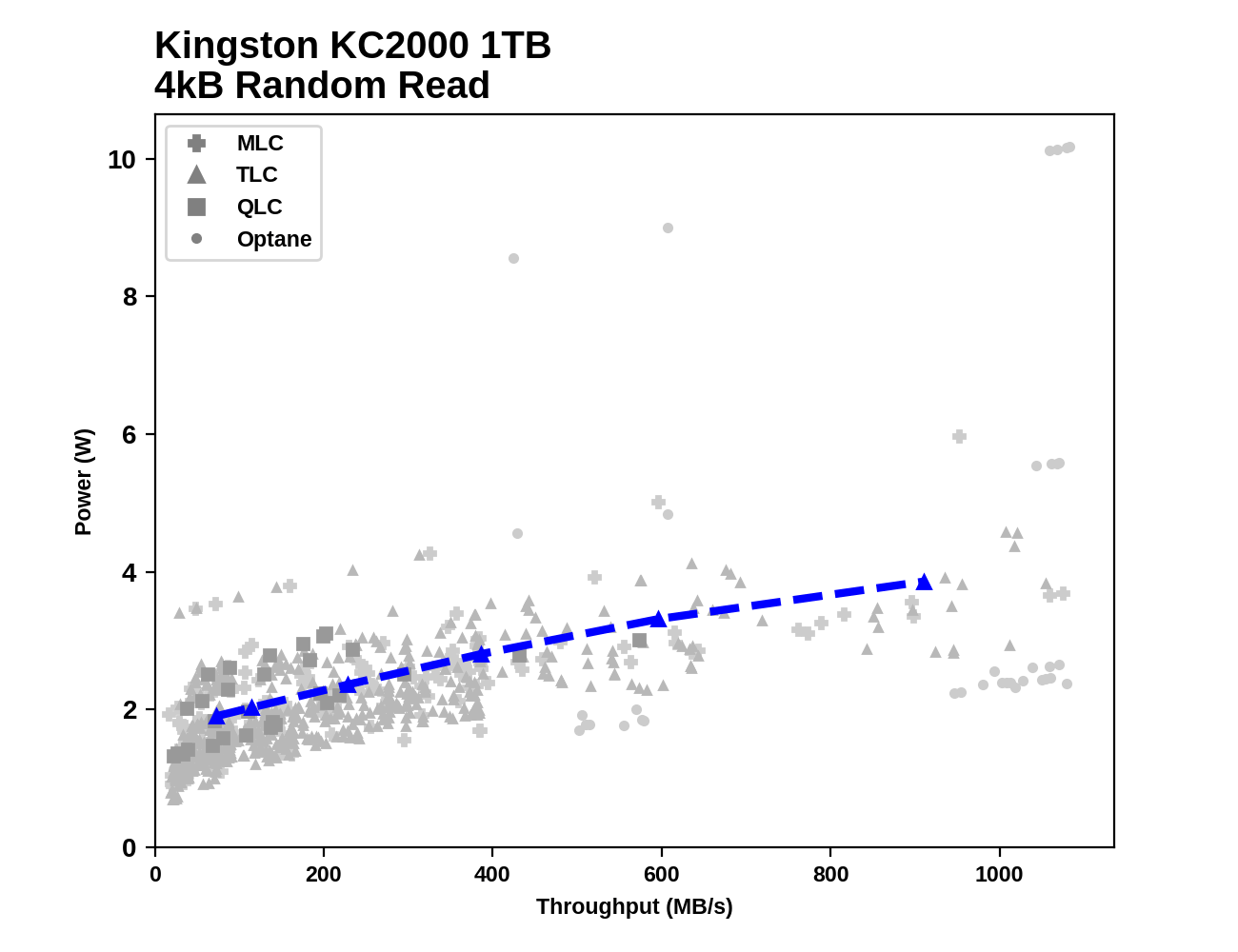
Comparing the KC2000's random read test results against our entire database of results shows that its peak peak performance is good but not quite up to the limits of what TLC drives can deliver, and the power consumption at higher queue depths is on the high side.
Random Write Performance
Our test of random write burst performance is structured similarly to the random read burst test, but each burst is only 4MB and the total test length is 128MB. The 4kB random write operations are distributed over a 16GB span of the drive, and the operations are issued one at a time with no queuing.
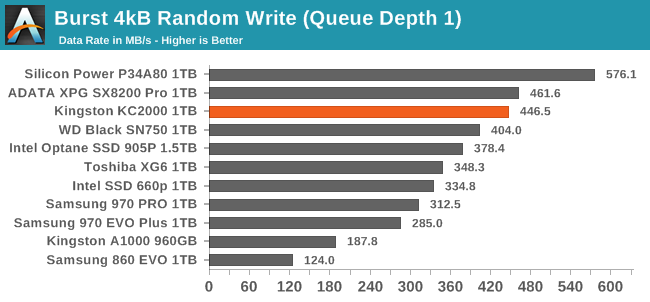
The burst random write performance of the Kingston KC2000 is pretty good, but is overshadowed by the Phison E12-based Silicon Power drive that has a wide lead over the rest of the high-end drives thanks to a very fast SLC write cache.
As with the sustained random read test, our sustained 4kB random write test runs for up to one minute or 32GB per queue depth, covering a 64GB span of the drive and giving the drive up to 1 minute of idle time between queue depths to allow for write caches to be flushed and for the drive to cool down.
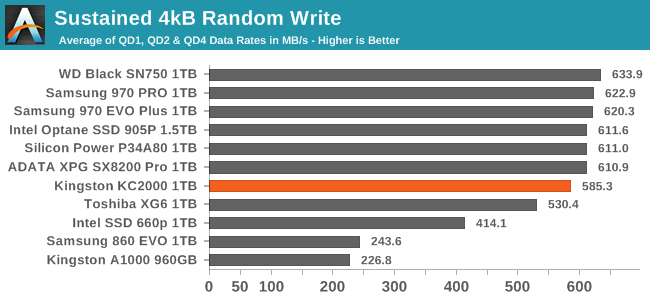
On the longer random write test, the KC2000 falls slightly behind most top NVMe drives but still performs very well.
 |
|||||||||
| Power Efficiency in MB/s/W | Average Power in W | ||||||||
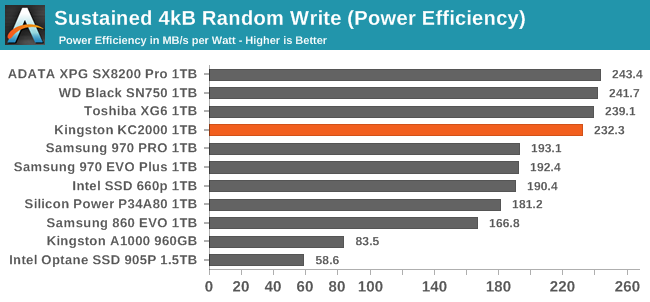
The power efficiency of the KC2000 during random writes is top tier, but drives with the same NAND and different controller or vice versa are slightly ahead of the KC2000.
 |
|||||||||
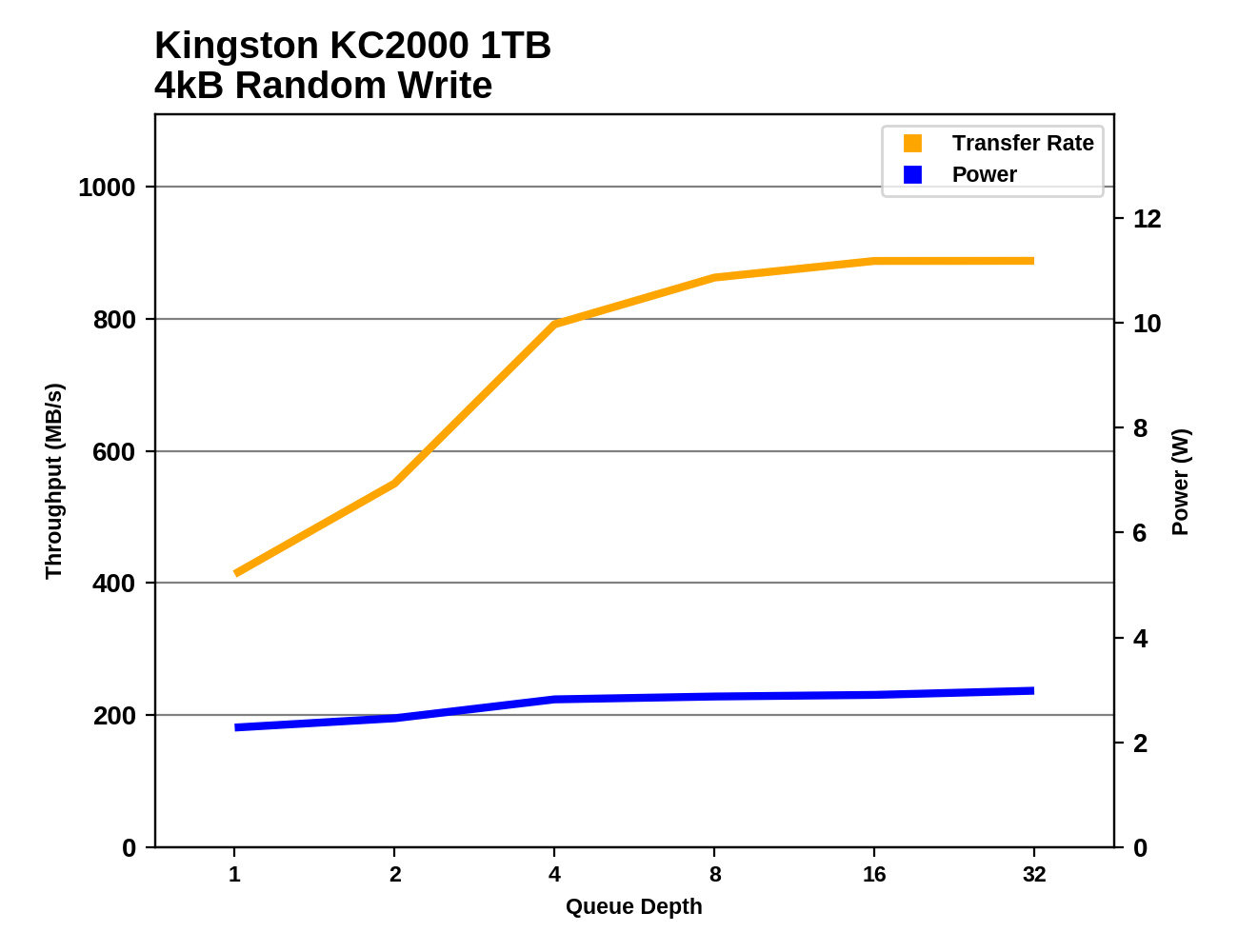
At queue depths of 4 or higher, the high-end drives offer roughly similar performance but power consumption varies significantly. Of the drives that match the power consumption of the KC2000, the ADATA SX8200 Pro is consistently a little bit faster, while the Toshiba XG6 underperforms at low QDs and surpasses the KC2000 at high queue depths.
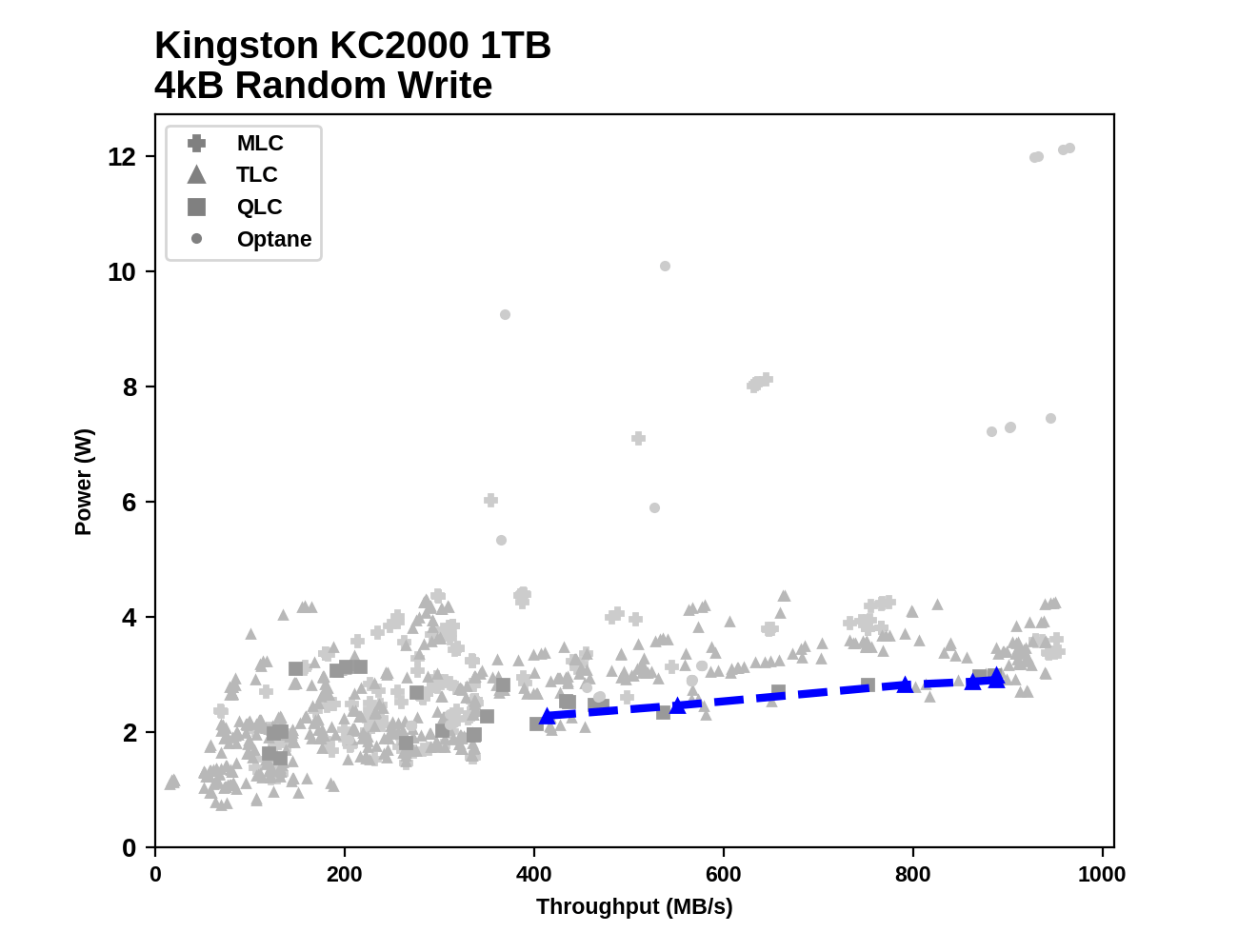
Comparing the KC2000's random write results against the entire database shows that the power efficiency of the KC2000 is quite good, with only a handful of scores from other drives offering similar performance at slightly lower power levels.
Originally published at https://www.anandtech.com/show/14601/the-kingston-kc2000-ssd-review (Wayback Machine).