
Intel's Xeon Cascade Lake vs. NVIDIA Turing: An Analysis in AI
SAP S&D
One last stop before we start with our data analytics/ML benchmarks: SAP. Enterprise Resource Planning software is the perfect example of "traditional" enterprise software.
The SAP S&D 2-Tier benchmark is probably the most real-world benchmark of all the server benchmarks done by the vendors. It is a full-blown application living on top of a heavy relational database.
We analyzed the SAP Benchmark in-depth in one of our earlier articles:
- Very parallel resulting in excellent scaling
- Low to medium IPC, mostly due to "branchy" code
- Somewhat limited by memory bandwidth
- Likes large caches (memory latency)
- Very sensitive to sync ("cache coherency") latency
There are lots of benchmarks result available from different vendors. To get a (more or less) apples-to-apples comparison, we limited ourselves to the "SAPS results" running on top of SQL Server 2012 Enterprise.
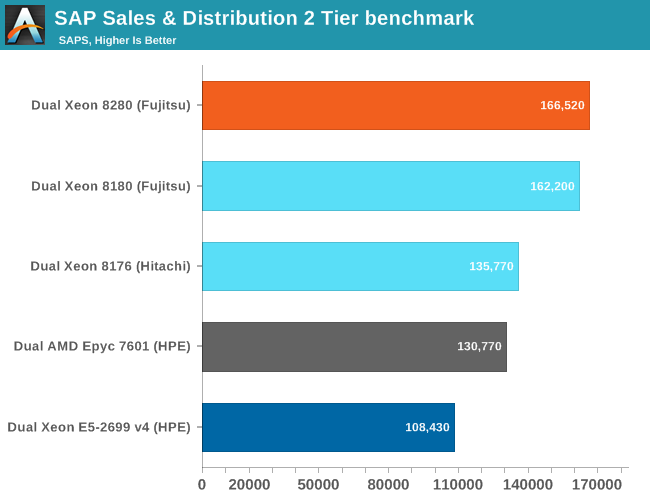
The Fujitsu benchmarks with the Xeon 8180 and 8280-based servers are as apples-to-apples as we can get: the same people who did the testing and tuning, the same OS and database. The slightly higher clocks (+200 Mhz, +8%) result in 3% higher performance. Both CPUs have 28 cores, but the 8280 has an 8% higher clockspeed, and in some senses it’s surprising that this bump in clockspeeds didn’t result in a larger performance increase. We get the impression that Cascade Lake might even be slightly slower clock per clock than Skylake, as both SPEC CPU benchmarks also increased by only three to five percent.
So in the typical enterprise stack, you’re looking at getting around 3% higher performance for the same price/energy consumption. However, AMD's much cheaper (ed: and soon to be updated) $4k EPYC 7601 is not that far behind. Considering that the EPYC is already within a margin of error of the twice as expensive 8176 (2.1 GHz, 28 cores), the 8276 with its slightly higher clockspeed (2.2 Ghz) does not significantly improve matters. Even the Xeon 8164 (26 cores at 2 GHz) offers about the same performance as the EPYC 7601, but still costs 50% more.
Considering how much progress AMD has made with the Zen 2 architecture, and the fact that the top SKUs will double the amount of cores (64 vs 32), it looks like AMD Rome will put even more pressure on Xeon sales.
Originally published at https://www.anandtech.com/show/14466/intel-xeon-cascade-lake-vs-nvidia-turing (Wayback Machine).