
Intel's Xeon Cascade Lake vs. NVIDIA Turing: An Analysis in AI
Analyzing Intel's Cascade Lake in the New Era of AI
Wrapping things up, let’s take stock of the second-generation Xeon Scalable’s performance, and what it brings to the table in terms of features. With Cascade Lake Intel has improved performance by 3 to 6%, improved security, fixed some incredibly important bugs/exploits, added some SIMD instructions, and improved the overall server platform. This is nothing earth shattering, but you get more for the same price and power envelope, so what’s not to like?
That would be fine 5 years ago, when AMD did not have anything like the Zen(2) architecture, ARM vendors were still struggling with cores that offered painfully slow single-threaded performance, and deep learning was in the early stages. But this is not 2014, when Intel outperformed the nearest competition by a factor 3! Ultimately Cascade Lake delivers in areas where CPUs – and only CPUs – do well. But even with Intel’s DL Boost efforts, it’s not enough if the new chips have to go head-to-head with a GPU in a task the latter doesn’t completely suck at.
The reality is that Intel's datacenter group is under tremendous pressure from all sides, and the numbers are showing it. For the first time in years, the datacenter experienced a revenue drop, despite the fact that the overall server market is growing.
It is been going on for a while, but as we’ve experienced firsthand, machine learning-based AI applications are being rolled out successfully, and they are a game changer for both software and hardware. As a result, future server CPU reviews will never quite be the same: it is not Intel versus AMD or even ARM anymore, but NVIDIA too. NVIDIA is extremely successful in the deep learning market, and they are confident enough to take on Intel in areas where Intel dominated for years: HPC, machine learning, and even data processing. NVIDIA is ready to accelerate a much larger part of the data pipeline and a wider range of AI applications.
Features found in Intel Cascade Lake like DL Boost (VNNI) are the first attempts by Intel to push back – to cut away at the massive advantage that NVIDIA has in inference performance. Meanwhile, the next Xeon – Cooper Lake – will try to get closer to NVIDIA in training performance.
Moving on, when we saw this slide, we were gasping for air.
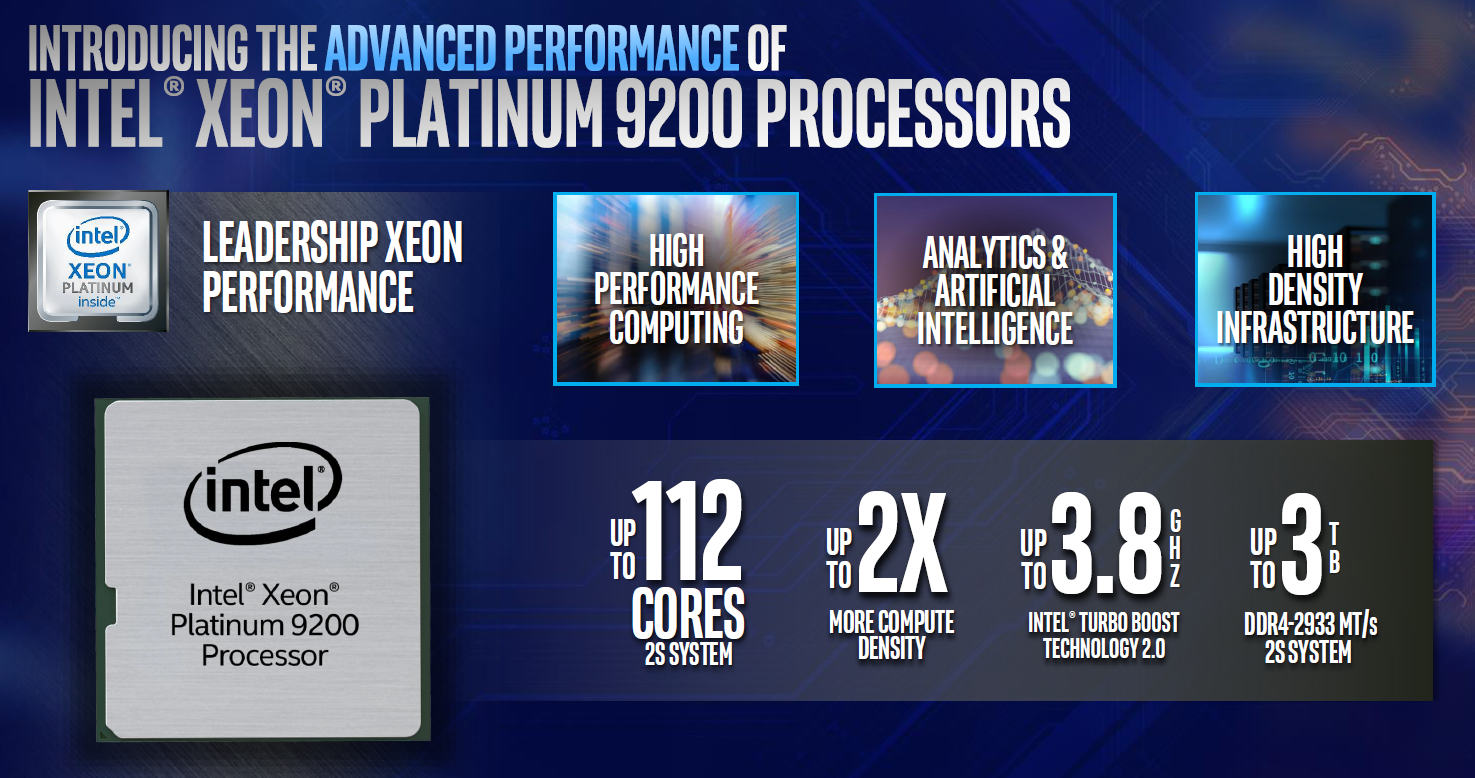
This slide boasting "leadership performance" also conveniently describes the markets where Intel is a very vulnerable position, despite Intel's current dominant position in the datacenter. Although the slide focuses on the Intel Xeon 9200, this could easily be a slide for the high-end Platinum 8200 Xeons too.
Intel points towards HPC, AI, and high-density infrastructure to sell their massively expensive Xeons. But as the market shifts towards less traditional business intelligence and more machine learning, and more GPU-accelerated HPC, the market for high end Xeons is shrinking. Intel has a very broad AI portfolio from Movidius (edge inference) to Nervana NNP (ASIC for DL training), and they’re going to need it to replace the Xeon in those segments where it falls out.
A midrange Xeon combined with a Nervana NNP coprocessor might work out well – and it would definitely be a better solution for most AI applications than a Xeon 9200. And the same is true for HPC: we are willing to bet that you are much better off with midrange Xeons and a fast NVIDIA GPU. And depending on where AMD's EPYC 2 pricing goes, even that might end up being debatable...
Originally published at https://www.anandtech.com/show/14466/intel-xeon-cascade-lake-vs-nvidia-turing (Wayback Machine).