
Intel's Xeon Cascade Lake vs. NVIDIA Turing: An Analysis in AI
Convolutional Neural Network Training
For a long time, the way forward in CNNs was to increase the number of layers – increasing the network depth for "even deeper learning". As you can probably guess, this resulted in diminishing returns and made the already complex neural networks even harder to tune, leading to more training errors.
The ResNet-50 benchmark is based upon residual networks (hence ResNet), which have the merit of fewer training errors as the network gets deeper.
Meanwhile, as a little bit of internal housekeeping here, for regular readers I’ll note that the benchmark below is not directly comparable to the one that Nate ran for our Titan V review. It is the same benchmark, but Nate ran the standard ResNet-50 training implementation that is included in NVIDIA's Caffe2 Docker image. However, since my group is mostly using TensorFlow as a deep learning framework, we tend to with stick with it. All benchmarking
tf_cnn_benchmarks.py --num_gpus=1 --model=resnet50 --variable_update=parameter_server
The model trains on ImageNet and gives us throughput data.
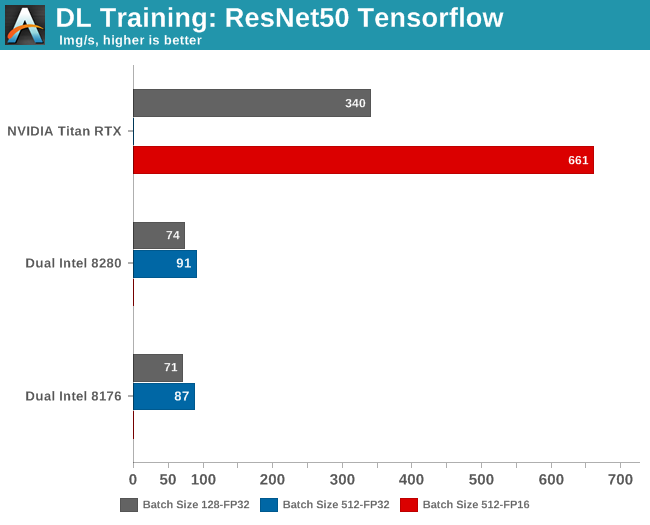
Several benchmarks are missing, and for a good reason. Running a batch size of 512 training samples at FP32 precision on the Titan RTX results in an "out of memory" error, as the card "only" has 24 GB available.
Meanwhile on the Intel CPUs, half precision (FP16) is not (yet) available. AVX512_BF16 (bfloat16) will be available in the Cascade Lake's successor, Cooper Lake.
It has been observed that using a larger batch can causes significant degradation in the quality of the model, as measured by its ability to generalize. So although larger batch sizes (512) make better use of the massive parallelism inside the GPU, the results with the lower batch sizes (128) are useful too. The accuracy of the model loses only a few percent, but in many applications a loss of even a few percent is a significant.
So while you could quickly conclude that Titan RTX is seven times faster than the best CPU, it is more accurate to say that it is between 4.5 and 7 times faster depending on the accuracy you want.
Inception (v3)
Inception is based upon GoogLeNet. Contrary to the earlier dense neural networks, GoogLeNet was based on the idea that neural networks can be much more efficient if you do not connect every neuron in every layer to the next one. The downside of this optimization is that this results in sparse matrices, which are far from optimal for the typical SIMD/GPU architectures and their BLAS software.
Overall, the main goal of "Inception" was to turn GoogLeNet into a neural network that would result in dense matrix multiplication. Or in other words, something that ran a lot faster on a GPU or SIMD hardware. In the end, version 3 of this neural network has proven to be even more accurate than ResNet-50.
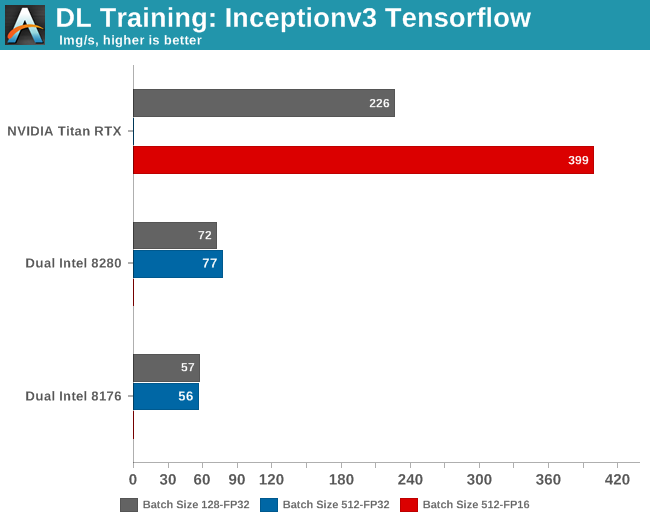
This time, the GPU is about 3 to 5 times faster, depending on the batch size. It is interesting to note that ResNet is more GPU friendly than Inception. But of course, this only matters for academics and hardware enthusiasts.
Software engineers who have to build AI models will however remark quickly that a $3k GPU is at least 3 times faster than a $20k+ (or worse) CPU configuration. And they are right: there is no contest. When it comes to Convolutional Neural Networks, the rock stars of AI, a good GPU (with a good software stack) will mop the floor with even the best CPUs. In a datacenter you typically encounter the NVIDIA Tesla GPUs which cost around four times more, but offer anywhere from 1.5x to 2x the performance of similar Titan cards.
Originally published at https://www.anandtech.com/show/14466/intel-xeon-cascade-lake-vs-nvidia-turing (Wayback Machine).