
Buyer's Guide: Mid-Range System - August 2004
- Posted in
- Guides
Memory
Recommendation: 2 X 256MB OCZ PC3200 EL (Enhanced Latency) CAS2.0Price: $114 shipped
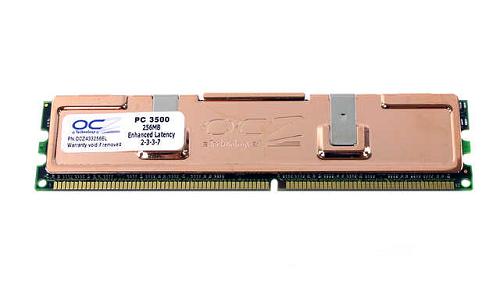
We've talked about OCZ's troubled past and history in detail before, but thankfully, those issues have been resolved and OCZ is able to bring great memory to market, and has been doing so for over a year now. With that said, OCZ has had tremendous success with their EL series of modules for a reason: great price/performance ratio. At only slightly more than the modules that we recommended a few months before, you get lower CAS timings (CAS 2-2-3-6 1T) with OCZ EL modules instead of high CAS timings (CAS 3-3-3 4T) with the cheaper no-name modules. Lower CAS timings along with the EL series' overclocking capability translates into better performance for a great price. If you can still find the PC3500 EL modules, you can run them at DDR433. Of course, you can do that with the PC3200 EL modules as well.
We should also mention that you don't have to get a pair of 256MB modules if you think you'll be making big memory upgrades in the future. That is, you can opt for a 512MB OCZ PC3200 EL stick in order to save an additional DIMM slot for future memory expansion. And don't worry about a price hike; the cost difference between two 256MB OCZ PC3200 EL modules and a 512MB OCZ PC3200 EL module is virtually nothing.
Alternative: 2 X 512MB OCZ PC3200 EL Dual Channel Platinum
Price: $246 shipped
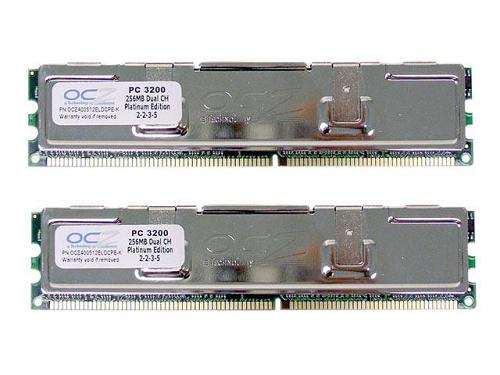
For our alternative pick, we've decided to recommend more memory this time around. We feel that additional memory (in this case, an extra 512MB) can be quite useful as systems get more powerful. Lower latency modules have never been a huge difference maker in comparison to additional main memory for systems that require such powerful resources. As your system ages and as you use applications that require more resources, your need for memory will go up. This is why we choose to list 1GB of memory as our alternative today. The dual channel certified capability for these modules is an added bonus if you decide to migrate to a Socket 939 platform, which is relatively easy even now. Though to be fair, you could just as easily migrate with 256MB modules.
Video
Recommendation: 128MB Sapphire Radeon 9600 Pro, DVI, TV-outPrice: $131 shipped
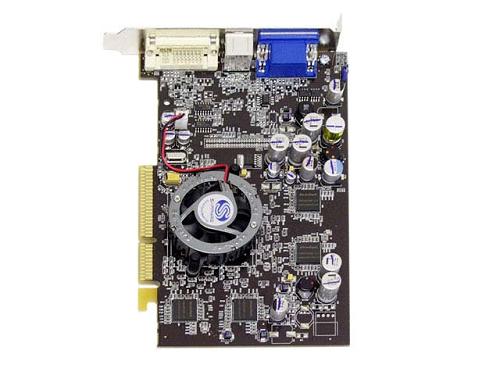
Ever since the release of the ATI R300 cores and their later iterations, ATI has either led or has had a clear lead over NVIDIA in terms of performance and price. The same is still true of ATI at the moment, 24 months since the release and availability of R300 core video cards. That's why, today, we highly recommend purchasing a 9600 Pro for your mid-range system, as it offers great DX8 and good DX9 performance for the price. To put it simply, the 9600 Pro is still the best bang-for-the-buck video card on the market. Sapphire makes a great 9600 Pro for just $131 or so shipped; the additions of DVI and TV-out for this price are unique, and overall, a great deal. 2D IQ quality is excellent, up to 1600x1200 desktop resolutions with the right monitor, essentially on par with retail ATI versions of the 9600 Pro. As previously mentioned, 3D performance is excellent in DX8 games and good in DX9 games, and 128MB of memory will be plenty until more intense DX9 games are released later this year and next year. If you plan on being a heavy Doom 3 gamer, however, you definitely do not want to be purchasing this card, and should instead be looking at NVIDIA's GeForce6 offerings at higher price levels. Anyway, we can also attest to the fact that 9600 Pro cards have been known to overclock extremely well, and usually come with 3.3ns Samsung memory chips.
Of course, if you're not a gamer or don't plan on playing games more than once a year, or ever, a 9600 Pro would be a pointless purchase. We would instead suggest the ATI Radeon 9200SE, 9200, 9600SE, 9550, or 9550SE, all of which can be found for under $90 shipped online (the 9200 and 9200SE for about half that). These lower end cards provide excellent 2D quality that non-gamers need, along with reliable drivers, great online ATI customer support, and up to DX9 support (in addition to excellent DX8 performance) for future Microsoft operating systems. You could always opt for the cheapest of cheap ATI cards in the Radeon 7000, but you won't be getting DX8 support, which should be the bare minimum for computer systems that plan to be used beyond the next 18-24 months, when XP64 will necessitate DX8 of some form for smooth operation.
Alternative: 128MB ATI Radeon 9800 Pro, DVI, TV-out
Price: $199 shipped
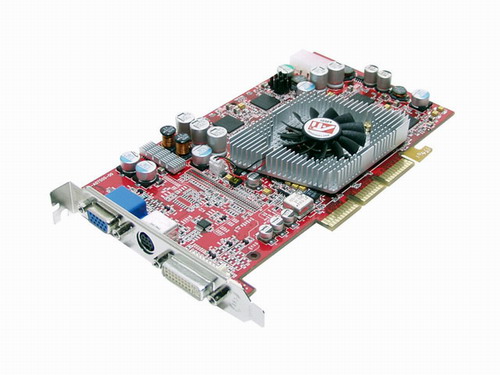
ATI's 9800 Pro has been rapidly declining in price for the last several months, and over the last two months has stabilized around the $200 mark. Even with the introduction of ATI's next generation X800 GPU, we don't see the 9800 Pro dropping more than a few more dollars in retail from where it stands now for the foreseeable future. ATI's X800 GPU and the 9800 Pro's lower price are precisely why we believe that the 9800 Pro is a perfect alternative to the 9600 Pro (or even 9700 Pro) for your mid-range system. It offers good performance for tomorrow's games and great performance for the vast majority of today's games. The 128MB memory chips at their rated 3.3ns is standard these days and should fit the needs of a mid-range user. Thankfully, 2D IQ is still superb with high end retail ATI video cards like the 9800 Pro, so non-gamers have nothing to worry about in that department.
Listed below is part of our RealTime pricing engine, which lists the lowest prices available on ATI video cards from many different reputable vendors:
If you cannot find the lowest prices on the products that we've recommended on this page, it's because we don't list some of them in our RealTime pricing engine. Until we do, we suggest that you do an independent search online at the various vendors' web sites. Just pick and choose where you want to buy your products by looking for a vendor located under the "Vendor" heading.
Originally published at https://www.anandtech.com/show/1445 (Wayback Machine).