
Linux and L2 Cache; Sempron vs. Athlon
- Posted in
- Linux
Opstone
Blue Sail Software's Opstone benchmarks were used in this portion of the review. We will use the Athlon XP 32-bit precompiled optimized binaries of the Scalar Product (SP) and Sparce Scalar Product (SSP) benchmark. Unfortunately, this means the Athlon 64 does not receive the benifit of SSE2 in this benchmark. The SP benchmark is explained by the author:
"The 'SP' benchmark calculates the scalar product (dot product) of 2 vectors ranging in size from 16 elements to 1048576 elements for both single and double-precision floats. Although the Gflops/sec. for every vector length is recorded (in the resulting output log file), the average of all these values is reported. This benchmark is indicative of the performance of many raw floating-point data processing apps (movie format conversion, MP3 extraction, etc.)"
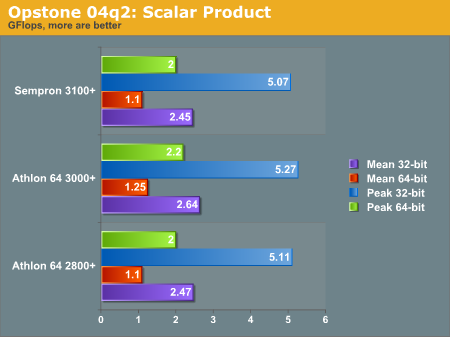
The integer intensity scalar product benchmark is relatively unscathed by the difference in L2 cache, with the exception of a slightly higher sustained mean GFlops.
Below is the SSP benchmark, as explained by the author:
"The 'ssp' benchmark also calculates the scalar product of 2 vectors, except that these vectors are sparsely populated (only the non-zero value elements are stored) ranging from a 'loading factor' (non-zero/zero elements) of 0.000001 to 0.01 for both single and double-precision floats. Since the data is not contiguous in memory, the performance is much lower than regular 'sp' and is measured in Mflops/sec. There is not much difference in performance between different loading factors as this benchmark really challenges the ability of the processor to perform short bursts of calculations coupled with lots of conditional testing. It is this reason that the P4 with its longer pipeline does not generally perform as well as the Athlon64. This benchmark is indicative of the performance of many 3D games as the processing is similar (short bursts of calculations with numerous conditional testing)"
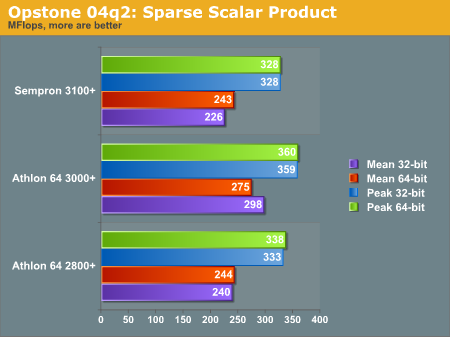
Floating point operation scales much better than integer processing if we are to trust Opstone. All three processors scale in the same order of their price range, although the AMD PR rating obviously does not hold on this benchmark.
Originally published at https://www.anandtech.com/show/1438 (Wayback Machine).