
The Team Group MP34 512GB SSD Review: Refining Phison's NVMe Workhorse
Mixed Random Performance
Our test of mixed random reads and writes covers mixes varying from pure reads to pure writes at 10% increments. Each mix is tested for up to 1 minute or 32GB of data transferred. The test is conducted with a queue depth of 4, and is limited to a 64GB span of the drive. In between each mix, the drive is given idle time of up to one minute so that the overall duty cycle is 50%.
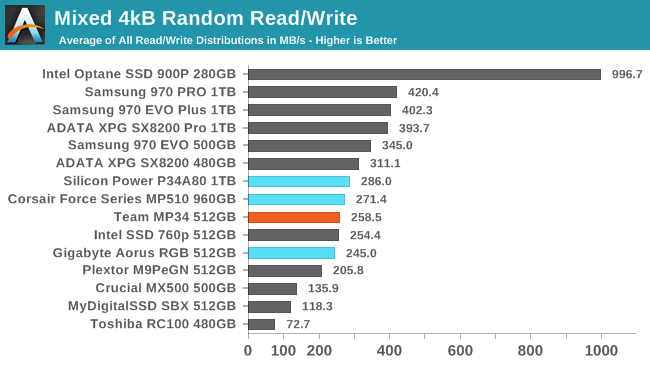
The newer firmware on the Team Group MP34 gives it a slight edge over the Gigabyte Aorus RGB SSD, but both drives are significantly slower overall on the mixed random IO test than the fastest 512GB-class drives we have tested. The Samsung and Silicon Motion based competitors are even outperforming the higher-capacity Phison E12 drives.
 |
|||||||||
| Power Efficiency in MB/s/W | Average Power in W | ||||||||
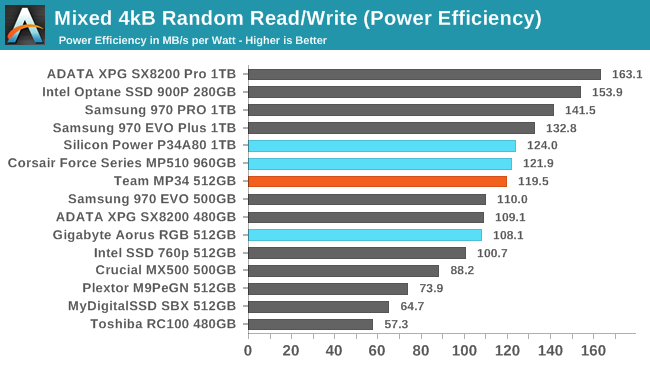
The Team MP34's power efficiency during the mixed random IO test is a bit lower than the 1TB Phison E12 drives, but it's clearly more efficient that all the other 512GB-class drives in this bunch. The Gigabyte Aorus SSD's lower efficiency is no surprise given the RGB LEDs, but it actually still draws less power than the Samsung and ADATA drives.
 |
|||||||||
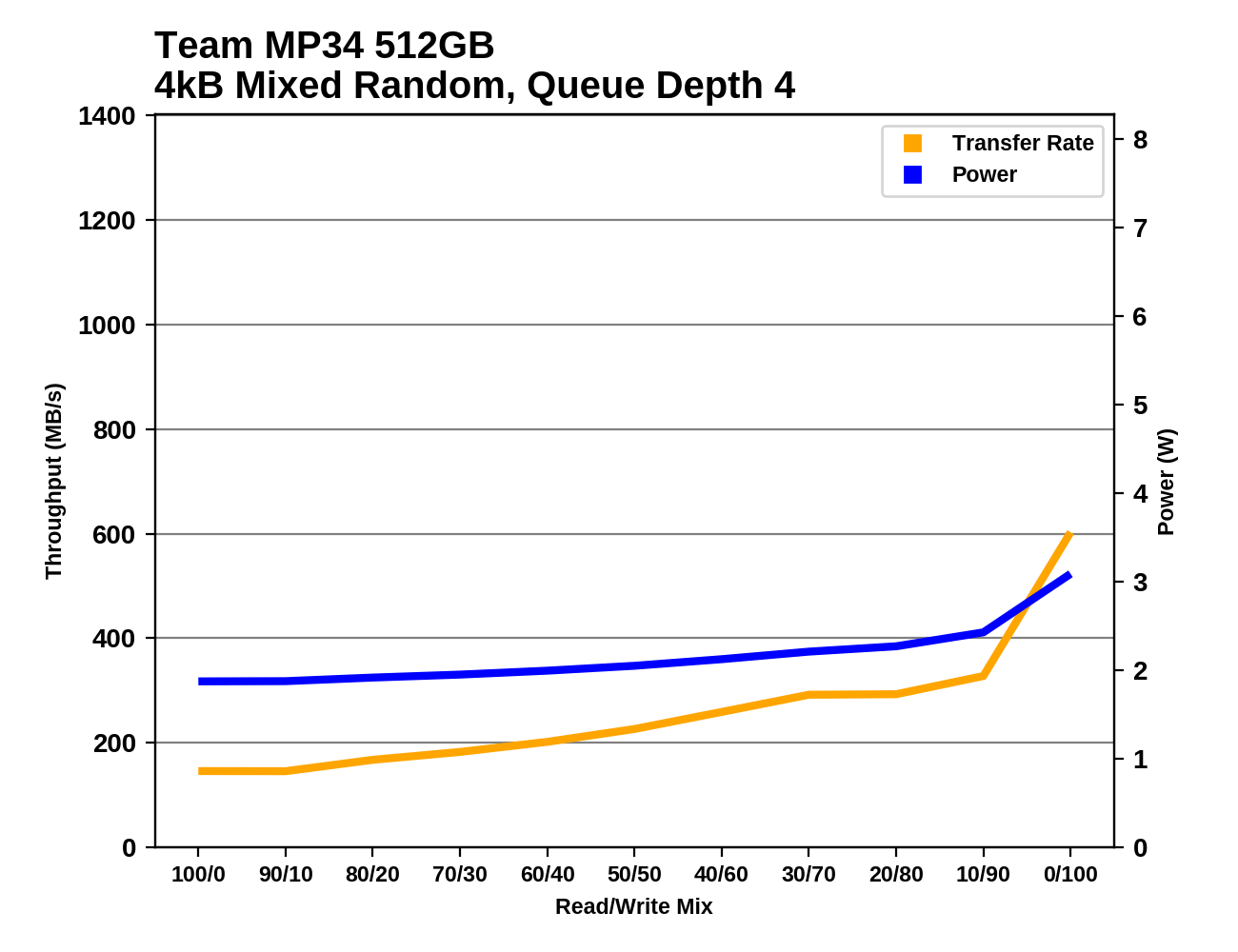
The Team MP34 has generally the same performance profile as the earlier Phison E12 drives, but it performs a bit better than the earlier firmware during the more write-heavy half of the test. The only large difference in performance is at the very end of the test, where the pure random write speed of the MP34 is a clear improvement over the Gigabyte Aorus. The competitors that offer much better overall performance have small advantages during the read-heavy portions of the test and build up a larger lead over the MP34 in the write-heavy half.
Mixed Sequential Performance
Our test of mixed sequential reads and writes differs from the mixed random I/O test by performing 128kB sequential accesses rather than 4kB accesses at random locations, and the sequential test is conducted at queue depth 1. The range of mixes tested is the same, and the timing and limits on data transfers are also the same as above.
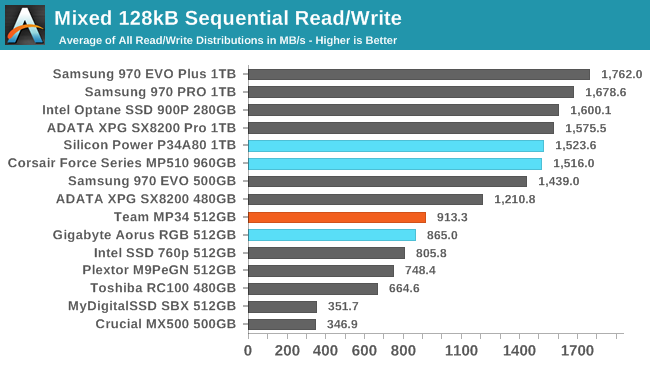
Drive capacity is obviously the primary factor affecting overall performance on the mixed sequential IO test, with all of the 1TB class drives outperforming all of the 512GB class drives. The 500GB Samsung 970 EVO comes very close to matching the performance of some 1TB drives, and the ADATA SX8200 is not too far behind, but the Team MP34 doesn't get close and is only slightly faster than the drive with older Phison E12 firmware.
 |
|||||||||
| Power Efficiency in MB/s/W | Average Power in W | ||||||||
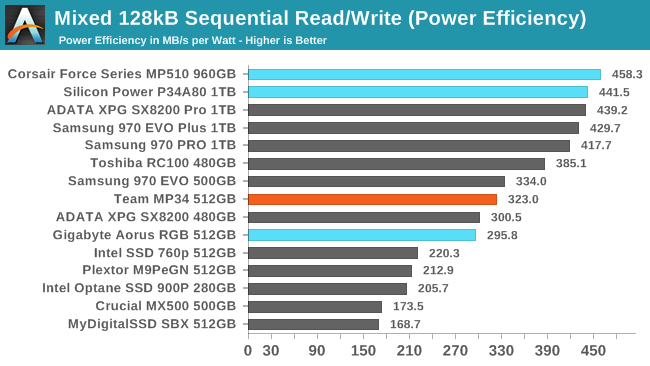
The Team MP34 provides competitive power efficiency for its capacity class when running the mixed sequential IO test. The 500GB Samsung 970 EVO is a bit more efficient, drawing much more power but also offering much more performance. The Toshiba RC100 entry-level NVMe drive provides the best efficiency in this capacity class, because it uses less power on average than even the Crucial MX500 SATA drive.
 |
|||||||||
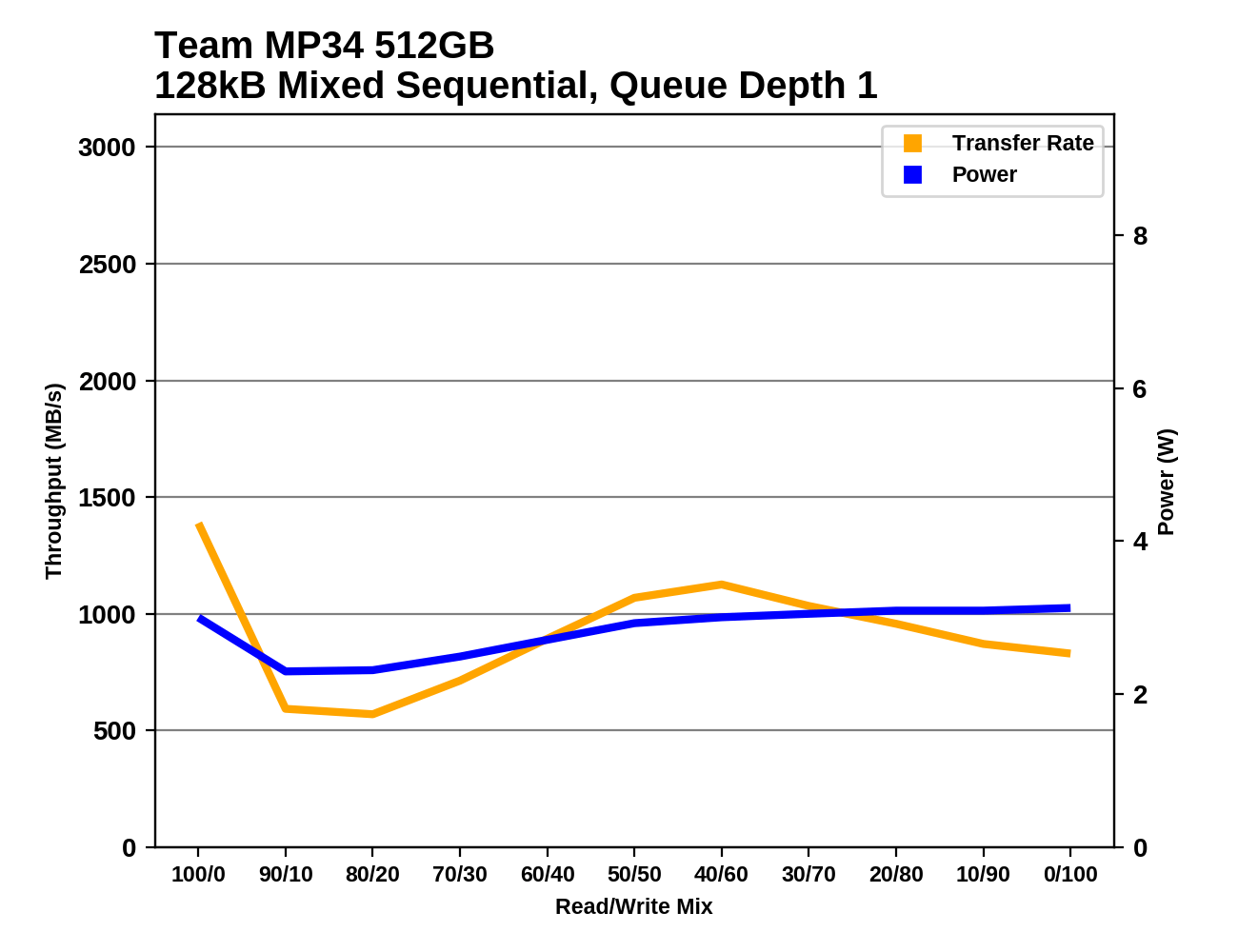
The performance of the Team MP34 wobbles around as the workload shifts from mostly reads to mostly writes, but this is the same basic pattern we saw with the Gigabyte Aorus SSD, though the MP34's newer firmware brings slight improvements to the more write-heavy phases of the test. Overall, the MP34's performance is sub-par for the most read-heavy tests, but it holds up reasonably well against the competition during the more write-heavy parts of the test.
Originally published at https://www.anandtech.com/show/14331/the-team-group-mp34-512gb-ssd-review (Wayback Machine).