
The LG G8 Review: Solid, But Not Great
- Posted in
- Mobile
- LG
- Smartphones
- LG G8
- LG G8 ThinQ
Video Recording
Video recording on the LG G8 is a straightforward matter. Videos are recorded in AVC/H.264 format as seemingly the camera app doesn’t allow for a switch to HEVC/H.265. Nevertheless , the resulting is very high bitrate with 24Mbps 1080p60 videos, 48Mbps 4K30 and 64Mbps 4K60 video.
60fps video recording works only on the main camera sensor and 4K60 recording doesn’t have EIS.
Quality in 4K recording is great. Particularly 4K30 on the wide camera sensor with EIS results is a great experience. 60fps recording at 1080p seems to be a compromise in terms of quality as I feel the bitrate isn’t high enough, resulting in a lot of loss of detail.
Finally 4K60 looks great, however the lack of EIS is immediately visible as things become extremely shaky. The lack of HEVC recording in this mode is also of a major concern as the resulting 54 second clip above results in a 421MB file – very quickly filling up your internal storage.
One disappointing aspect of the video recording was the audio recording. The audio wasn’t very clear and it really sounded as if recorded within a box, with the microphone picking up even the slightest amount of wind.
Speaker Evaluation
The speakers on the G8 are interesting. LG continues to advertise the “Boombox” feature of the main speaker design, which means that the phone has a large internal reverberation volume. This results in the back cover vibrating quite a lot with audio, but also has the benefit that when placing the phone on a flat surface it’ll amplify the sound significantly.
Also new on the G8 is the secondary “earpiece” which isn’t a traditional speaker. Instead, LG went with an under-screen piezoelectric exciter which vibrates the screen assembly, which in turn acts a speaker membrane. For the G8, this new speaker also acts as the left stereo speaker for audio, fixing one of the most major shortcomings of the G7’s mono speaker design.
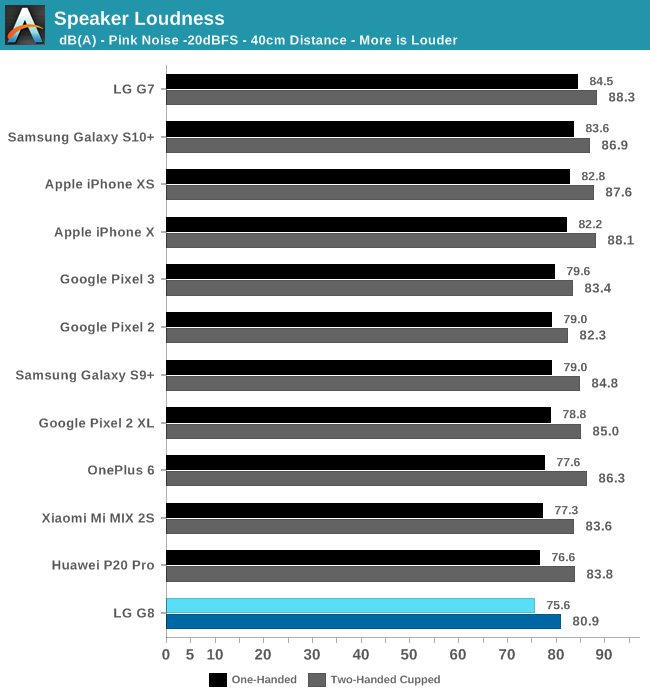
In terms of maximum volume, we’re measuring pink noise while holding the phone both one-handed and also when holding it two-handed with cupped palms from a 40cm distance. This should represent the two most common use-cases for smartphone speakers.
Unfortunately, the G8 doesn’t get nearly as loud as its predecessor, showcasing one of the lowest maximum volume measurements of recent flagships. The phone is still able to somewhat maintain good frontal directionality as the delta between one-handed and two-handed measurements is in line with most phones at ~5dB, although Samsung’s new Galaxy S10 sets the bar at a mere 3.3dB
To test and showcase the new stereo separation of the new stereo speaker setup, I setup a volume measurement with help of a binaural recording rig. The phone is at a 40cm distance for the recording:
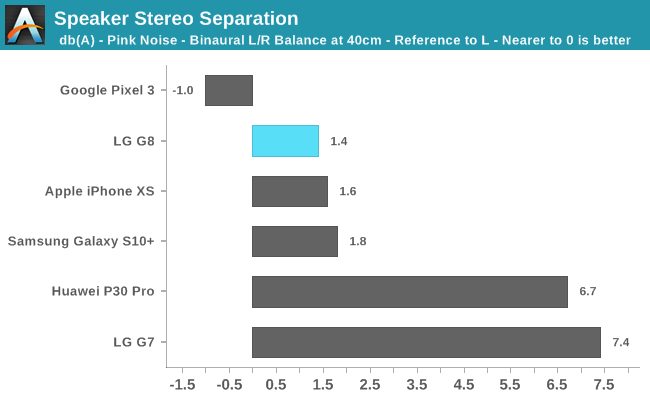
Here, we see the clear difference between phones with stereo and mono speakers. In particular, the G8 is able to massively improve over the G7, and this creates a much better listening experience. It’s to be noted that most phones still have a slight volume bias towards the right main speaker, with the Pixel 3 being the exception where the earpiece unit sounds louder than the bottom front speaker.

While in terms of stereo playback the G8 represents a big jump over the G7, the quality of the audio still very much lags behind the competition. While the G8’s speakers aren’t bad, they’re somewhat still prone to distortions at the highest volume levels. More importantly, Samsung’s S10 has much better bass, low-ends, and high-end treble than the G8, resulting in significantly better clarity.
Nevertheless, the G8’s speaker system is a good improvement over its predecessor. I was particularly surprised how well the under-screen speaker worked, even though again it’s just not as good as a proper powerful earpiece design. I wonder if LG would be able to shift the unit further up the phone, as currently it sits below the level of the rear cameras. One thing however is for sure: LG needs to improve its speaker audio processing as the competition has shown just how much better one can make speakers sound through software alone.
Originally published at https://www.anandtech.com/show/14166/the-lg-g8-review (Wayback Machine).