
The NVIDIA GeForce GTX 1660 Review, Feat. EVGA XC GAMING: Turing Stakes Its Claim at $219
Overclocking
Last, but not least, we'll take a look at overclocking. While NVIDIA does support overclocking, they have limited actual overvolting, and instead providing the ability to unlock 1-2 more boost bins and associated voltages. Either way, Maxwell 2 and Pascal certainly have much to thank for high clockspeeds; for Maxwell 2, it was a combination of high efficiency and ample overclocking headroom, while Pascal took advantage of the FinFET process to ramp up the clocks to new heights.
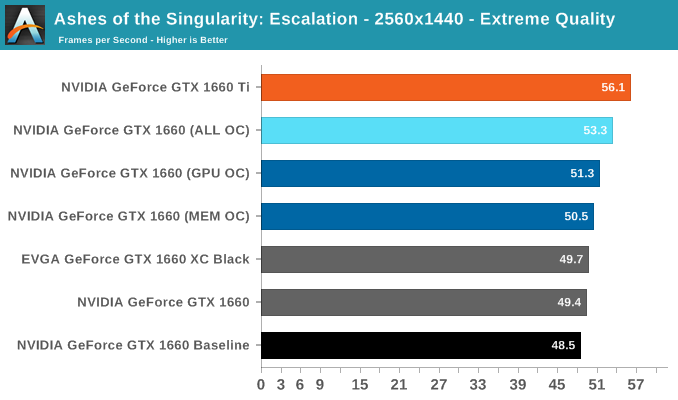
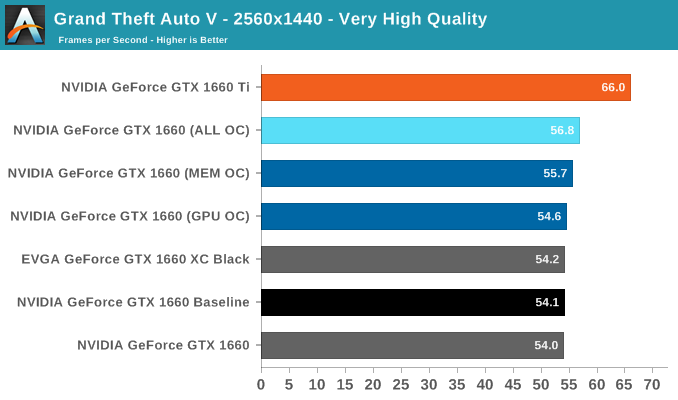
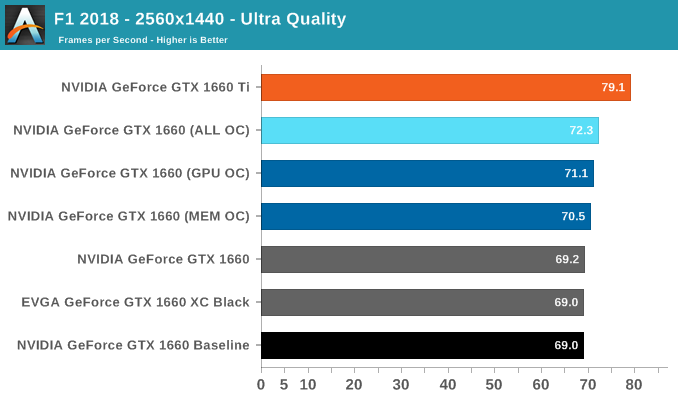
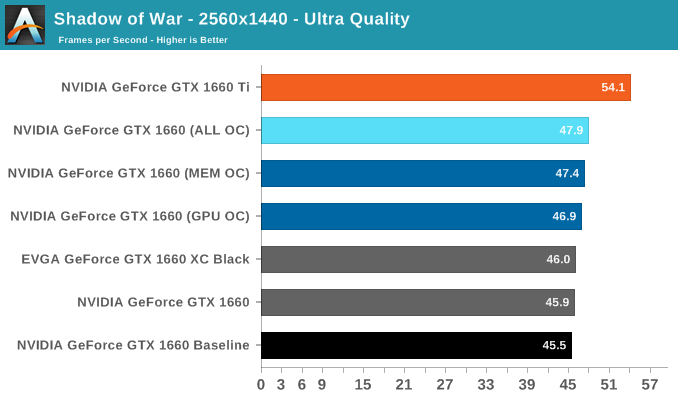
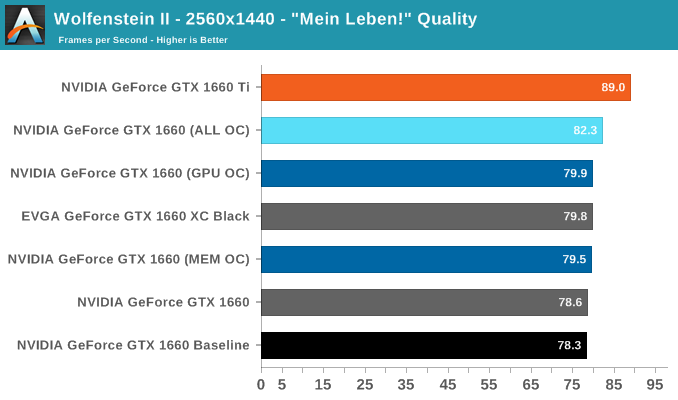
A total of four different overclocks were tested via EVGA's Precision X1; unfortunately, we were not able to get the auto OC scanning functionality to fully work. First was a baseline, consisting of 100% overvoltage and max temperature limits; power limit is already set to a soft cap of 130W at stock. The second was overclocking the GDDR5 memory by 1Gbps. The third was overclocking the GPU by +100MHz; in practice, observed clocks were in the mid 1900MHz. Lastly, all previous adjustments were combined for an overall overclock.
| GeForce GTX 1660 Overclocking | ||||||
| Baseline | Memory OC | GPU OC | All OC | |||
| Core Clock | 1530MHz | 1530MHz | 1530MHz | 1530MHz | ||
| Boost Clock | 1785MHz | 1785MHz | 1885MHz | 1885MHz | ||
| Memory Clock | 8Gbps | 9Gbps (+250MHz) | 8Gbps | 9Gbps (+250MHz) | ||
Naturally, these results cannot be taken as representative of all GTX 1660 cards, but results here can offer some insight.
Originally published at https://www.anandtech.com/show/14071/nvidia-gtx-1660-review-feat-evga-xc-gaming (Wayback Machine).