
The Lenovo Yoga C930 Review: Atmos Acoustics
GPU Performance
Since Intel’s integrated UHD 620 hasn’t seen any real architectural updates in quite some time, it’s feeling dated in terms of 3D performance, although it definitely has its strengths as well. Intel’s media block offers some pretty incredible efficiency, excellent hardware decode for H.264, HEVC, and VP9, and QuickSync capabilities for encoding in those codecs as well.
Still, until we see an update architecture from Intel, there’s definitely a GPU gap in terms of overall 3D performance compared to AMD’s Raven Ridge platform.
The Yoga C930 was run through our Ultrabook suite of GPU tests, and once again, if you’d like to compare its performance to any other laptop we’ve tested, please check out our online Bench.
3DMark
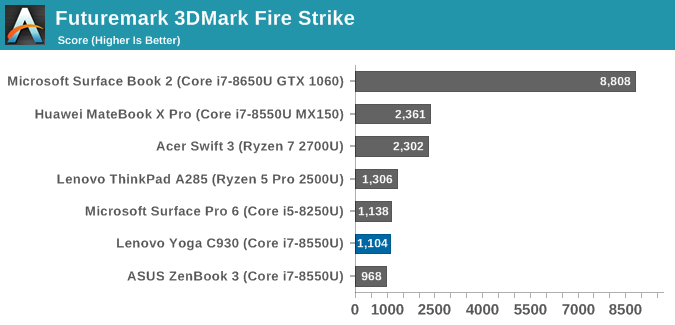
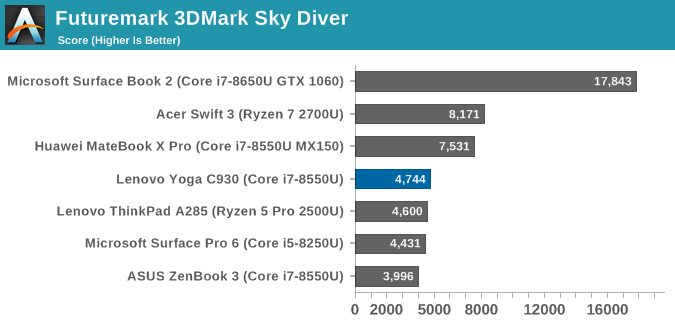
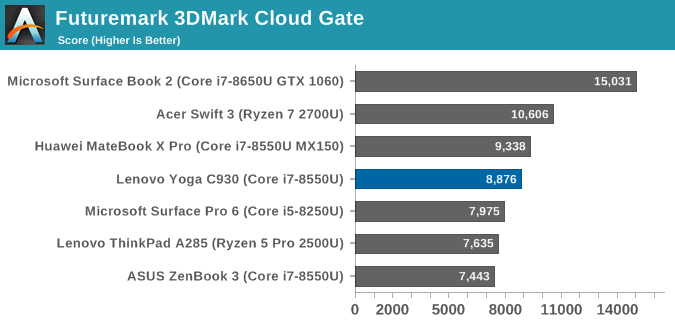
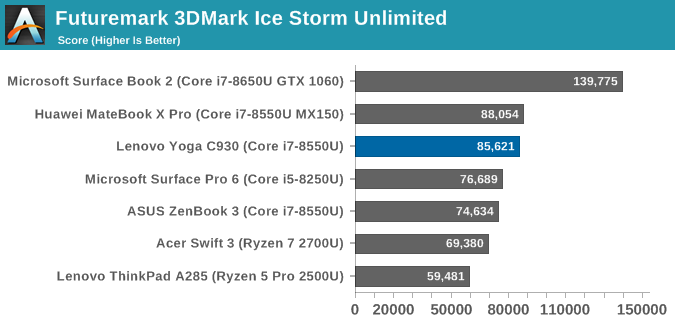
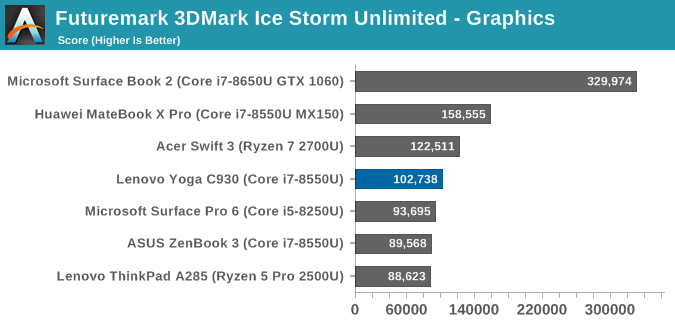
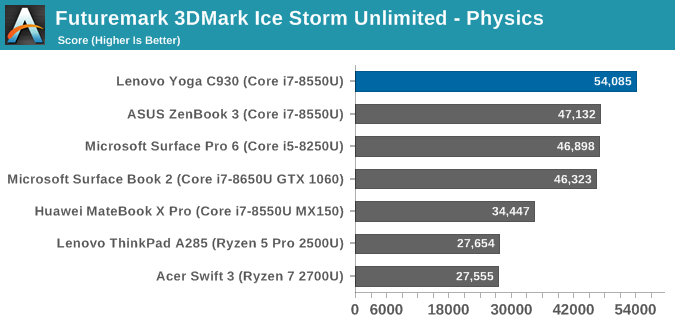
3DMark offers multiple tests with varying levels of scene complexity, with Fire Strike being the most difficult we run on notebooks, and Ice Storm Unlimited at the other end. There’s not a lot to highlight here other than the better CPU performance in the Ice Storm Unlimited Physics test, putting this laptop ahead of the rest of the Ultrabooks, but overall the performance is similar to other UHD 620 equipped devices.
GFXBench
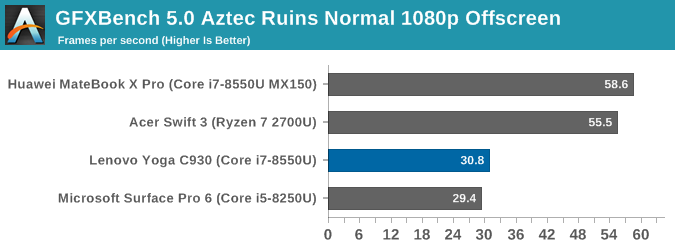
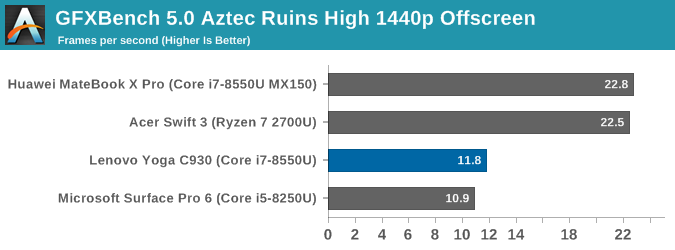
GFXBench revamped their suite in summer 2018, and GFXBench 5 brings some DX12 based tests with Aztec Ruins. This will be our new test going forward, and as such we’re still filling out our Bench data with the new version on new reviews. There’s not a lot of good to say about UHD 620 performance here though.
Dota 2
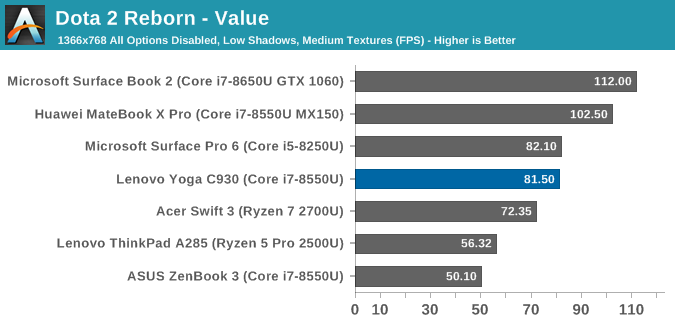
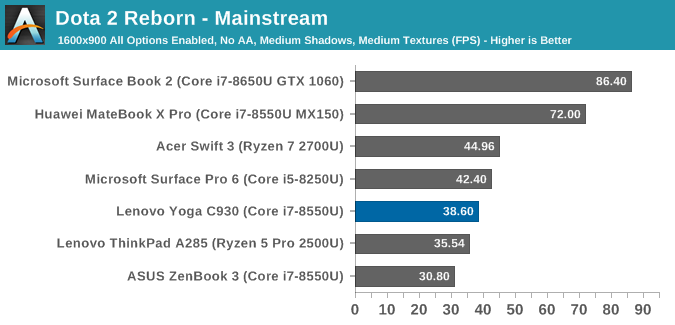
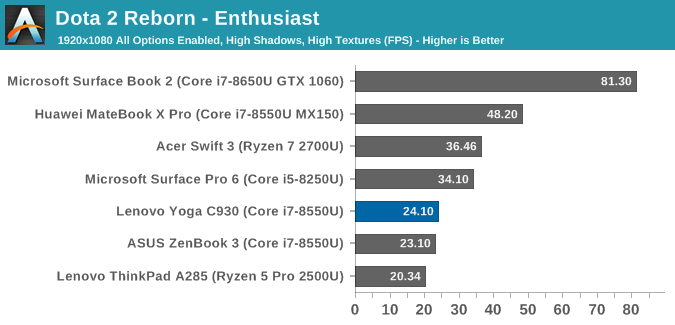
Valve’s Dota 2 offers support for a wide range of hardware and is one of the few 3D games that would be playable on low-end GPUs like those found in Ultrabooks. Once again Ryzen is the real winner here for integrated graphics, although the Huawei MateBook X Pro shows how much performance you can add with even a small dGPU added to the mix.
GPU Summary
Although Intel’s UHD 620 offers excellent media playback capabilities, it is feeling quite dated in modern devices for 3D performance. We shall see what the future brings. The slightly higher CPU performance in the Yoga C930 does help draw out more of the GPU performance in situations, but not enough to really change things by more than a few percentage points.
Storage Performance
The review unit shipped with just a 256 GB SSD, and with the parallel nature of SSDs having less capacity means this will be the least performant version available. It shipped with the SK Hynix SL300 SSD, although drives are typically multi-sourced. This particular model features MLC NAND, which is a bit of a surprise.

As a full NVMe PCIe drive with x4 capabilities, the performance is much higher than SATA based SSDs, and we see sequential read speeds coming in at over 2600 MB/s. Write speeds are quite strong as well, although the higher capacity version would do better here.
Originally published at https://www.anandtech.com/show/14021/the-lenovo-yoga-c930-review-atmos-acoustics (Wayback Machine).