
Intel's 90nm Pentium M 755: Dothan Investigated
- Posted in
- CPUs
General Usage Performance - SYSMark 2004
Like the Winstone tests, SYSMark is an important suite to look at as this is how most users will use their notebooks. Just like Winstone, SYSMark is divided into both office and content creation suites; let's have a look.This time, we look at content creation performance first. Here's what happens with the Internet Content Creation suite:
"In this scenario, the content creator creates a product-related website targeting a broadband and narrowband audience. The user first renders a 3D model to a bitmap, while preparing web pages using a web site publishing tool. The user opens a video editing package, creates a movie from several raw input movie cuts and sound cuts and starts exporting it. While waiting on this operation, the user imports the rendered image into an image-processing package, modifies it and saves the results. Back in the 3D modeling software, the user modifies a 3D model and exports it to a vector-graphics format. Once the movie is assembled, the user edits it and creates special effects using one of the modified images as input. The user extracts content from an archive. Meanwhile, he uses an animation creation tool to open the exported 3D vector graphics file. He modifies it by including other pictures and optimizes it for faster animation. The final movie with the special effects is then compressed in a format that can be broadcast over broadband Internet. The web site is given the final touches and the system is scanned for viruses."
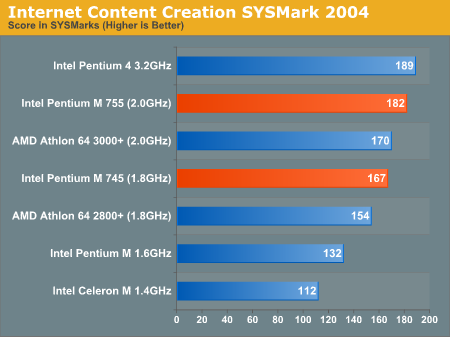
ICC SYSMark 2004 has always favored Intel processors; more specifically, the Pentium 4. Under the older SYSMark 2002 benchmark, this was the only test where the Pentium M could not hang with its older brother. This time around, we see that the Banias based Pentium M doesn't fair well at all, but with a few architectural tweaks, twice the cache and a higher clock speed, the Pentium M 755 is nipping at the heels of the Pentium 4.
The Pentium M also manages to outperform the Athlon 64, but that is to be expected here; once again, SYSMark has always favored Intel processors.
Next, we have the Office Productivity suite:
"In this scenario, the office productivity user creates a marketing presentation and supporting documents for a new product. The user receives email containing a collection of documents in a compressed file. The user reviews his email and updates his calendar while a virus checking software scans the system. The corporate web site is viewed and the user begins creating the collateral documents. The user also accesses a database and runs some queries. A collection of documents are compressed. The queries' results are imported into a spreadsheet and used to generate graphical charts. The user then transcribes a document. Once the document has all the necessary pieces in place, the user changes it into a portable format for easy and secure distribution. The user edits and adds elements to a slide show template. Finally, the user looks at the results of his work (both the slide show and the portable document) in an Internet browser. "
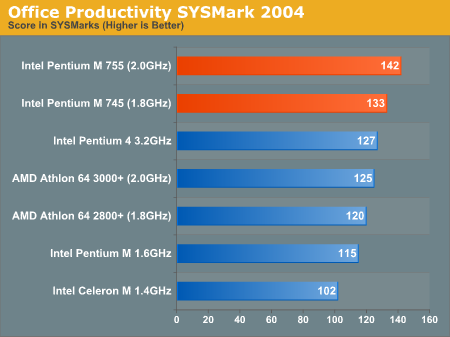
Here, the Dothan based Pentium M 755 manages to outperform the Pentium 4 3.2 and the Athlon 64 3000+, both by a significant margin. Further echoing our results from Winstone, it's clear that for business users, the new Pentium M is the king of the hill when it comes to mobile computing.
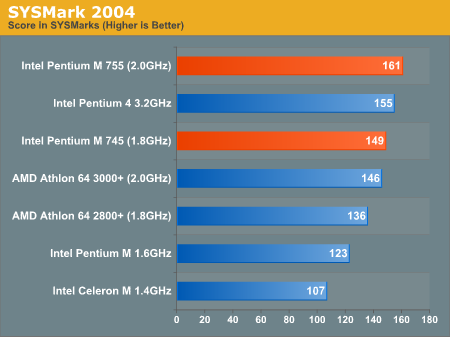
The overall SYSMark graph takes both ICC and Office Productivity performance into account. For reference, we show it below:
Originally published at https://www.anandtech.com/show/1399 (Wayback Machine).