
Intel's 90nm Pentium M 755: Dothan Investigated
- Posted in
- CPUs
Dothan's Model Numbers
Intel started their model numbering system with Dothan's launch. For those of you who are confused by the "helpful" system, here is a table to tell you at what clock speeds the various processors are really running:| Core | Clock Speed | Thermal Design Power | |
| Intel Pentium M 755 | Dothan | 2.0GHz | 21W |
| Intel Pentium M 745 | Dothan | 1.8GHz | 21W |
| Intel Pentium M 735 | Dothan | 1.7GHz | 21W |
| Intel Pentium M 733 | Dothan Ultra Low Volt | 1.1GHz | 5W |
| Intel Pentium M 725 | Dothan | 1.6GHz | 21W |
| Intel Pentium M 723 | Dothan Ultra Low Volt | 1.0GHz | 5W |
| Intel Pentium M 715 | Dothan | 1.5GHz | 21W |
| Intel Pentium M 713 | Banias Ultra Low Volt | 1.1GHz | 7W |
| Intel Pentium M 705 | Banias | 1.5GHz | 24.5W |
For the most part, a higher number means a faster processor when it comes to the Pentium M, but there are a few exceptions.
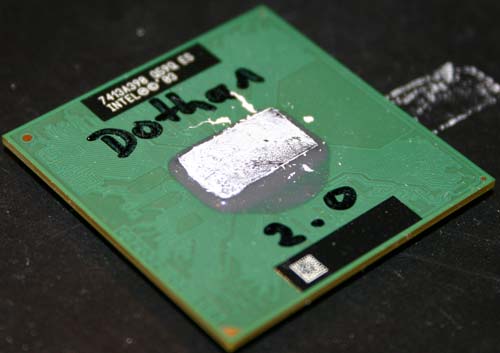
First of all, the 715, 725, 735 and 745 all have one thing in common - for every 10-point increase in model number, there is a 100MHz increase in clock speed. The 755 is the only exception, which has a 10-point increase in model number for a 200MHz increase in clock speed.
The 705 runs at the same speed as the 715, but it uses the older Banias core - so that's a chip that you'll want to stay away from as it offers lower performance and is more power hungry.
The Ultra Low Voltage Dothans run at 1 - 1.1GHz, but have model numbers close to that of the 1.6GHz and 1.7GHz Dothans. Although they consume far less power, keep in mind that they will not perform similarly to the 725 and 735 processors. Then again, these chips are normally found in ultra portable notebooks that wouldn't offer normal Pentium M chips, so it's not usually a decision that you'll have to face. If you want an ultra portable, you'll have to put up with lower clocked processors.
Looking at the TDP values, you see that clock for clock, Banias consumes more power than Dothan, making Dothan better for performance and battery life. For those who look at Prescott as an example of how "bad" Intel's 90nm process is, take a look at Dothan as a more accurate measurement. Without any architectural changes, 90nm allows Dothan to run cooler and faster - the opposite of what we've seen on Prescott, leading us to believe that the reason for Prescott's heat issues isn't Intel's 90nm process, but rather the architectural changes to Prescott.
Originally published at https://www.anandtech.com/show/1399 (Wayback Machine).