
The Xeon Entry Quad-Core CPU Review: Xeon E-2174G, E-2134, and E-2104G Tested
Power Consumption
Users who normally deal with consumer processors will likely know that consumer processors in consumer motherboards, especially for Intel, can consume a lot more power than their TDP rating. This is because Thermal Design Power (TDP) is not strictly a measure of power consumption, but of cooling performance required. Both Intel and AMD treat the TDP rating differently - for AMD is relates to peak performance when all cores are loaded, but for Intel it becomes related to the long-term steady state performance.
Intel defines several power levels (PL) for its processors, but the key ones are PL1 and PL2: the power level for sustained performance and the power level for short term turbo performance respectively. Normally PL1 is equal to the TDP, and PL2 is set to 1.25x the PL1. A CPU will also have a time parameter defined, telling the system how long PL2 is sustained before PL1 kicks in. It looks like this:
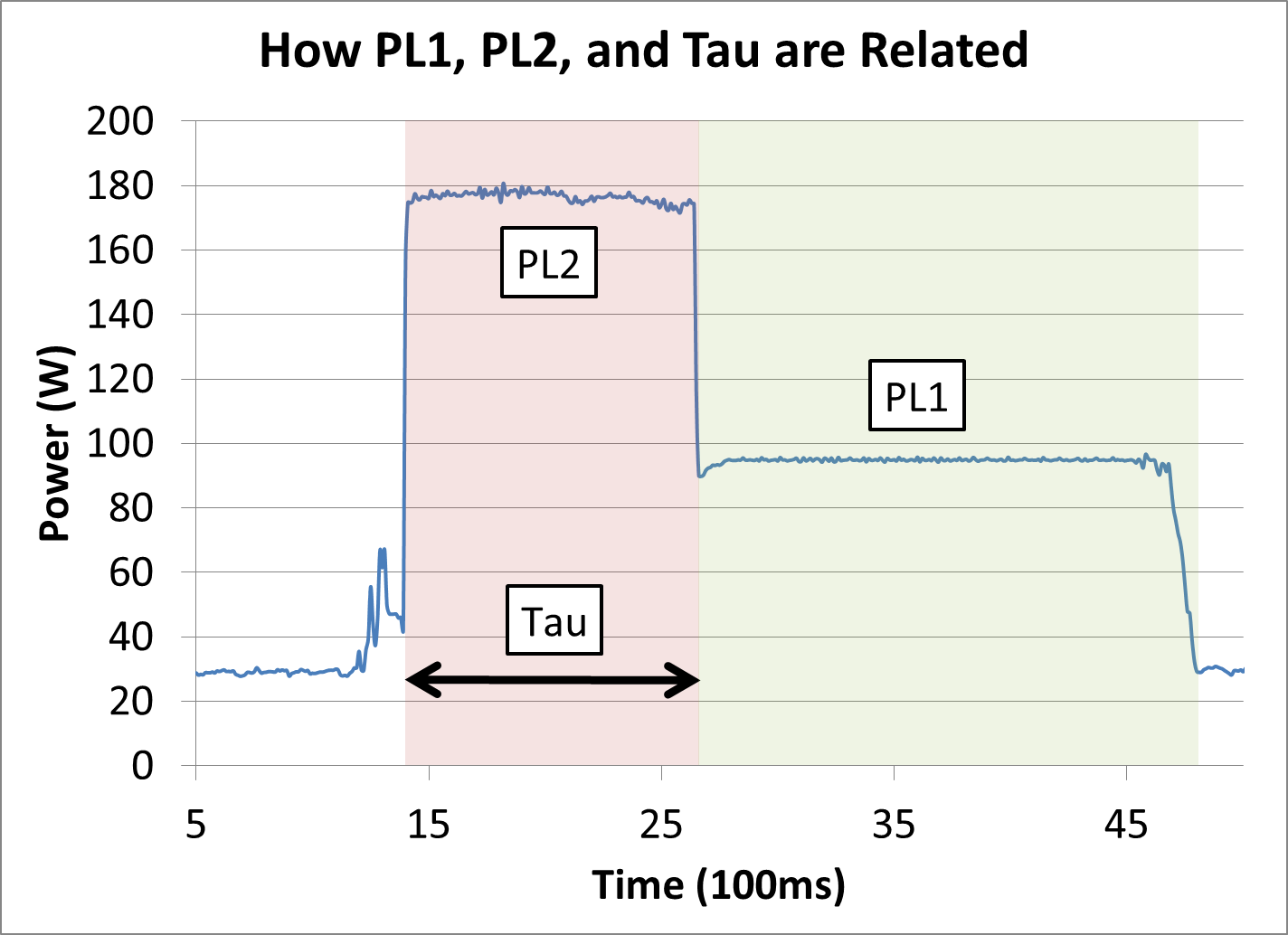
I wrote an article going deep into this issue, and it is worth reading for anyone interested in how turbo, performance, and power are related. Here is the link:
https://www.anandtech.com/show/13544/why-intel-processors-draw-more-power-than-expected-tdp-turbo
So these values, PL1, PL2, and the time variable, are all configurable by the motherboard manufacturer. Whatever Intel states as the recommended value can be overridden, and motherboard manufacturers often exchange better sustained frequencies for more power if the board is designed above Intel’s base specifications.
This matters when looking at consumer and commercial productions. Consumer hardware, such as the Core i3, i5, i7, and i9 processors, when paired with a consumer motherboard, often ignore PL1 and run at PL2 levels of performance all day. This enables users of those motherboards to perform long tasks quicker, because the motherboard manufacturer has designed for it.
For commercial systems, such as Xeon E, we find that motherboard manufacturers prefer to adhere to the power profiles rigidly. In this market, Intel guarantees performance with defined parameters, and this market typically insists on staying within those specifications. This means that for two processors equal in specifications but one is consumer and one is commercial, the commercial one will be lower power but perform worse in long tests. This is by and large what we have seen in our benchmarks, and our power testing.
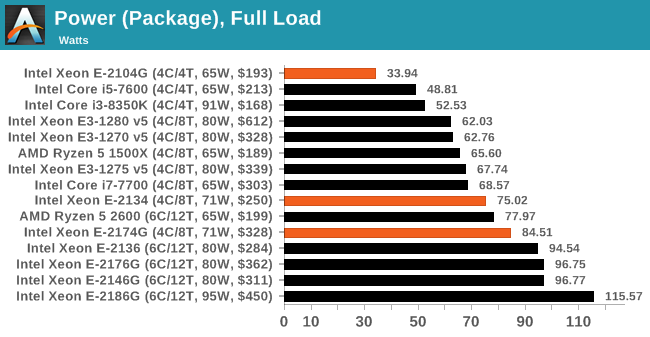
For short intervals, for the parts that go anywhere near any power limits, these Xeon E processors go up to their PL2 values, up to 100W, but then fall back to TDP values. However, the E-2104G does not have hyperthreading, so doesn't actually ever go near those PL1 or PL2 values, making it a very efficient part.
Originally published at https://www.anandtech.com/show/13971/the-xeon-entry-cpu-review-e-2174g-e-2134-e-2104g (Wayback Machine).