
The Microsoft Surface Go LTE Review: Unmatched Mobility
Battery Life
The Surface Go offers just a 27 Wh battery capacity, which is about half the size of a typical Ultrabook released in the last year. It’s also 40% smaller than the battery offered in the Surface Pro 6 which is the longest life Pro released yet. On the plus side, the smaller display has a lower pixel density, which should help, and the processor doesn’t offer any Turbo modes which would move the power draw of the CPU higher.
As with all of our battery testing, the display is set to 200 nits brightness, to provide an even playing field for all devices. We run several different tests of varying intensity with our 2016 Web test being the most demanding.
2013 Light Web
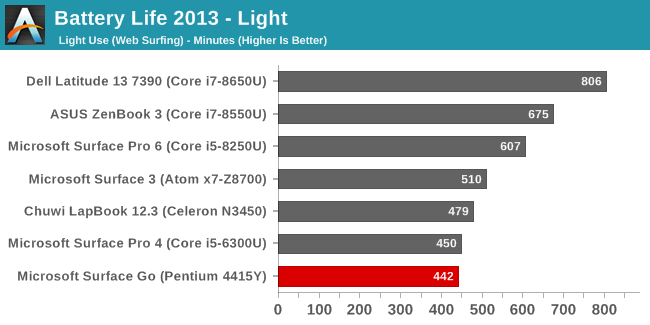
Our lightest test is our oldest, and the Surface Go isn’t off to a great start. At under eight hours on this test, the battery life is much less than a current generation Ultrabook, and well back of the latest model Surface Pro as well. A couple of years ago, this would have been reasonable battery life. In fact, the Surface Go almost matches the Surface Pro 3 in terms of runtime on this test, but the goal posts have definitely moved.
2016 Web
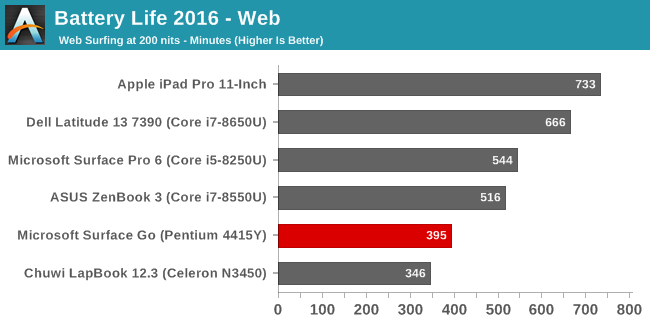
As with the previous test, the Surface Go struggles to keep up to the latest devices in this test as well. The Surface Pro 6 with a Core i5 offers 2.5 hours more battery life in this more demanding workload, which isn’t an insignificant amount of time. The tiny battery capacity hampers the Surface Go significantly here compared to other devices we’ve tested.
Movie Playback
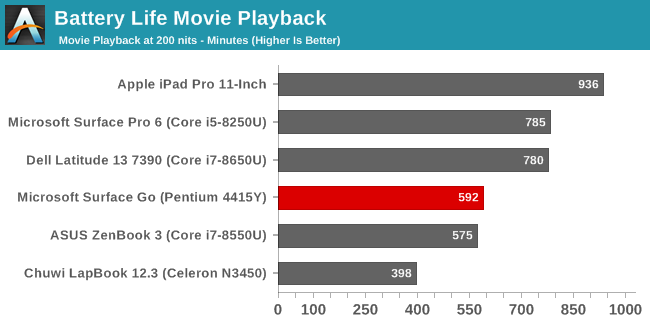
Movie playback is generally one of the best-case scenarios for modern devices since the media playback can be offloaded to the video decode unit, allowing the rest of the processor to go to sleep for much of the time. The Surface Go is still shy of the impressive results seen in the latest Surface Pro, but does get awfully near the 10-hour mark that Microsoft advertises for this device.
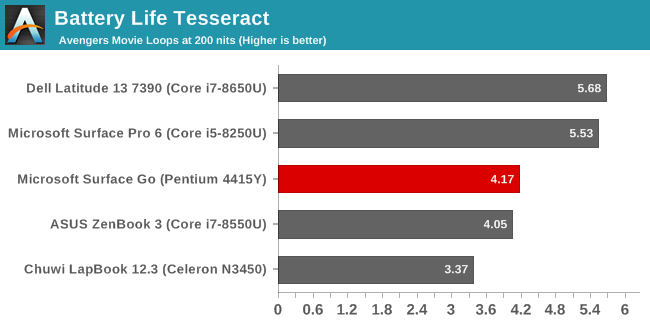
In terms of how many movies can you watch before the device runs out of juice, the Surface Go is pretty stout in this regard, with well over four runnings of The Avengers worth of battery life.
Normalized Results
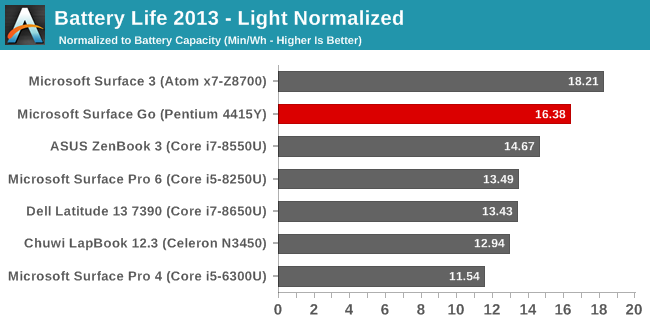
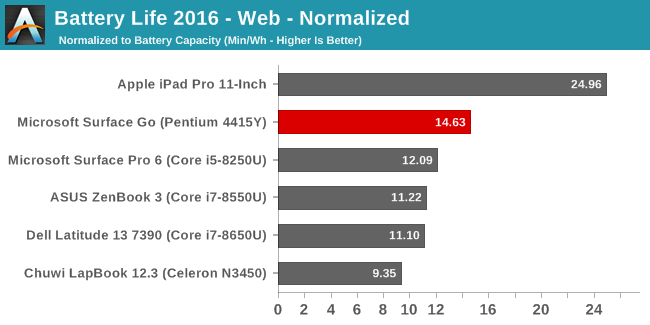
By removing the battery capacity from the equation, we can see how many minutes a device can last per Watt-Hour capacity of the battery. The Surface Go, mostly thanks to the display, does quite well in terms of efficiency. Put another way, on our 2016 Web test, the Surface Go averages 4.1 Watts of power draw with the display at 200 nits, and a Surface Pro 6 draws just a hair under 5 Watts during the same workload. So really, the less than amazing battery life really just comes down to not being able to fit more capacity in the Surface Go. The device is one of the most efficient we’ve tested.
Charge Time
The previous small form factor convertible tablet from Microsoft was the Surface 3, and it took a very long time to charge. Microsoft had outfitted it with a Micro USB port for charging, and then shipped it with just a 13 Watt AC adapter. It seems the company has learned its lesson there, and the Surface Go now offers the same Surface Connect port as the rest of the Surface lineup. It also ships with a 24 Watt adapter.
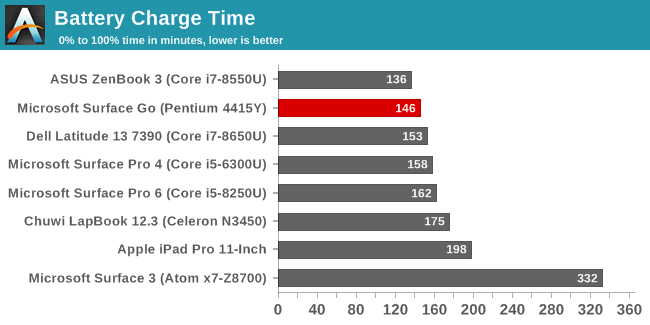
The result is a much better charge time than the Surface 3, and thanks to the smaller capacity battery, better than the Pro as well.
In addition, the Surface Go offers a USB-C port which will also do charging. This is a huge benefit for portable device such as this, since it would let you leave the main charger at home or work, and then use the same charger you use for your phone to top up the Surface Go. Microsoft seems to have an animosity towards USB-C, but this is the perfect device for them to offer it on.
Originally published at https://www.anandtech.com/show/13864/the-microsoft-surface-go-lte-review-unmatched-mobility (Wayback Machine).