
The NVIDIA GeForce RTX 2060 6GB Founders Edition Review: Not Quite Mainstream
Compute & Synthetics
Shifting gears, we'll look at the compute and synthetic aspects of the RTX 2060 (6GB). As a cut-down configuration of the TU106 GPU found in the RTX 2070, we should expect a similar progression in results.
Starting off with GEMM tests, the RTX 2070's tensor cores are pulled into action with half-precision matrix multiplication, though using binaries originally compiled for Volta. Because Turing is backwards compatible and in the same compute capability family as Volta (sm_75 compared to Volta's sm_70), the benchmark continues to work out-of-the-box, though without any particular Turing optimizations.
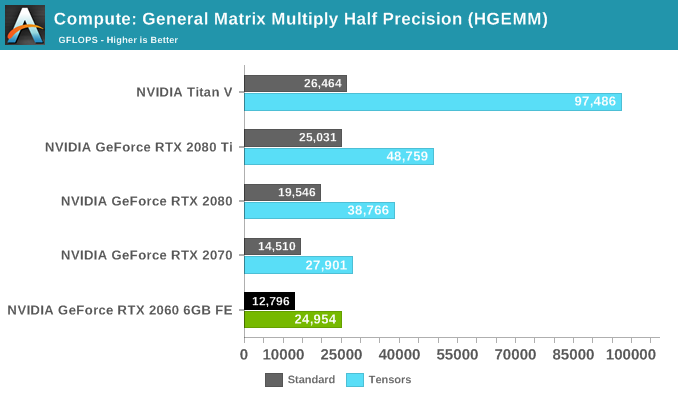
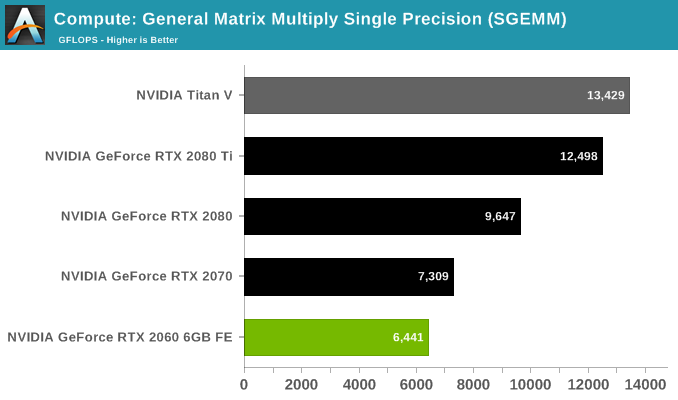
For Turing-based GeForce, FP32 accumulation on tensors is capped at half-speed, thus resulting in the observed halved performance. Aside from product segmentation, that higher-precision mode is primarily for deep learning training purposes, something that GeForce cards wouldn't be doing in games or consumer tasks.
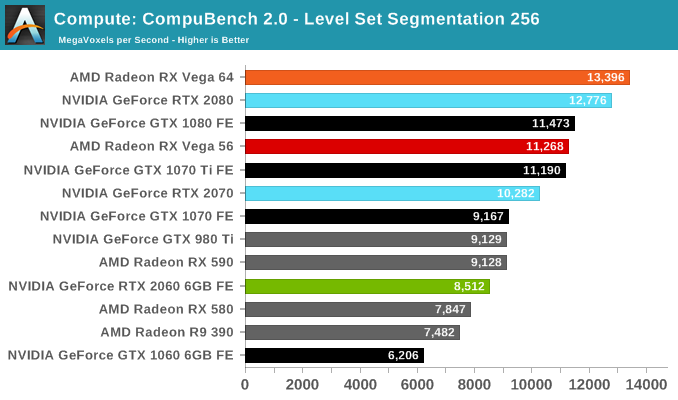
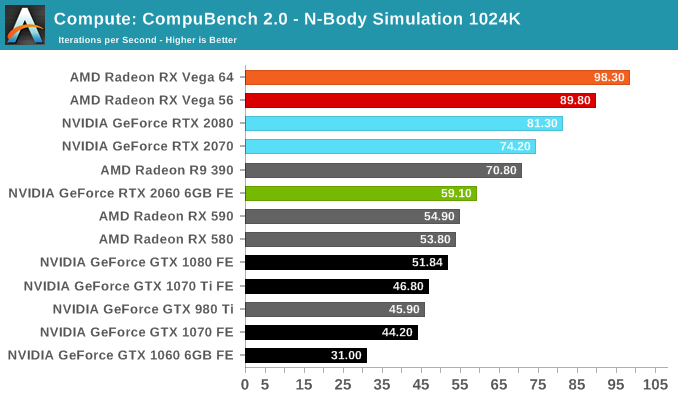
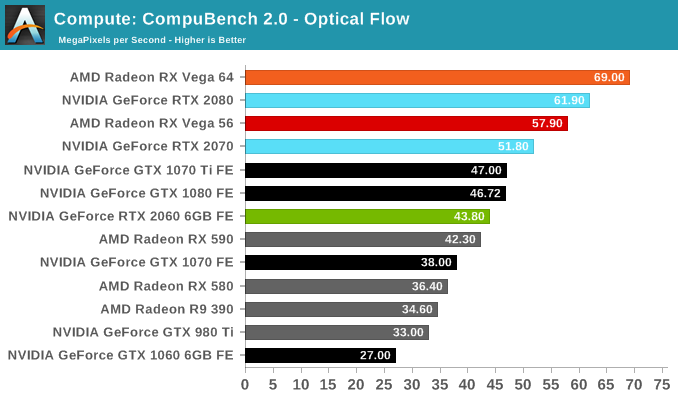
Moving on, we have CompuBench 2.0, the latest iteration of Kishonti's GPU compute benchmark suite offers a wide array of different practical compute workloads, and we’ve decided to focus on level set segmentation, optical flow modeling, and N-Body physics simulations.
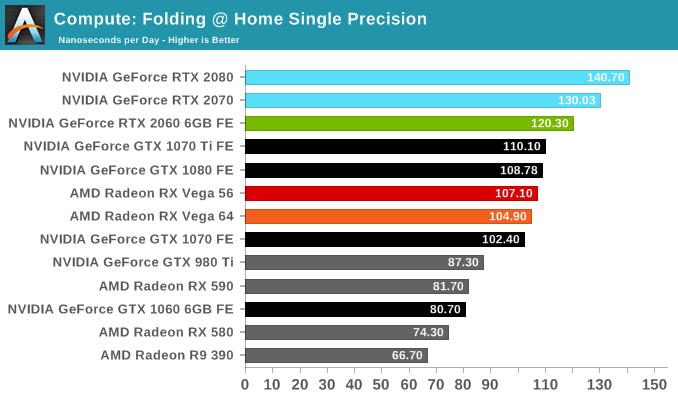
Moving on, we'll also look at single precision floating point performance with FAHBench, the official Folding @ Home benchmark. Folding @ Home is the popular Stanford-backed research and distributed computing initiative that has work distributed to millions of volunteer computers over the internet, each of which is responsible for a tiny slice of a protein folding simulation. FAHBench can test both single precision and double precision floating point performance, with single precision being the most useful metric for most consumer cards due to their low double precision performance.
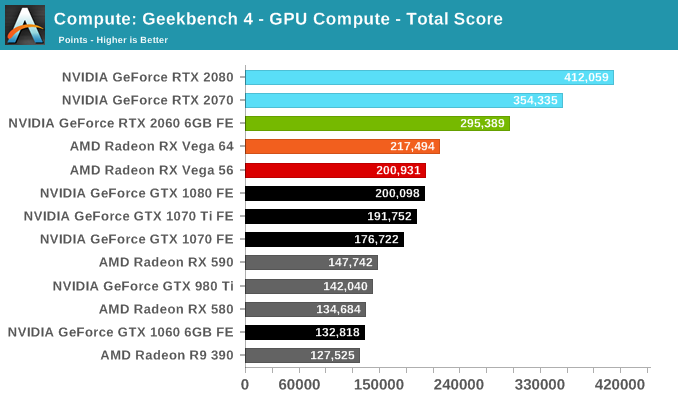
Next is Geekbench 4's GPU compute suite. A multi-faceted test suite, Geekbench 4 runs seven different GPU sub-tests, ranging from face detection to FFTs, and then averages out their scores via their geometric mean. As a result Geekbench 4 isn't testing any one workload, but rather is an average of many different basic workloads.
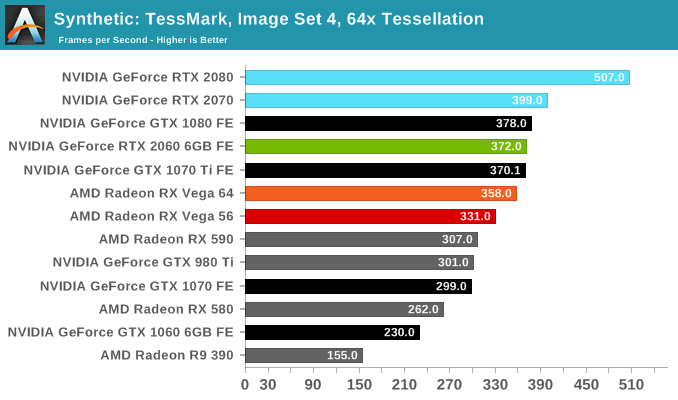
We'll also take a quick look at tessellation performance.
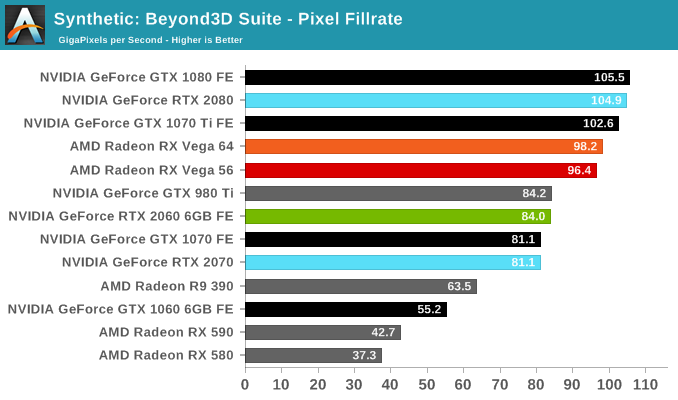
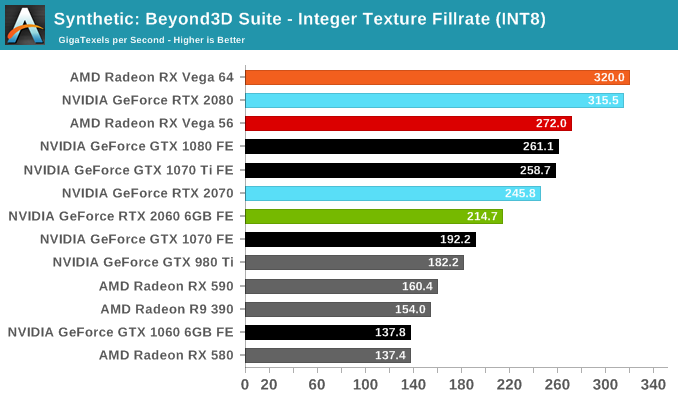
Finally, for looking at texel and pixel fillrate, we have the Beyond3D Test Suite. This test offers a slew of additional tests – many of which use behind the scenes or in our earlier architectural analysis – but for now we’ll stick to simple pixel and texel fillrates.
Originally published at https://www.anandtech.com/show/13762/nvidia-geforce-rtx-2060-founders-edition-6gb-review (Wayback Machine).