
Digital Camera Review Guide
- Posted in
- Digital Camera
Glossary
These are just some of the terms that we thought were particularly important to know before reading our articles. We will explain detailed features of individual cameras in our reviews.F-Stop: An f-stop number refers to the size of the aperture opening. Think of the aperture as working the same as our pupils. If there is too much light, our pupil must shrink down to limit the amount of light coming into our eyes. The opposite occurs if there is not enough light - our pupil will dilate to let in more light. This is the same type of process that a camera must employ in order to attain a proper exposure when taking a picture. Typical examples of f-stop numbers are between f/1.0 - f/22. If the number is higher, the opening will be smaller and will let in less light. If the number is smaller, the opening will be larger and will let in more light.
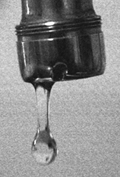
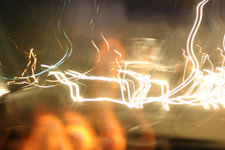
| Shutter speed: The shutter speed refers to how long a picture is exposed. In lower lighting conditions, you must use a slower shutter speed in order to allow enough light to give a good exposure. On the other hand, if you are outside on a bright day, you would have to use a much faster shutter speed for the same type of exposure. Typical shutter speeds range from slow (30 seconds) to really fast (1/4000th of a second). The speed of the shutter will greatly affect the way movement is captured on a picture. A fast shutter speed (anything above around 1/500th) will freeze fast action such as water dripping (top right), while slow shutter speeds can be used for numerous creative effects (bottom right). Slow exposures are commonly used when taking pictures of waterfalls to give them a silky look, for example. Shutter speeds and f-stops have an inverse relationship. In other words, changing the shutter speed to the next fastest setting, while changing the f-stop to the next lowest number, will retain the same exposure effect. |
|
Depth-of-field: The easiest way to explain depth-of-field is to use examples. A small depth-of-field produces a picture that has a specific focal plane in focus (below left). A large depth-of-field, on the other hand, produces a picture where the area in front of the focal point, the focal point, and the area past the focal point are all in focus (bottom right). Depth-of-field is dependent on the aperture setting of the camera. The larger the aperture opening (smaller f-stop number), the smaller depth-of-field that you will achieve; while the smaller the aperture opening (larger f-stop number), the greater the depth-of-field. A small depth-of-field is often desirable when you want to direct the viewer's eyes to a specific part of the picture. This effect is especially used in portraits where the background has a soft blurred look and the subject is focused. Famous photographers, like Ansel Adams, have popularized the use of extremely large depth-of-field, by using high f-stops, to take clear pictures where everything is in focus.
|
|
|


CCD: A CCD sensor is one of the two main types of image sensors in digital cameras. CCD stands for Charge Coupled Device. Digital cameras with CCD sensors are the most common type used, but they tend to be more expensive to manufacture. They also consume more battery power than CMOS sensor-based cameras.
CMOS: CMOS (complementary metal oxide semiconductor) is the other main type of image sensor. It is generally used in lower-end digital cameras because they are cheaper to manufacture. However, they are now being used for some professional digital cameras. They tend to be more efficient with battery power.
ISO: ISO is also referred to as the speed setting of a camera. Digital cameras offer a range of settings, typically from ISO 50-800. The higher the speed setting, the more sensitive the camera will be to light. Photographers select different speed settings depending on the lighting situation. This gives them more options when it comes to setting f-stop and shutter speeds. ISO is also used in film cameras to indicate the light sensitivity of a specific roll of film. Lower ISO settings tend to result in less grainy pictures while high ISO settings will generally produce a grainy effect.
Metering: Nearly all digital cameras have built-in light meters. This means that when you point the camera at the subject that you are trying to capture, your camera will automatically determine the f-stop and shutter speed that you should use. Most cameras also have a fully automatic mode where it will adjust these settings for you, allowing you to simply point and shoot.
Hot-shoe: This term refers to a slot found on the top of some cameras that provides the option of attaching an independent flash.
Aperture Priority: Aperture priority is a setting on most digital cameras that allows you to specify what aperture you want to use. The camera will automatically set the shutter speed accordingly to obtain a good exposure.
Shutter Priority: Shutter priority is just like aperture priority, except that you set the desired shutter speed and the camera will pick the correct aperture needed to provide a proper exposure.
Originally published at https://www.anandtech.com/show/1375 (Wayback Machine).