
Gemini Lake SFF PC Showdown: Intel's June Canyon (NUC7PJYH) and ECS's LIVA Z2 Reviewed
Concluding Remarks
Earlier I briefly touched upon the HTPC capabilities of the two Gemini Lake PCs. Of the two, the ECS LIVA Z2 is particularly attractive due to its passively cooled nature. Gemini Lake has one of the most power-efficient and full-featured video decoders in the market - It is capable of even handling VP9 Profile 2 in hardware. The only disappointing aspect from a HTPC viewpoint is that HDR is not supported. Consumers looking for a full-featured HTPC setup have to look beyond Gemini Lake for their needs. That said, if HDR is not a concern (as is likely in most TVs installed in a secondary location), Gemini Lake in general and the ECS LIVA Z2 in particular are good choices to consider.
Moving on to the power consumption aspect, we recorded the maximum sustained at-wall numbers while running the AIDA64 System Stability Test.
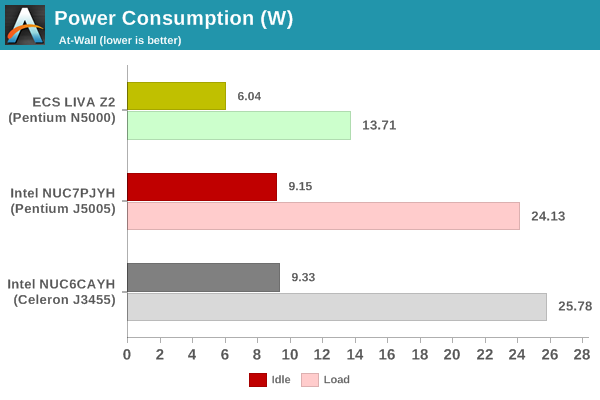
These numbers show that Gemini Lake, despite running at the same clocks as Apollo Lake, has managed to provide better performance per watt. The raw numbers are approximately the same when two systems with similar cooling situations are compared.

The Intel June Canyon NUC7PJYH Build Components
Coming to the business end of the review, Gemini Lake has shown itself to be a solid successor to Apollo Lake. Doubling the internal cache has led to significant performance increase in many real-life workloads. This is particularly evident when comparing the performance numbers of the NUC7PJYH (June Canyon) and the older NUC6CAYH (Arches Canyon). In addition to the performance bump, we also have better Wi-Fi capabilities. The product is not perfect, though - the installation of a 2.5" drive is not as easy as it is in some of the other UCFF PCs such as the ECS LIVA Z2. With the rise in popularity of M.2 SSDs, Intel could as well replace the 2.5" drive caddy with a M.2 SATA SSD-only slot on the motherboard, and reduce the system volume. The default fan curves could always use some tweaking, but, that is more of a subjective issue. These are very minor issues.

Accessing the Drive Caddy and the SODIMM Slots in the ECS LIVA Z2
On the other hand, the move from the ECS LIVA Z to the Z2 is a mixed bag. While the all-important fanless nature is still present, the retaining of aspects such as the measly 32GB of eMMC (with Windows 10 Home pre-installed) do not make for a good user experience. 32GB of eMMC may suffice for certain single-purpose industrial application systems, but, as a general-purpose PC, consumers will need to install an additional 2.5" SATA drive (similar to what we had to do for processing this review). Some consumers may appreciate the replacement of the mini-DP port in the LIVA Z with a full-sized HDMI one in the LIVA Z2. However, the sacrifice of a second LAN port for this is not a particularly good trade-off. That said, the performance increase enabled by Gemini Lake still makes the ECS LIVA Z2 a good choice over the ECS LIVA Z for most applications.
Originally published at https://www.anandtech.com/show/13734/ecs-liva-z2-and-intel-nuc7pjyh-gemini-lake-ucff-pcs-review (Wayback Machine).